

![Handwork: Handcrafted Objects that Made America [Craft in America]](http://www.phaidon.com/cdn/shop/files/M-handwork-en-3727-3d-standing-front-3000_cf7b8381-b3a2-41fd-86da-6fe623fb0a35.jpg?v=1784715138&width=400)
![Handwork: Handcrafted Objects that Made America [Craft in America]](http://www.phaidon.com/cdn/shop/files/M-handwork-en-3727-3d-overview-3000_038c21c2-0af7-41e2-8a96-9b0beaf9c2d6.jpg?v=1784715138&width=400)
![Handwork: Handcrafted Objects that Made America [Craft in America]](http://www.phaidon.com/cdn/shop/files/M-handwork-en-3727-3d-spread-1-3000_675d5a59-80e7-4b98-bb57-f9d68d61b20d.jpg?v=1784715138&width=400)
![Handwork: Handcrafted Objects that Made America [Craft in America]](http://www.phaidon.com/cdn/shop/files/M-handwork-en-3727-3d-spread-2-3000_a21c9230-7856-470d-8101-09ae2fef75e3.jpg?v=1784715138&width=400)
![Handwork: Handcrafted Objects that Made America [Craft in America]](http://www.phaidon.com/cdn/shop/files/M-handwork-en-3727-3d-spread-3-3000_6dbd48c4-eaab-4b0d-86a2-19b97d8be954.jpg?v=1784715138&width=400)
![Handwork: Handcrafted Objects that Made America [Craft in America]](http://www.phaidon.com/cdn/shop/files/M-handwork-en-3727-3d-spread-4-3000_851a14d9-3b23-4197-85c5-3a4503b24548.jpg?v=1784715138&width=400)
![Handwork: Handcrafted Objects that Made America [Craft in America]](http://www.phaidon.com/cdn/shop/files/M-handwork-en-3727-3d-spread-5-3000_232b034c-682e-4a6f-b47b-81d5a99dd497.jpg?v=1784715138&width=400)
![Handwork: Handcrafted Objects that Made America [Craft in America]](http://www.phaidon.com/cdn/shop/files/M-handwork-en-3727-3d-spread-6-3000_4c787d9d-1fb6-4812-9652-d15d93423bc0.jpg?v=1784715138&width=400)


























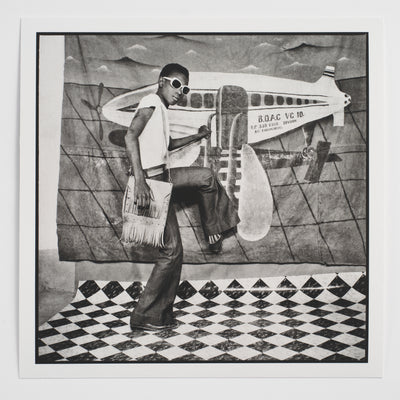
Phaidon is excited to announce the latest release in our ongoing limited editions programme, Sanlé Sory Je vais décoller, 1977/2026 (I’m Taking Off)- a photographic print by the Burkina Faso-based photographer Sanlé Sory.
Sory is one of Africa's most significant photographers, and one of the great chroniclers of everyday life in Burkina Faso, West Africa. His images document the emergence of new fashions, musical cultures and youth identities.
Born in 1943, he opened his studio, Volta Photo, just months before Burkina Faso gained independence from France in 1960. Alongside his studio portraits, he travelled extensively to photograph dances, sporting events, market vendors and community celebrations.
For more than six decades, he photographed the people of Bobo-Dioulasso, creating a visual record of a nation in transformation from the 1960s to the 2010s. His work reveals how photography became a space for self-fashioning, self-expression and West African agency.
Sanlé Sory Je vais décoller, 1977/2026 captures the spirit of optimism that defines Sory's work. Posing confidently before a painted backdrop featuring a jetliner open for boarding, his subject embodies the aspirations of a generation looking toward the future.
"My pictures showcase an era, a city and the good people of Bobo-Dioulasso, who were the stars of their own existence. They illustrate the meeting between tradition and modernity, between country and city life, colonization and independence, past and future – as an immediate present," says Sory.
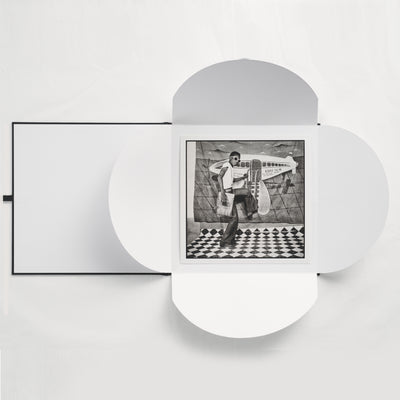
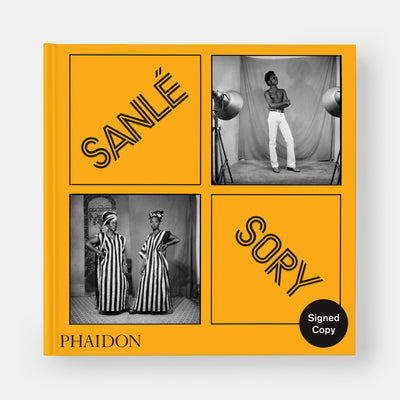
Sanlé Sory Je vais décoller, 1977/2026 includes a signed and numbered print, as well as a copy of Phaidon’s monograph, Sanlé Sory, created in close collaboration with the artist.
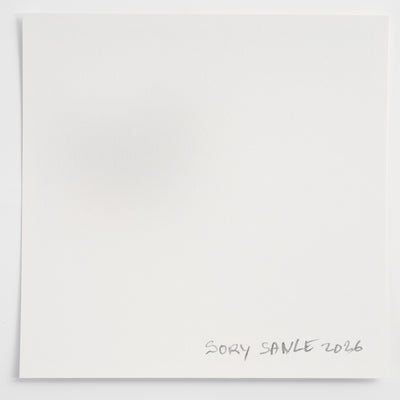
The limited edition measures 22 x 22 cm and comes in an edition of 30 + 6 APs It is a digital print on 350 gsm paper, signed and numbered on the back. It is available for $1,500 USD/ £1,000 GBP.
We asked Dr Taous Dahmani the London-based French, British, and Algerian art historian specialising in photography and curator of a new Sanlé Sory show at the Photographers Gallery to tell us a little more about the edition and Sanlé Sory's significance.
Dahmani has curated both group and solo exhibitions internationally. Her solo curatorial projects include SMITH at NOUA (Bodø, Norway), Anastasia Samoylova at the Saatchi Gallery (London, UK), and Adam Rouhana at Kyotographie (Kyoto, Japan). Dahmani’s writing has been widely published in photobooks and journals and she is a contributor to our new monograph Sanlé Sory.

What should someone look for in the new edition? One of the joys is seeing how inventive Sanlé Sory was as a portrait-maker. In his early black-and-white photographs, he commissioned painted backdrops from artists in Ghana - gardens, beaches, aeroplanes and even a modern cityscape featuring the façade of his own Volta Photo studio. These weren't simply decorative; they offered his clients imagined worlds of travel, ambition and possibility, transforming the studio into a stage where people could perform the lives they dreamed of.
What makes Sory's practice especially significant is its geographical context. Much of the history of West African photography has centered on countries such as Mali and Ghana, yet Sory built his practice in Bobo-Dioulasso, in the southwest of Burkina Faso. His work offers a distinct perspective on the region and on the social and cultural transformations that shaped post-independence West Africa. For much of this period, Burkina Faso was also an important example of coexistence between different ethnic and religious communities, something that quietly underpins his photographs.
Although his archive is estimated to have once contained more than one million negatives, the vast majority has since been lost or destroyed. The surviving photographs are therefore all the more remarkable. The Phaidon print, publication, and exhibition at The Photographers' Gallery present these images as living records of everyday life in Burkina Faso, affirming Sanlé Sory's place as one of Africa's most significant photographers.

What made him different when he began and how has his work changed over the years? What I find especially compelling about Sanlé Sory is his deep fascination with photography as a practice. He wasn't simply interested in taking pictures or the resulting images; he was captivated by every aspect of the process - from cameras and film to developing and printing. He was a true craftsman who knew about every stage of photography.
What makes Sory's practice truly distinctive is not only its longevity, but also its continual evolution. Rather than repeating the same formulas, he constantly renewed and reinvented his approach, responding to changing technologies, fashions and the aspirations of his sitters. His archive is not simply a record of a particular place and time; it reflects the work of a photographer who remained curious, inventive and deeply engaged with the possibilities of photography throughout his career.

Trained as a black-and-white photographer, Sory embraced colour in the mid-1980s as it became increasingly popular. Working primarily with Konica 35 mm film, alongside Kodak, Agfa and Minolta, he adapted to the changing expectations of his clients, who were looking for more contemporary forms of self-representation. By the late 1980s, colour had become central to his practice: another example of his willingness to evolve with the times.
Another very interesting element of Sory's practice is his use of self-portraiture. Throughout his career, he repeatedly stepped in front of the camera, using photography to experiment with identity, performance and self-fashioning. These playful, self-aware images feel strikingly contemporary.

Sory is going through a renaissance right now, what do you think has caused this wider interest in his work? Sanlé Sory's work has long been admired by photographers, curators and collectors, particularly in the United States, where his photographs have been exhibited and collected for many years. Yet, despite his significance, he has remained comparatively under-recognised in Europe. The Phaidon publication and exhibition at The Photographers’ Gallery are an opportunity to introduce his work to a new and wider audience and to recognise his place within the global history of photography.
The renewed interest has come about through a shared commitment between Charlotte Flint, (senior editor, art surveys) at Phaidon, and myself to bring overlooked chapters of photographic history into the spotlight. Working closely with Sory's archive keeper and his galleries, we wanted to create a moment that celebrates the richness and originality of his work. More broadly, this renewed attention reflects a growing recognition that the history of photography is far richer and more geographically diverse than the traditional canon has suggested.

Where does Sanlé Sory fit within the pantheon of great photographers? Rather than trying to place Sanlé Sory neatly within an established canon, I think it's more interesting to recognise him as one of the great overlooked figures in the history of photography, particularly in Europe, where his work has yet to receive the attention it deserves. This project, the book, limited edition and print, and exhibition, is part of a wider effort to give those missing chapters of photographic history the visibility they deserve.
What is particularly resonant about his black and white work and how does it differ from the color work that followed? Sory's black-and-white photographs belong to a moment when people were embracing modern life within visual conventions inherited from the colonial period. His color work feels different. It belongs to a generation defining modernity on its own terms, using photography not simply to document change but to participate in it. Color becomes a way of seeing Burkina Faso through its own lens, rather than through one inherited from elsewhere. Color becomes more than a technical process; it embodies the right to determine how Burkina Faso’ should be seen – West Africa as seen through its own lens.
The shift from black-and-white to color is about far more than technology; it mirrors a changing Burkina Faso. Sanlé Sory embraced color in the mid-1980s, as the country moved through the revolutionary years of Thomas Sankara and into an increasingly globalised era. His photographs don't just record changing fashions; they capture a society reimagining itself and expressing new ideas of identity, aspiration and modernity.
What do you think will be his lasting legacy, and his influence on emerging African photographers? Sanlé Sory is part of a remarkable lineage of West African studio photographers whose work has profoundly shaped contemporary photography, influencing African, African American and Afropean artists alike. Yet I still think his contribution is less widely recognised than it deserves, particularly outside specialist circles. His photographs demonstrate that portraiture can be culturally significant, capturing how people wanted to be seen. My hope is that both the publication and the exhibition will introduce Sanlé Sory to a new generation of artists, photographers and audiences, and inspire fresh conversations about photography, modernity and visual culture in Africa.
Buy Sanlé Sory Je vais décoller, 1977/2026 (I’m Taking Off) here.
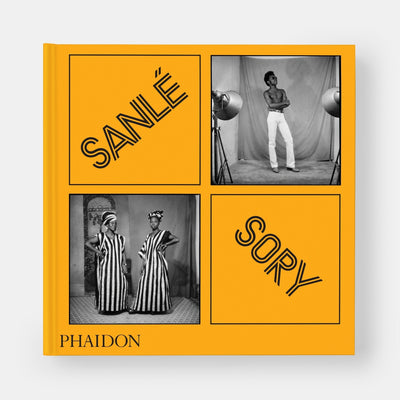
And take a look at the standalone, signed edition of our new book Sanlé Sory, here.