


![Handwork: Handcrafted Objects that Made America [Craft in America]](http://www.phaidon.com/cdn/shop/files/M-handwork-en-3727-3d-standing-front-3000_cf7b8381-b3a2-41fd-86da-6fe623fb0a35.jpg?v=1784715138&width=400)
![Handwork: Handcrafted Objects that Made America [Craft in America]](http://www.phaidon.com/cdn/shop/files/M-handwork-en-3727-3d-overview-3000_038c21c2-0af7-41e2-8a96-9b0beaf9c2d6.jpg?v=1784715138&width=400)
![Handwork: Handcrafted Objects that Made America [Craft in America]](http://www.phaidon.com/cdn/shop/files/M-handwork-en-3727-3d-spread-1-3000_675d5a59-80e7-4b98-bb57-f9d68d61b20d.jpg?v=1784715138&width=400)
![Handwork: Handcrafted Objects that Made America [Craft in America]](http://www.phaidon.com/cdn/shop/files/M-handwork-en-3727-3d-spread-2-3000_a21c9230-7856-470d-8101-09ae2fef75e3.jpg?v=1784715138&width=400)
![Handwork: Handcrafted Objects that Made America [Craft in America]](http://www.phaidon.com/cdn/shop/files/M-handwork-en-3727-3d-spread-3-3000_6dbd48c4-eaab-4b0d-86a2-19b97d8be954.jpg?v=1784715138&width=400)
![Handwork: Handcrafted Objects that Made America [Craft in America]](http://www.phaidon.com/cdn/shop/files/M-handwork-en-3727-3d-spread-4-3000_851a14d9-3b23-4197-85c5-3a4503b24548.jpg?v=1784715138&width=400)
![Handwork: Handcrafted Objects that Made America [Craft in America]](http://www.phaidon.com/cdn/shop/files/M-handwork-en-3727-3d-spread-5-3000_232b034c-682e-4a6f-b47b-81d5a99dd497.jpg?v=1784715138&width=400)
![Handwork: Handcrafted Objects that Made America [Craft in America]](http://www.phaidon.com/cdn/shop/files/M-handwork-en-3727-3d-spread-6-3000_4c787d9d-1fb6-4812-9652-d15d93423bc0.jpg?v=1784715138&width=400)



































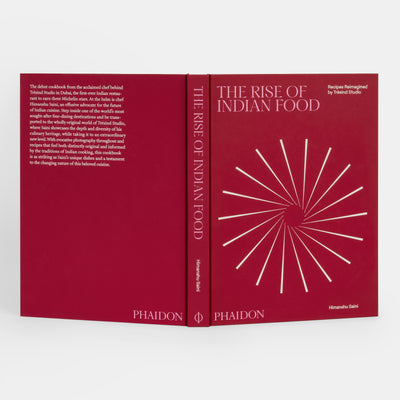
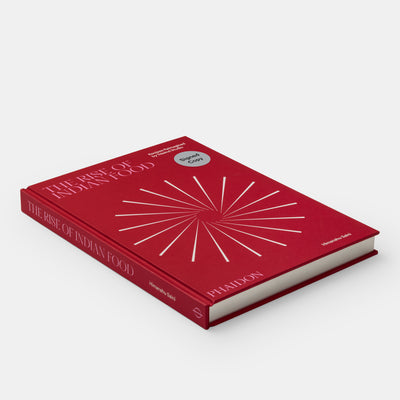
Himanshu Saini is an internationally acclaimed Indian chef based in Dubai. From an agricultural family, he started his culinary training at eighteen in Delhi. In 2014, he moved to Dubai as head chef of the a la carte restaurant Trèsind, and in 2018, he opened its sister tasting menu restaurant Trèsind Studio. This year, he earned Trèsind Studio a third Michelin star—the first Indian restaurant in the world to achieve this honor.
Trèsind Studio is one of the most sought-after dining destinations in Dubai and Himanshu an effusive advocate for the future of Indian cuisine.
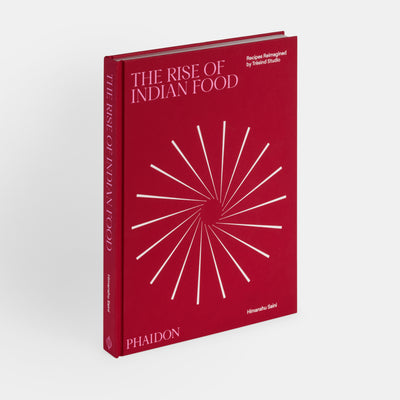
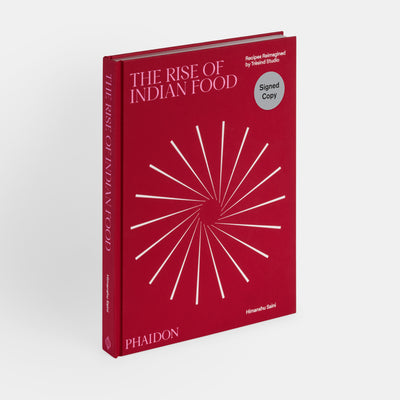
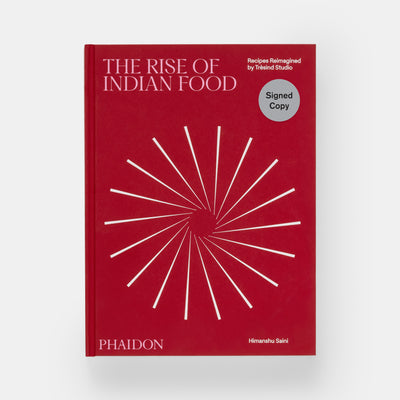
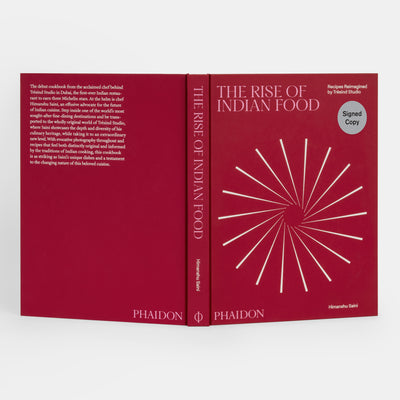
In the introduction to The Rise of Indian Food: Recipes Reimagined by Trèsind Studio, he shares both his personal journey towards becoming a chef and the winding road it took to forge the restaurant.
He showcases the depth and diversity of his culinary heritage, while taking it to an extraordinary new level, and shares insights into how each recipe has been meticulously developed. The recipes are organized into five tasting menus of twelve courses each, plus a pantry section of his signature sauces and spices.
Each chapter covers a region in India: the Thar Desert in the west, the Deccan Plateau in the south, the Coastal Plains, the Northern Plains and Himalayan Mountains in the north. We asked him a few questions about the book and his beginnings.
(Main image, above, Chef Himanshu Saini. Photography: Shresth Maloo)
 Tender Coconut Kushiyaki, Yuzu Rasam. Photography: Shresth Maloo
Deccan Plateau
Who inspired you to cook and how? I remember being very small at my grandmother's house. It was a large and complex family with about 50 people living in the same house - so many aunts! It was like a banquet kitchen. My grandmother used to assign everybody a specific job. One aunt’s job was to pound the spices, another’s job was to peel the peas. Somebody else would be doing the popedoms, and somebody else making the dough.
It was the kind of routine I see happening every day now in my kitchen. That was my first memory of being in a kitchen. I was surrounded by the many women of the house, all of them planning to serve three meals a day, for about 50 people.
You can imagine the love and affection goes into that process. Nobody worked as if they were doing their jobs, but everybody felt that their lives revolved around the kitchen.
I was always my mama's boy. I used to follow her around in the kitchen, even though I never intended to help. Being in the kitchen made me absorb so much of the atmosphere. That was my earliest memory.
Seeing all of that probably inspired me to do what I do. Back in the day, all the parents wanted their children to become doctors or engineers, but all the kids who were not good academically would go into hospitality. I was a very average student, not good at anything else. There was nothing else to pursue for a guy like me.
 Kebab Scarpetta, Sourdough Toast. Photography: Shresth Maloo Northern Plains
What was the bit of mom advice you’ve held on to? Don’t make a business out of something you love. We never saw the studio as a money maker, it’s always been a passion project. We never made money at the start but then, with the accolades that came, it eventually turned into a sustainable business.
The book tells a funny tale of the opening night, how was it for you? We literally had four guests. The chairs hadn’t arrived, and half-an-hour before we were supposed to open, we got a call from someone saying Rasmus Monk, the two Michelin star chef of Alchemist, was in town and wanted to come. Can you imagine the pressure of having him on the first service of a new restaurant? We had nothing in place. But he had a great time, and now, whenever he's in town, he always comes to eat with us. In hindsight, to have him as one of the first diners was a good blessing to start a new restaurant with.
Was there a moment when what you were doing seemed to fall into place? When you get your first star, it's an approval which makes you feel that the path you are going on is probably the right one. And then we felt that a concept like this can be evolved going forward. I don’t say, even after getting three stars, is this restaurant perfect? Am I perfect? I'm still learning. I'm still growing. I'm still adapting to many things.
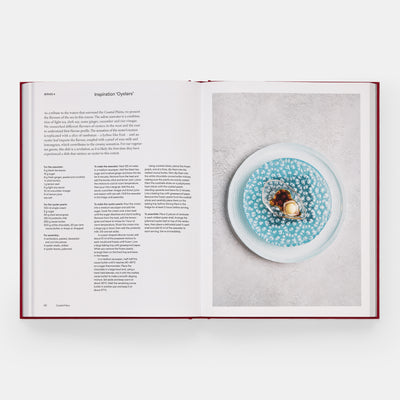
 Inspiration ‘Oysters’. Photography: Shresth Maloo Coastal Plains
Tell us about the food in the book, how would you describe what you do?It’s based on the principles of Indian food. I’m not trying to bastardise the cuisine. I’m allowing the personality to reflect what me and my team do.
There are people who come to the restaurant and sometimes challenge me. They say, this is not Indian food. This is not how we used to consume Indian food. My answer to this question is straightforward. Usually the person who's telling me this is not wearing traditional Indian attire, and he's not speaking in a native Indian language. He's speaking to me in English, but then he expects that the cuisine should be so far-fetched as to imagine time has stood still.
Chilies, for example, were never grown in India. They were brought to us by traders from Latin America. But when chillies were first used in India, did we say the food is too modern? Potatoes and tomatoes were never grown in India, but when they were first being used, were they called too modern?
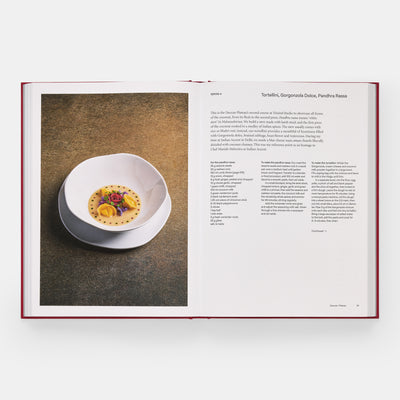
Sometimes a guest will ask me why do you use Gorgonzola on your menu? Yes, it's not Indian, yes, it's not made in India, but most of the dairy farmers who work in Italy, who make Parmigiano, Reggiano, who make Gorgonzola, belong to the Sikh community in India.
All I’m saying is why restrict cuisine when you don’t restrict yourself in order to become a more evolved version of yourself? Cuisine has every right to evolve too. I embrace tradition, and of course I respect it. But then there is a way how it should move forward. I'm not here to provoke you. I'm here to find a balance between nostalgia and provocation. I try to preserve both.
 Turnip Kebab, Roomali Roti Tartlet. Photography: Shresth Maloo Northern Plains
If you could cook for any person who would it be and what would you make them? I've fed a few footballers who’ve come to the restaurant, Mikaël Silvestre in particular. I've also cooked for Roger Feder in the past. But Sir Alex Ferguson is probably the person I really would want to make a meal for. And I would certainly not make a Sunday roast! I would make something very elevated for him. I'm a big fan of Manchester United. And I'm a big fan of Sir Alex Ferguson. I'm a fan in terms of what he's done for the club, but also his great book on leadership. Every person should read it irrespective of whether they like football and where they work. There are so many parallels I can draw between how he ran the club and how I run my kitchen. There are so many parallels between how he talks about leadership and how a person in the kitchen, a chef, or a manager in any field should lead his team.
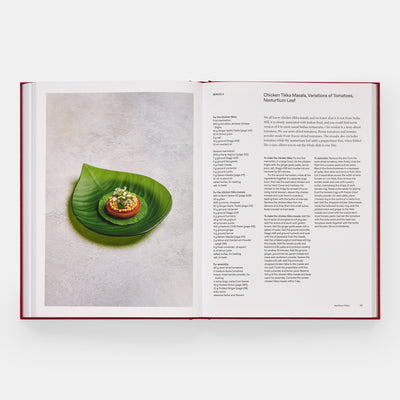
 Chicken Tikka Masala, Variations of Tomatoes, Nasturtium Leaf. Photography: Shresth Maloo Northern Plains
What’s the one song that always goes well with food? I'm a very simple person in terms of music but we have a course, which is connected to music. That's the last dish of the service and the dish is called Honeymoon, Tea ‘Milk’ and Honey. It’s in the book. And when we serve that course, we shut off all the lights, and we play Frank Sinatra’s Fly Me To The Moon. That's part of the ritual in the restaurant. After we finish the service, the lights are brought back up a little and then, the song that comes next is My Way. And we relate to that. It's like us telling the diners that the journey they’ve been on, whatever it is they’ve eaten, has been a performance. It's like a performer who's telling you that he's done it in his way, with no regrets. It's me saying goodbye to the diners and letting them know that the meal they have just eaten was made with no regrets, but a lot of passion.
 Pani Puri. Photography: Shresth Maloo Deccan Plateau
Is there any food you just can’t eat? I tried duck tongue once, which literally felt like chewing my own tongue. Also Horsemeat. I actually have a worst experience and a greatest experience with it. The worst was in Kazakhstan. I was there for a dinner and it's part of the tradition that the first thing which comes on the table is the horse milk, or camel milk. Then the main attraction of the dinner is the horse meat. But at the same time, I had horse meat in Belgium, which was probably better than Wagyu.
What was your biggest culinary disaster? When I was a very young chef I was working for Chef Manish Mehrotra. There was a dish of a chicken meatball, stuffed with raw egg yolks. You couldn’t use a thermometer to check the inside was cooked as it would puncture the meatball and the egg would run out.
I made a batch and I put them in a freezer to make sure they took up a nice shape. Chef Manish invited me out at break time, and I was so excited that he had asked me to accompany him somewhere I went along with him. But we were so late coming back we already had the first table in. I frantically tried to cook the frozen chicken, but the dishes kept coming back into the kitchen. I remember I cried that night.
 Bone Marrow Rogan Josh. Photography: Shresth Maloo Himalayan Mountains
How do you turn a great dish into a three Michelin star dish? Most of the great dishes which we have served in the Studio, are made in the mind, then applied in the kitchen.
It's a clichéd, boring thing to say from a chef's perspective, but it's very important for a cuisine like Indian to have creativity, otherwise, it is not going to attract people.
A lot of dishes spring from imagination. Sometimes an idea becomes more original if you don’t follow an established trail where you have to make a dish with a protein, a sauce, a vegetable.
The menu in the Studio breaks that barrier and challenges that perception. But I believe that a restaurant should have a right balance of dishes which are popular among people. The way dishes are presented should make a connection with the guest.
 ‘Not a Nigiri’ Langoustine, Balchão XO. Photography: Shresth Maloo Coastal Plains
50% of the dishes should be critical and reflect what the chef really wants to do. I feel if I do 100% of the dishes on the menu in a provocative way, then I'm challenging my guest, which I don't like in a restaurant. Comfort is important. People come to places like this to eat or celebrate, not to get challenged. So the menu should have the right balance between those dishes.
In the book, there is a dish which is named Not a Nigiri. It looks like a nigiri. It's eaten like a nigiri, but that's the comfort I offer to my guest, because the restaurant is in Dubai and we attract travellers from around the world. But the dish is not about how a nigiri should be because that's not my expertise, but the way it's presented makes an immediate connection with the guest and everybody knows how to eat it.
 King Oyster Mushroom Noodles, Black Fungus XO, Morel Shoyu Photography: Shresth Maloo Himalayan Mountains
What’s the reason for structuring the book around tasting menus? We wanted the book to reflect the way the restaurant is. So even in the restaurant, we go about these five macro regions in India and there are three dishes which come out of each region in our tasting menu. And then, whenever we change the menu, we change the dishes from those regions. But the ideology of the concept and the ideology of the restaurant remains the same where it’s region driven.
The idea behind doing this thing is also outside India people just relate to North Indian dishes, because most of the restaurants outside India are that genre. But there is so much of the cuisine and culture which India has to offer that that cuisine misses out. It's not about giving the guest a geography lesson, but to tell them that’s why North Indian dishes are like that. Delhi has no coastal belt around it. So logically, there is more meat and poultry consumed there.
All the information we give to our guests is related to the courses they are going to consume. These are small touches, which I feel people connect with. By the end of the meal the guests say they've learned 5% more about Indian food.
 Naan Soup’flé, Tomato Broth. Photography: Shresth Maloo Northern Plains
What do you know now that you wish you'd known back then? That coming out of culinary school to a professional kitchen you have to unlearn everything you've learned in culinary school. They are two different worlds.
If I had to give advice to someone, I would tell them to intern in different kitchens for three years rather than doing a three-year culinary education. Because they will learn more in a professional kitchen than in culinary school. Some of the greatest chefs started cooking when they were 14 or 15 years-old in a professional kitchen. The first real first exercise begins with how much you love food. The more you've eaten in your life, the more you understand food better in terms of palate.
I always say to young people when you make some money, take some money out of your salary and go out to eat. Not to eat something in order to try to replicate it but to learn to understand the palate. Imagine someone having his first sip of whiskey in their life. They're not going to like it. There is no one who, on sipping whisky for the first time, doesn't make a bad facial expression.
It’s the same with food. There are a lot of people I come across who come from the north part of India. And they have not grown up eating seafood, so they have no palate for seafood. I am sure they would enjoy a meat dish more than a seafood dish. So I always feel it's very important if you want to understand a cuisine, you start eating it first. You have to start developing a palette for many things before you try to judge them. You need to give every cuisine at least two or three chances.
 Inspiration’ Coconut Apple. Photography: Shresth Maloo Deccan Plateau
Is there one dish at in the book you'd happily eat every day for the rest of your life? There are so many. But maybe the Naan Soupl’flé. I didn't realise when we developed the recipe, we were in the process of bookmaking and then we said, okay, we'll include it in the book recipes. Two years down the line, it has become quite a thing, and people are buying the book because they want to understand how to make it!
 Tortellini, Gorgonzola Dolce, Pandhra Rassa. Photography: Shresth Maloo Deccan Plateau
That's one dish which, again, is giving something as iconic as a piece of naan bread without actually giving it to you. So you get all the feeling and emotion, and you get that comfort feeling of you've come to an Indian restaurant for. At the same time, we are narrating it with our own voice, our own personality. It's not about technique as such, but it is about making a guest feel comfortable and relaxed that, yes, they have eaten something they feel they know!
Take a closer look at The Rise of Indian Food: Recipes Reimagined by Trèsind Studio