










































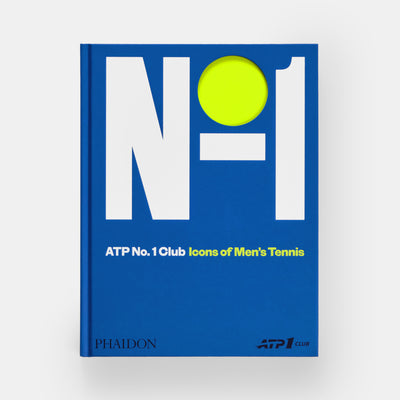





























































Our new book ATP No. 1 Club Icons of Men's Tennis presents a lavish portrait of the 29 players who have been ranked as number one in the ATP men’s tennis world rankings. It includes more than 300 photographs, from on-court battles to behind-the-scenes moments and intimate off-court portraits. ATP No. 1 Club creates a rich photographic timeline of men’s tennis at its highest level and charts a complete trajectory of the sport since the beginning of the ATP Rankings.
Organized chronologically – from Ilie Năstase to Jannik Sinner – there are richly written profiles of each World No. 1, paired with a spectacular collection of photographs that capture the emotion, craft, and evolution of champions across five decades.
The photographs include such iconic imagery as Björn Borg with an eight-year-old Andre Agassi, rivals Agassi and Pete Sampras in the heat of battle, and Roger Federer, Rafael Nadal, and Novak Djokovic at the peak of their powers. The book features a preface by Andrea Gaudenzi, chairman of ATP, and a foreword by tennis legend Rod Laver.
Here are six short excerpts from the book accompanying six spreads.

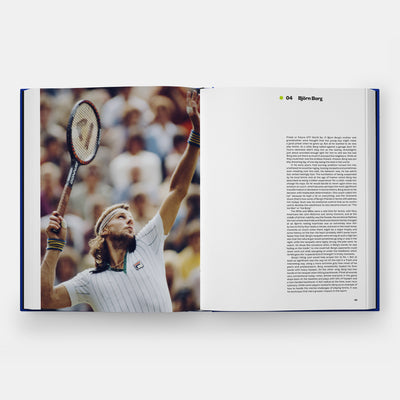
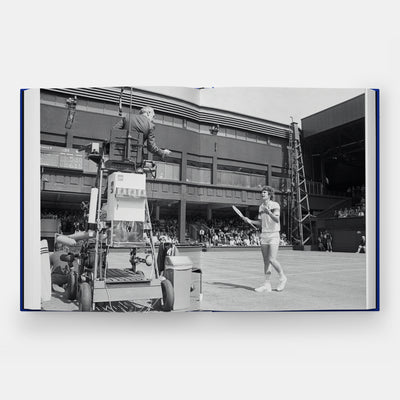
Priest or future ATP World No. 1? Björn Borg’s mother and grandmother once thought that the young boy might make a good priest when he grew up. But all he wanted to do was play tennis. As a child, Borg rallied against a garage door for hours— darkness didn’t stop him as the nearby streetlights just about provided enough light for him to still see the ball. Borg was out there so much it annoyed the neighbors. While all they could hear was the endless thwack, thwack, Borg was quietly dreaming big, of one day being the best in the world.
In his early years, that burning ambition turned him into a hothead; he would be raging, tossing racquets and sometimes even cheating over line calls. His behavior was, he has admitted, embarrassingly bad. The humiliation of being suspended by his local tennis club at the age of twelve—which Borg has described as being “a bitter experience” for a child—made him change his ways. So he would decide to never again show any emotion on court, which became perhaps the most significant transformation in demeanor in tennis history. Borg stuck to his decision with implacable determination. One coach called him “Jar” because he kept a lid on everything, and the nickname stuck (that’s how some of Borg’s friends in tennis still address him today). Such was his emotional control that as he continued to develop into adulthood, he also became known as “The Ice Man” or “Ice Borg.”

Outrageous, or outrageously good? John McEnroe could be both, often on the same day. Indeed, the attention paid to his bursts of anger, the times when his mood flashed as red as his headband, meant that not quite enough was said about his artistry.
This serve-and-volleyer liked it very much when people called him an artist; in fact, he felt as though that was the greatest compliment he ever received. The New Yorker who often had harsh words for umpires played the game with a lightness of touch, particularly on his volleys. Others simply tried to whack the ball as hard as possible; this lefty had the imagination to do so much more. Arthur Ashe once said that when you played against Jimmy Connors and Björn Borg, it felt as thoughyou were being hit by a sledgehammer. McEnroe, on the other hand, used a stiletto. “He just slices you up,” said Ashe. “A nick here, a cut there, pretty soon you’ve got blood all over you and you’re bleeding to death.”
Though McEnroe had a well-earned reputation as an antiestablishment figure, immortalized by that video clip of him screaming “you cannot be serious” at a Wimbledon umpire in 1981, he did have reverence for at least one form of hierarchy: the ATP Rankings. He rose to the No. 1 spot by combining the creativity in his game with a hunger to be at the very top, a position he occupied for a total of 170 weeks. Less than two years after McEnroe had been a college tennis player for Stanford University, he became the World No. 1 in March 1980, replacing Borg. The American had a lot of joy on his way to the top, winning ten titles in 1979, and garnering early titles in 1980 with wins in Richmond and Memphis, where he defeated Connors in the final, giving him the final rankings points he needed.

Being the new ATP World No.1 felt “really strange” to Roger Federer. Strange as in unreal, leaving Federer, the first Swiss player to have risen so high, trying to process how he had officially become the best tennis player in the world. Amid the strangeness and euphoria of realizing a dream he’d had since his childhood in Basel, Federer felt as though he now had a choice to make. Was he happy just to have achieved that ranking? Or did he want to stick around?
“I decided I would like to stay there,” said Federer, a short and simple sentence that had an enormous impact on men’s tennis, and the ATP Rankings, for years to come.
Once Federer had committed to holding on to that position for as long as he could, he didn’t relent. In an uninterrupted run from February 2004 until August 2008, he stayed atop the rankings for a record 237 straight weeks (far ahead of Jimmy Connors, who has the second biggest unbroken stretch with 160 weeks).Most in tennis would agree that the only thing harder than reaching No. 1 is staying there; that Federer was able to hold onto that ranking for so long is one of those mind-bending feats that, years later, still defy comprehension.
The great majority of the ranking points that first took Federer to No. 1 came in his fabulous 2003 season, in which he landed seven titles across three different surfaces including his first Grand Slam singles trophy at Wimbledon. After finishing the season in triumphant style at the ATP Finals in Houston, Federer had momentum going into the 2004 Australian Open.
It’s rare for a tennis player to drop to their knees after winning a semi-final, but that was how Federer marked his victory over Juan Carlos Ferrero in the last four of the 2004 Australian Open. That was the moment that Federer knew he would be replacing Andy Roddick in the next edition of the ATP Rankings. As he disclosed later, a voice in his head was saying: “Oh my god, I made it to World No. 1.” While Federer understood he had a final to play just a couple of days later, he tried to savor that moment as much as possible, since you only get to No. 1 for the first time once. So began a period of dominance that the sport had never seen before and hasn’t seen since.

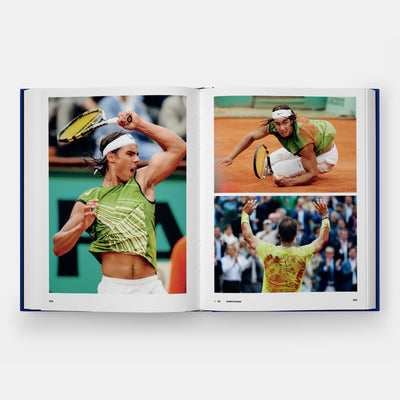
Patience was Rafael Nadal in the mid- to late-2000s, waiting for his moment. The propulsive young athlete with the whippy topspin forehand, one of the most explosive and dynamic shots in the history of tennis, was waiting and waiting and waiting some more. For 160 straight weeks, the Mallorcan was the ATP World No. 2, which is one of those records that no tennis player ever sets out to achieve. That was more than three years, starting in July 2005, of playing high-intensity tennis and looking like a generational talent, only to be kept at bay by Roger Federer, who was just that little bit more successful.
In 2005, for instance, Nadal won eleven titles, which wasn’t quite good enough to be No. 1 because Federer, who won the same number of tournaments, gathered more ranking points because of the higher values of the events where he had been champion. Perhaps it was inevitable that Nadal asked himself: if it weren’t for that Swiss guy, would he have spent all those weeks and all those years at No. 1? And then, when Novak Djokovic emerged as a powerful force by winning his first major at the 2008 Australian Open, Nadal thought that maybe he would never get to the top.
Ultimately, though, the Spaniard didn’t become dispirited. He kept on going. And after all that waiting and wondering, when it finally happened for Nadal, when he became the No. 1 for the first time in August 2008, the emotions he felt were overwhelming. Such was Federer’s dominance—he had been No. 1 since February 2004—that it was always going to take a special effort to dislodge him. The tennis that Nadal produced in the middle of 2008 was nothing less than special. From April to August, he played in ten tournaments and he won eight of them, starting with four clay-court titles in MonteCarlo, Barcelona, Hamburg, and Roland Garros, before he was also crowned champion on the Queen’s Club grass in London.
Nadal’s rise to the World No. 1 came, in no small part, from defeating Federer in that Wimbledon final, a five-set clash that is one of the most iconic matches of all time. Nadal’s rivalry with Federer was a collision of two contrasting athletes that took the sport to new heights of popularity, with fans around the world animated in support of one or the other.
Nadal was a lefty while Federer gripped his racquet with his right hand. Nadal brought energy, topspin, and force of will, while Federer was celebrated for his elegance and poise, with an old-school single-handed backhand that traditional tennis types all agreed was simply gorgeous. Federer’s attacking tennis looked to be almost effortless—some said he didn’t even sweat—while you could see how much work Nadal was putting into his tennis, into every shot, every point, every match. His clothes were wet with perspiration, he was grunting, and he was pushing himself to the limit in the pursuit of victory. Nadal never gave anything less than everything.

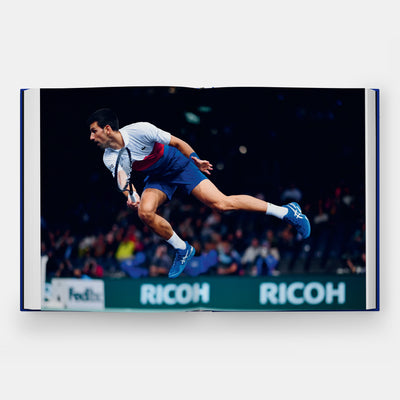
Many young tennis players aspire to be the ATP World No. 1. Not all are bold enough to say so out loud, even privately to friends, family, or a trusted coach. However, when Novak Djokovic was just seven years old, he appeared on Serbian television with a reversed baseball cap and an optimistic outlook: speaking very openly in an interview, he told viewers of his ambition to become the best tennis player on the planet.
That seven-year-old was prescient. In his twenties and thirties, Djokovic didn’t just a spend a week or two at the top of the rankings, but a mind-bending 428 weeks, which is more than any other player in tennis history. To put that into context, consider that the next man on that list, Roger Federer, has a mere 310 weeks. Because of the magnitude of his achievement, it’s perhaps easier to think in terms of years: Djokovic has spent more than eight years as No. 1.
Eight times the Serbian finished a season at No. 1, which is two more than Pete Sampras. Another of Djokovic’s records is being the oldest No. 1, a marker of longevity from 2024, when he was thirty-seven years old. The season before, aged thirtysix, he had been the oldest ever year-end No. 1. Djokovic never appeared more dominant than in June 2016, when he had just won his first Roland Garros title to become the first man since Rod Laver in 1969 to hold all four majors simultaneously, and when he held 16,950 ranking points, the highest total in the history of the ATP. That was almost double the points that Andy Murray, who was in second place, had to his name.
In any era, Djokovic’s records would have been hugely impressive: they have even more weight because they were earned during his historic competition against two of the other all-time greats in Federer and Rafael Nadal. It’s even more remarkable when you consider Djokovic’s backstory—in 1999, the year he turned twelve, he had spent many nights in a Belgrade bunker where he and his family took shelter during the NATO bombing campaign.
When Djokovic became the World No. 1 for the first time in July 2011, he did so in unprecedented fashion: by being unbeatable for the first five months of the season. In 2010, it hadn’t been clear that he was ready to end Federer and Nadal’s domination. But in 2011, Djokovic was an altogether different player, with the technique, tactics, and supreme confidence to go all the way to the top of the sport. Djokovic’s forty-one-match winning streak brought him seven titles, including the Australian Open and Dubai, the Sunshine Double in Indian Wells and Miami, and championships in Belgrade, Madrid, and Rome.

Early one Monday morning in September of 2022, Carlos Alcaraz woke up in his Manhattan hotel room and reached for his phone. He wanted to check the freshly updated ATP Rankings, to see for himself that, at just nineteen years old, he really was the new World No. 1. Happily, his phone confirmed that the teenager from El Palmar, a village in southern Spain, had just become the youngest No. 1 in history.
Alcaraz’s youth wasn’t the only original aspect of his rise to No. 1, which had been completed the day before by defeating Casper Ruud in the US Open final, in what had been a contest between the Spaniard and the Norwegian for the top ranking. Never had there been a No. 1, of any age, whose tennis was as bold, spontaneous, inventive, and instinctive as Alcaraz’s. It’s easy, perhaps, to go for outlandish shots when you’re playing a relatively low-stakes match. But Alcaraz had shown in New York City, as well as in previous ATP tournaments, that he would not be inhibited by an important occasion; if anything, knowing that the world was watching encouraged him to be even bolder.
Whatever the match, whatever is on the line, Alcaraz produces “hot shots,” video-clip moments that score big numbers on TikTok. Some of his most thrilling are his signature drop shots. Alcaraz is also fast. Very fast. Possibly the quickest athlete ever seen on a tennis court. When Alcaraz isn’t smacking winners with his explosive forehand, he is using that shot to push an opponent back behind the baseline, setting up his slow and unreachable drop shot. Others try to copy Alcaraz, but no one else has the touch and skill of the first man born in the 2000s to reach the apex. Long before he broke into the Top 100 in May 2021, people in Spain were calling him “Baby Rafa,” “Mini Rafa,” or the “Next Nadal.” But Rafael Nadal hadn’t reached No. 1 until he was twenty-two years old. Alcaraz had a much faster journey to the top, so speedy that he even surprised himself.
Going into 2022, Alcaraz had been ranked No. 32 in the world. He felt ambitious about the year ahead, and believed that he might move into the Top 15 by the end of the season despite having only one ATP Tour title under his belt. Alcaraz’s coach, Juan Carlos Ferrero, who had been the World No. 1 in 2003, told his young player he didn’t have to be in a hurry. What happened next was wild. Alcaraz took his first title of the season in Rio de Janeiro, before landing his first ATP Masters 1000 crown in Miami. More success followed in Barcelona and in Madrid, another Masters 1000 title, in which he became the first player to defeat Nadal and Novak Djokovic at the same clay-court tournament. He then became a Grand Slam champion for the first time at the US Open. Already, Alcaraz had achieved two of his nlife goals: a first major and hitting the very top of the rankings. So, naturally, he asked himself: “Where do I go now?”
Kazakhstan was the answer. Unfortunately for Alcaraz, who had replaced Daniil Medvedev at the top, that first trip as the World No. 1 didn’t go so well as he lost his opening match to a “lucky loser” (someone who was beaten in the qualifying rounds but ended up in the main draw after another player’s withdrawal). Indeed, after the US Open Alcaraz didn’t win another title that season, and was unable to compete at the ATP Finals in Turin because of injury—though he did make a brief appearance on court to receive the trophy for being the year-end No. 1, the youngest-ever man to achieve that feat. Alcaraz’s first stretch at No. 1 lasted for twenty weeks, keeping him at the top until late January 2023.
Get your copy of ATP No. 1 Club Icons of Men's Tennis, here.