

![Handwork: Handcrafted Objects that Made America [Craft in America]](http://www.phaidon.com/cdn/shop/files/M-handwork-en-3727-3d-standing-front-3000_cf7b8381-b3a2-41fd-86da-6fe623fb0a35.jpg?v=1784715138&width=400)
![Handwork: Handcrafted Objects that Made America [Craft in America]](http://www.phaidon.com/cdn/shop/files/M-handwork-en-3727-3d-overview-3000_038c21c2-0af7-41e2-8a96-9b0beaf9c2d6.jpg?v=1784715138&width=400)
![Handwork: Handcrafted Objects that Made America [Craft in America]](http://www.phaidon.com/cdn/shop/files/M-handwork-en-3727-3d-spread-1-3000_675d5a59-80e7-4b98-bb57-f9d68d61b20d.jpg?v=1784715138&width=400)
![Handwork: Handcrafted Objects that Made America [Craft in America]](http://www.phaidon.com/cdn/shop/files/M-handwork-en-3727-3d-spread-2-3000_a21c9230-7856-470d-8101-09ae2fef75e3.jpg?v=1784715138&width=400)
![Handwork: Handcrafted Objects that Made America [Craft in America]](http://www.phaidon.com/cdn/shop/files/M-handwork-en-3727-3d-spread-3-3000_6dbd48c4-eaab-4b0d-86a2-19b97d8be954.jpg?v=1784715138&width=400)
![Handwork: Handcrafted Objects that Made America [Craft in America]](http://www.phaidon.com/cdn/shop/files/M-handwork-en-3727-3d-spread-4-3000_851a14d9-3b23-4197-85c5-3a4503b24548.jpg?v=1784715138&width=400)
![Handwork: Handcrafted Objects that Made America [Craft in America]](http://www.phaidon.com/cdn/shop/files/M-handwork-en-3727-3d-spread-5-3000_232b034c-682e-4a6f-b47b-81d5a99dd497.jpg?v=1784715138&width=400)
![Handwork: Handcrafted Objects that Made America [Craft in America]](http://www.phaidon.com/cdn/shop/files/M-handwork-en-3727-3d-spread-6-3000_4c787d9d-1fb6-4812-9652-d15d93423bc0.jpg?v=1784715138&width=400)












“I think artists should build trap doors. You shouldn’t build a thing that you can’t escape from,” the artist Tavares Strachan says in his new Phaidon Contemporary Artists Series book. “The whole premise of why I became an artist was that I was sold this idea that you could do whatever you want to do.”
It’s an ideal Strachan has pursued throughout his life. Born in Nassau in 1979 and an attendee of the Rhode Island School of Design and later Yale University, Strachan has emerged as one of contemporary art’s most ambitious storytellers, moving effortlessly between sculpture, installation, painting, performance, and conceptual research, bringing overlooked figures and narratives into the cultural spotlight.
Strachan often looks back to help us look forward. At the heart of his work is a seemingly simple yet actually complex question: Who gets to be remembered? His fascination with exploration and discovery led him to create works inspired by people such as Alvin Ailey, Robert Henry Lawrence Jr. and Matthew Henson—figures whose contributions have largely existed in the margins of mainstream historical memory.
“Artists are the best indicators of the future and I don’t say that with any bias,” he says in our CAS book. “There’s a great deal of research – and by research I mean scientific research, I mean ethnographic research, I mean history, philosophical research – that goes into art making. And this is why I think artists are particularly charged with having this way of understanding the future.”
There is often a theatrical quality to Strachan’s work. One of his most memorable projects, The Distance Between What We Have and What We Want (2006), began with a journey to the Alaskan Arctic to excavate a 4.5-ton block of ice, which was then transported via FedEx to his native Bahamas and displayed in a solar-powered freezer in the courtyard of his childhood elementary school. The project highlighted the little-known contributions of Matthew Henson—an under-recognized American explorer and the co-discoverer of the North Pole.
In December 2018, Strachan launched his project ENOCH into space, focused on the development and launch of a satellite that brings to light the forgotten story of Robert Henry Lawrence Jr., the first African American astronaut selected for any national space program.
 Tavares Strachan photographed by Alex Welsh
His sculptures especially often appear as relics from an alternate history. In 2019, Strachan represented the Bahamas at the Venice Biennale, where his exhibition The Encyclopedia of Invisibility an expansive, ongoing archive dedicated to documenting people, places, and ideas that have been overlooked or excluded from traditional records (a kind of inverse Encyclopedia Britannica), transformed the national pavilion into a meditation on memory, recognition, and belonging.
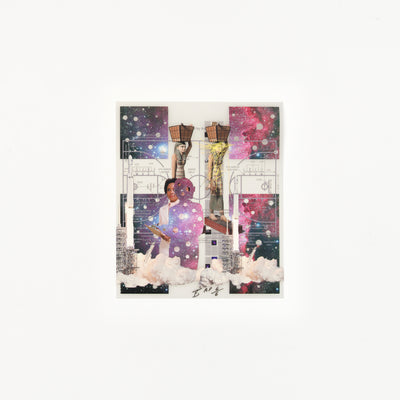
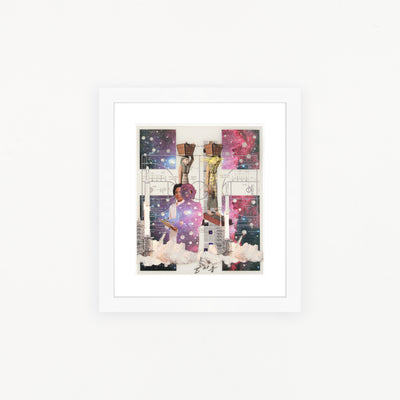
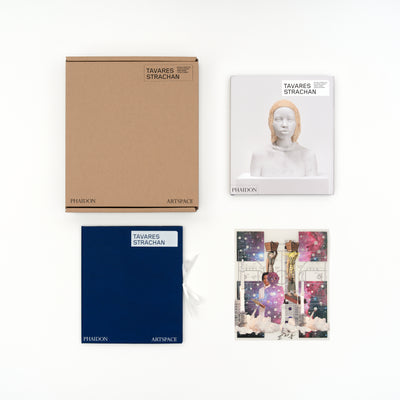
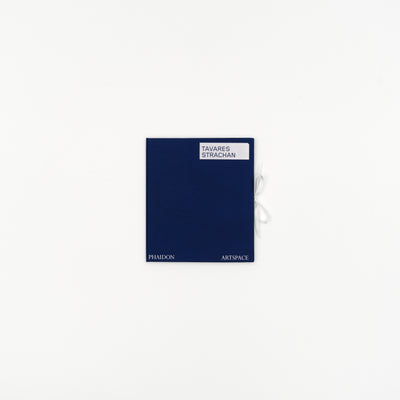
The latest example of his thinking is a new Artspace and Phaidon edition. The Stranger, 2026 encompasses many of his themes into a single, collectible work. “I don’t think of editions as separate from the larger practice,” he tells Artspace in our interview below.
“They often become another way to engage the same questions that animate the sculptures, installations, performances, and paintings. Sometimes an edition highlights a particular image or idea. Other times it serves as an entry point into a much larger body of work.”
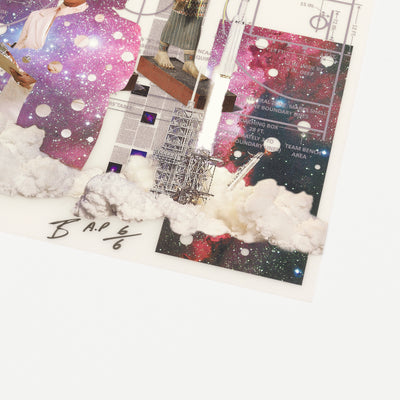
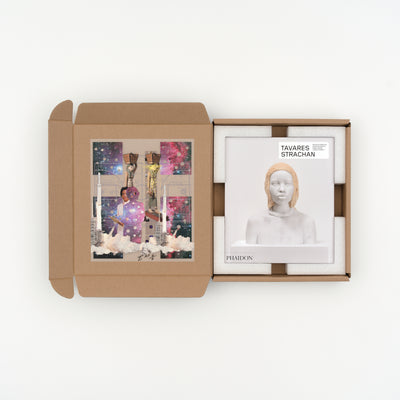
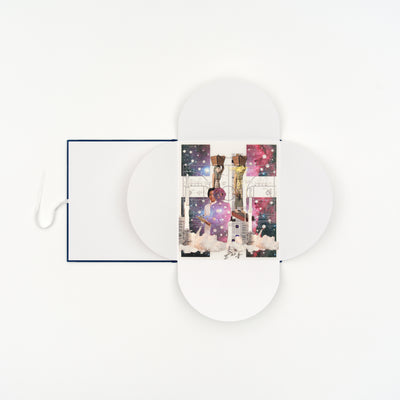
The Stranger, 2026 is a digital silkscreen on Mylar in an edition of 50 + 6 Aps measuring 11 1/4 x 9 1/2 inches, costing $1,500. On the eve of the release we asked him about Stranger Print Edition, 2026 and his wider practice.
 Tavares Strachan - The Stranger, 2026 - photography Garrett Carroll
Can you explain what you do? Is there an elevator pitch? I often say that I make artworks about the stories we inherit and the stories we choose to remember. My work explores visibility and invisibility—who is included in history, who is left out, and how we might imagine more expansive narratives about ourselves and our collective future.
When you create an edition, do you focus on a particular aspect of your practice? Not necessarily. I don’t think of editions as separate from the larger practice. They often become another way to engage the same questions that animate the sculptures, installations, performances, and paintings. Sometimes an edition highlights a particular image or idea. Other times it serves as an entry point into a much larger body of work.
Why did you choose this particular work for an edition? I chose this work because it contains many of the themes that have occupied my practice for years: exploration, belief, aspiration, and the ways histories collide and overlap. It feels like a compact expression of a much larger body of ideas. Editions allow a work to travel differently, reaching audiences that may never encounter the original object, and this image seemed particularly suited to that kind of circulation.
What are the connections you are making here? I have always been interested in bringing together figures, symbols, and narratives that do not traditionally occupy the same space. Bringing them together creates a space where different histories can speak to one another.
The work is less about providing a fixed meaning and more about creating a constellation of references. The viewer is invited to navigate those connections and discover their own path through the image. The (edition) resonates with my broader interest in space exploration and figures such as Robert Henry Lawrence Jr., whose story has been central to my practice. The newspaper element functions as both a historical document and a reminder that history itself is mediated, edited, and often incomplete.
 Tavares Strachan - The Stranger, 2026 - photography Garrett Carroll
How much of your work is about educating the viewer? Education is certainly part of the work, but it is not the primary goal. I am less interested in teaching facts than creating curiosity. Ideally the work encourages someone to ask a question, follow a thread, or investigate something they had not previously considered. The artwork becomes a starting point rather than an endpoint.
You’ve described yourself as 'always the outsider' or 'the foreigner'. How has that 'foreignness' shaped your attraction to extreme environments such as the Arctic and outer space? Extreme environments make visible what is often hidden. They expose our assumptions about belonging, identity, and survival. As someone who has often felt between places, cultures, and categories, I have been drawn to environments that challenge certainty. The Arctic, outer space, and other extreme conditions become metaphors for unfamiliarity itself.
Do you think your interest in exploration comes from your early life in the Bahamas or have more important elements come into play over the years? The Bahamas played an enormous role. Growing up on islands, the horizon is always present. The sea becomes both a boundary and an invitation. But over time my understanding of exploration expanded. It became less about geography and more about intellectual, emotional, and cultural discovery. Exploration is really a framework for understanding the unknown.
How do you choose which memories or interests to memorialise, are there particular focal points you tend to investigate at a time or does your mind work in a more-free flowing state? I don’t think I choose them as much as they choose me. Certain stories, images, or experiences remain persistent. They return repeatedly over many years and begin to reveal deeper questions. Those are often the things that enter the work. My process is both focused and associative. I tend to pursue particular themes intensely while remaining open to unexpected connections.
You recently described your practice as 'world-making.' How is that different from
storytelling? Storytelling often involves a narrative with a beginning, middle, and end. World-making is broader. It involves constructing an entire ecosystem of relationships, objects, histories, symbols, and possibilities. A story can exist within a world, but the world itself extends beyond any single narrative. I’m interested in creating spaces where multiple stories can coexist simultaneously.
 Tavares Strachan - The Stranger, 2026 - photography Garrett Carroll
Is your practice ultimately about adapting to otherness? In many ways, yes. But perhaps more than adapting to otherness, it is about recognizing that otherness is fundamental to the human condition. We are constantly encountering things beyond our understanding—other people, other cultures, other histories, other futures. My work explores how we navigate those encounters and how they transform us.
Who first turned you on to art? There was no single moment. It came from a combination of experiences—family, books, museums, conversations, and the creative resourcefulness of the community I grew up in. Looking back, I realize that many of the people who influenced me would not have called themselves artists at all. They were storytellers, builders, teachers, dreamers, and problem-solvers. They taught me that imagination is a way of understanding the world.
Do you fall in and out of love with art and how do you keep the affair going? Like any long relationship, there are periods of excitement and periods of doubt. What sustains it is curiosity. There is always another question, another mystery, another possibility. As long as I remain curious, the relationship continues.
You’ve said, “I am interested in a longer story”. What is the temporal scale of that longer story—is it personal, historical, planetary, or speculative? All of the above. It is personal, historical, planetary, and speculative at once. I am interested in how individual lives connect to larger systems of history and how those histories shape possible futures. The longer story is the story of humanity trying to understand itself.

How does what you learn every day play into the art you create? Learning is central to my practice. Every conversation, book, encounter, scientific discovery, historical account, or piece of research becomes potential material. The studio functions as a place where seemingly unrelated forms of knowledge can meet and generate new meaning.
What distinguishes your approach from archival recovery or historiography? I am deeply informed by archives and historical research, but I am not trying to reconstruct history in a purely academic sense. My interest lies in what history can become when it enters the realm of imagination. Art allows me to move beyond documentation and into speculation, empathy, symbolism, and possibility.
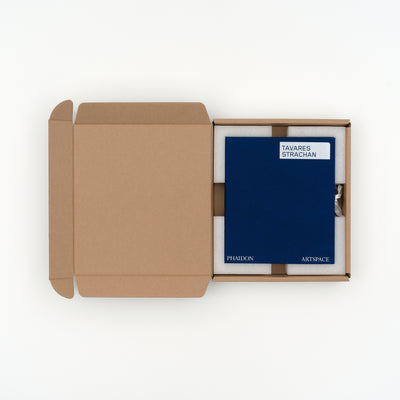
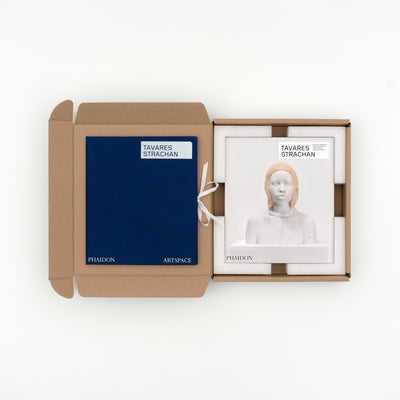
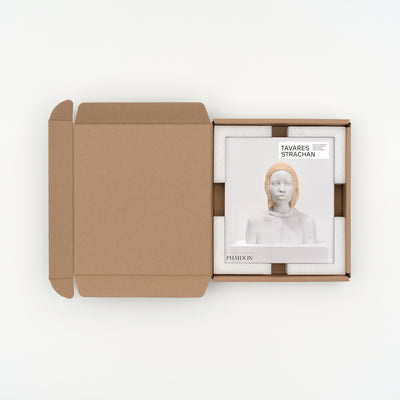
Take a closer look at The Stranger, 2026, or our Contemporary Artists Series book, Tavares Strachan.
 Tavares Strachan - The Stranger, 2026 - photography Garrett Carroll