

![Handwork: Handcrafted Objects that Made America [Craft in America]](http://www.phaidon.com/cdn/shop/files/M-handwork-en-3727-3d-standing-front-3000_cf7b8381-b3a2-41fd-86da-6fe623fb0a35.jpg?v=1784715138&width=400)
![Handwork: Handcrafted Objects that Made America [Craft in America]](http://www.phaidon.com/cdn/shop/files/M-handwork-en-3727-3d-overview-3000_038c21c2-0af7-41e2-8a96-9b0beaf9c2d6.jpg?v=1784715138&width=400)
![Handwork: Handcrafted Objects that Made America [Craft in America]](http://www.phaidon.com/cdn/shop/files/M-handwork-en-3727-3d-spread-1-3000_675d5a59-80e7-4b98-bb57-f9d68d61b20d.jpg?v=1784715138&width=400)
![Handwork: Handcrafted Objects that Made America [Craft in America]](http://www.phaidon.com/cdn/shop/files/M-handwork-en-3727-3d-spread-2-3000_a21c9230-7856-470d-8101-09ae2fef75e3.jpg?v=1784715138&width=400)
![Handwork: Handcrafted Objects that Made America [Craft in America]](http://www.phaidon.com/cdn/shop/files/M-handwork-en-3727-3d-spread-3-3000_6dbd48c4-eaab-4b0d-86a2-19b97d8be954.jpg?v=1784715138&width=400)
![Handwork: Handcrafted Objects that Made America [Craft in America]](http://www.phaidon.com/cdn/shop/files/M-handwork-en-3727-3d-spread-4-3000_851a14d9-3b23-4197-85c5-3a4503b24548.jpg?v=1784715138&width=400)
![Handwork: Handcrafted Objects that Made America [Craft in America]](http://www.phaidon.com/cdn/shop/files/M-handwork-en-3727-3d-spread-5-3000_232b034c-682e-4a6f-b47b-81d5a99dd497.jpg?v=1784715138&width=400)
![Handwork: Handcrafted Objects that Made America [Craft in America]](http://www.phaidon.com/cdn/shop/files/M-handwork-en-3727-3d-spread-6-3000_4c787d9d-1fb6-4812-9652-d15d93423bc0.jpg?v=1784715138&width=400)














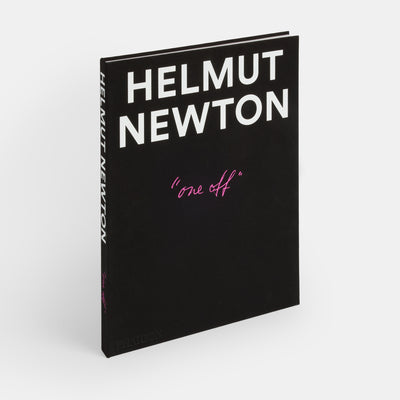
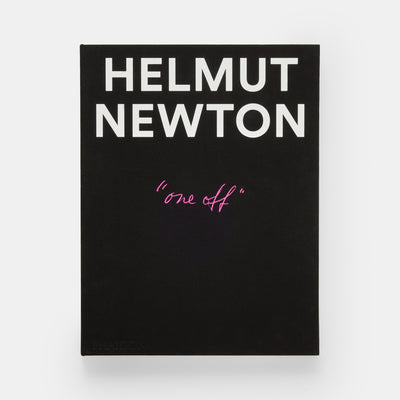
Photographer Helmut Newton's compelling images—filled with lush visual references from the history of painting to cinematography and literature—won him countless devoted admirers during his lifetime and continue to fascinate viewers today.
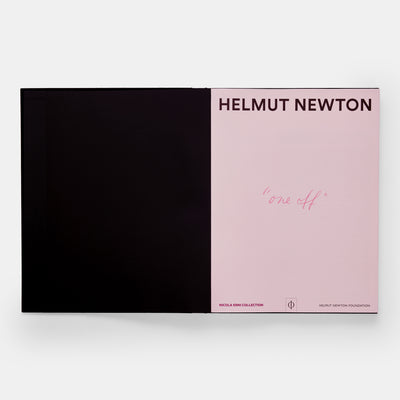
In 1999, Newton compiled a one-of-a-kind album comprising 103 photographs, each mounted on board accompanied by his own pencil annotation. This album belongs to the Switzerland based Nicola Erni Collection.
For our new book Helmut Newton One-off, we have collaborated with the Nicola Erni Collection reproducing this remarkable album in full, giving lovers of Newton’s work access to many of his best known, as well as some never-before-seen images.

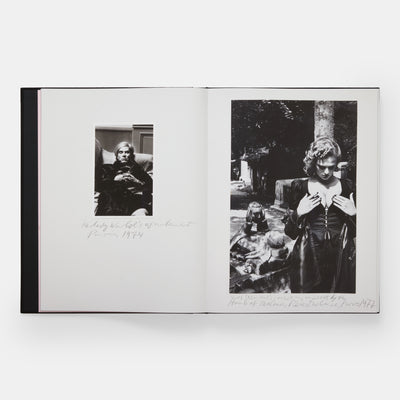
Helmut Newton, Père Lachaise, Tomb of Talma, Paris 1977. © Helmut Newton Foundation. Gelatin silver print. Image: 29.2 x 19.4 cm. Mount: 34.9 x 26.7 cm. Annotation: “Yves St. Laurent’s corset, my raincoat, by the Tomb of Talma, Père Lachaise, Paris, 1977”.
The book includes a range of Newton’s striking black and white photographs and color Polaroids – there are works from his iconic series such as Big Nudes, his commissioned work for Vogue and other magazines, and his collaboration with Yves Saint Laurent, photographing the le smoking jacket, and, in the process, creating one of the most famous fashion photographs of all time.
Helmut Newton One-off includes newly commissioned texts – an introduction by renowned photography specialist Philippe Garner and an interview between Matthias Harder (director of the Helmut Newton Foundation) and Gert Elfering, a photography collector, who compiled the One-off album with Newton which will be exhibited for the first time as a loan at the Helmut Newton Foundation in Berlin in the spring of 2026.
Here we reprint a small portion of that interview.

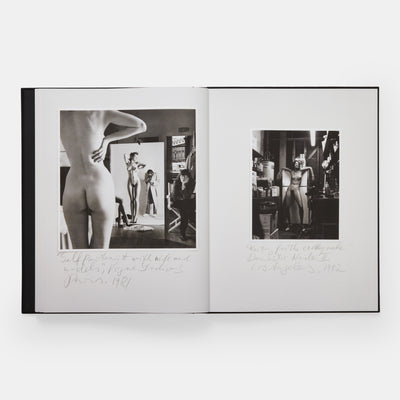
Helmut Newton, Self-portrait with Wife and Models, Vogue Studio, Paris 1981. © Helmut Newton Foundation. Gelatin silver print. Image: 21.2 x 20.8 cm. Mount: 34.9 x 26.7 cm. Annotation: “‘Self-Portrait with wife and models’, Vogue Studios, Paris, 1981”.
A close friend of Helmut Newton, Gert Elfering collaborated with the photographer in 1999 on a unique portfolio, personally dedicated to him by Newton. Shortly thereafter, Elfering sold it to the American collector Leon Constantiner, with Newton’s approval. Seven years later, in the fall of 2008, the album was auctioned at Christie’s New York and entered an American private collection. It then passed through a German art dealer into the Swiss private collection of Nicola Erni, where it remains, being exhibited for the first time as a loan at the Helmut Newton Foundation in Berlin in the spring of 2026.

Helmut Newton, In the New World, Prague 1988. © Helmut Newton Foundation. Gelatin silver print. Image: 16.7 x 16.7 cm. Mount: 34.9 x 26.7 cm. Annotation: “‘In the New World’, Prague, 1988”.
This conversation between Gert Elfering and Matthias Harder, Director of the Helmut Newton Foundation, took place in June 2025. They spoke not only about the creation of the portfolio but also about Helmut Newton himself, his photography, and the establishment of his foundation. During the late 1990s and early 2000s, pivotal and visionary decisions made both by Newton and within the art world ultimately led to the establishment of this unique institution in Newton’s hometown of Berlin—one he himself did not live to see completed. The Helmut Newton Foundation preserves his artistic legacy and keeps his work alive through numerous exhibitions and publications both in Germany and internationally.

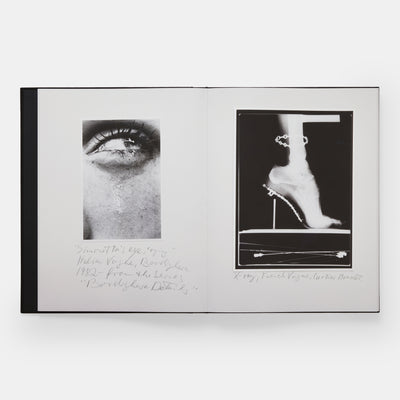
Helmut Newton, Close-up, Simonetta's Eye, Italian Vogue, Bordighera 1982. © Helmut Newton Foundation. Gelatin silver print. Image: 18.2 x 12.1 cm. Mount: 34.9 x 26.7 cm. Annotation: “‘Simonetta’s eye, crying’, Italian Vogue, Bordighera, 1982—from the series ‘Bordighera Details’”.
MATTHIAS HARDER Today we’re talking about the album Helmut compiled for you twenty-six years ago. It was put together shortly before his major retrospective at the Neue Nationalgalerie and the establishment of his foundation. How did that come about?
GERT ELFERING From 1996 until after his big Berlin retrospective, I spent a lot of time with Helmut—he often enjoyed traveling alone to Miami. Like many famous people, he didn’t have that many close friends. He frequently called, saying, “Let’s go out to eat, let’s do something.” We spent hours together, walking on the beach, chatting about anything and everything, which was very interesting. I must admit that Helmut influenced me significantly. I didn’t just admire his photography—I admired the whole person.

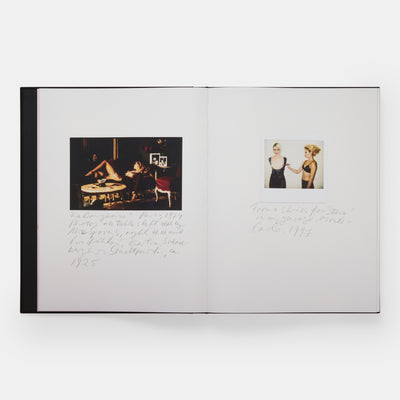
Helmut Newton, Stern, Monte Carlo 1997. © Helmut Newton Foundation. Color Polaroid. Image: 7.3 x 9 cm. Mount: 34.9 x 26.7 cm. Annotation: “From a series for ‘Stern’, in my garage, Monte-Carlo, 1997”.
MH And during those walks, did you discuss the portfolio, which would be created later?
GE I suggested he do something with his small-format images. I’m a big fan of his Polaroids, and own or have owned many hundreds of them. Once he invited me to Monte-Carlo and said over lunch, “I need a siesta. Here’s my room; those are the drawers. Feel free to go through them. Pick out whatever you like—we’ll talk about it afterward.”

Helmut Newton, Love for Sale, Playboy, Paris 1975. © Helmut Newton Foundation. Gelatin silver print. Image: 12.3 x 8.2 cm. Mount: 34.9 x 26.7 cm. Annotation: “Wedding dress, rue des Guillemites (?) in the Marais, at the back of my house, Paris, 1975”.
MH Was that in Monte-Carlo or Miami? Did you use the originals straight away or start with copies?
GE It was in Miami, where we spent two weeks alone. Helmut could be very generous, but also quite frugal. He even saved on film. Rather than making new prints, he preferred using existing ones—even if they were more valuable. “No need to spend new money,” he’d say. That’s why there are so many vintage prints in the album. Helmut would say: “Let’s take these; they fit perfectly.” Then I got the mounts—we even tested the pencils—I glued the photographs, and Helmut added short annotations. He had an extraordinary story for every single photo. His openness and lack of celebrity airs deeply impressed me—though he was always a bit stressed around the exhibition openings.

Helmut Newton, Domestic Nude II: Waiting for the Earthquake, Chateau Marmont, Hollywood 1992. © Helmut Newton Foundation. Gelatin silver print. Image: 16.6 x 13.4 cm. Mount: 34.9 x 26.7 cm. Annotation: “‘Waiting for the earthquake’, Domestic Nude II, Los Angeles, 1992”.
MH How would you characterize his photography?
GE Helmut worked more like a film director. He was interested in strong women—and depicted them as such. His images embody a new type of woman. His photography is poetry at its highest.
MH How did you select these 103 photographs?
GE We chose them together—mostly motifs I favored, and Helmut added a few vintage prints. He thoroughly enjoyed these small formats. Initially, I thought of having the album bound but then dropped the idea. At the same time, I was also helping him finance his retrospective in Berlin. I had a good connection at Volkswagen, and later Helmut created a portfolio for them featuring his advertising images of the new Beetle. With the fee he received for that, he was able to pay for the prints for his exhibition.

Helmut Newton, La Bourgeoise, Paris 1974. © Helmut Newton Foundation. Chromogenic print. Image: 11.1 x 16.8 cm. Mount: 34.9 x 26.7 cm. Annotation: “‘La Bourgeoise’, Paris, 1974. Photos on table: left H.N. by Alice Springs, right, H.N. and his father, Berlin, Schöneberger Stadtpark, ca. 1925”.
MH That was the same year, in 1999, wasn’t it? There were multiple images combining a car with a nude, and the shoot took place in Milan.
GE Since it was, in a way, a project we worked on together, he included several of those Volkswagen motifs in the album. Then another collector approached me and offered to buy the portfolio— for five times what I had paid Helmut. I called Helmut and told him about the tempting offer—and my guilty conscience. He simply said, “You’d be an idiot not to do it. Think of all the wonderful new things we can do with that nice money!” We both loved embarking on new projects. Helmut also got bored quickly, as was the case with the portfolio we compiled for the 1997 exhibition at Camera Work in Berlin. He never understood why people mainly wanted to see his classics, in both exhibitions and portfolios—so he said he would only do a “best of” portfolio on the condition that he could also do something else. In the end, we made two portfolios: the Big Classics and one with nudes of Arielle {one of Newton’s favorite fashion models}.

Helmut Newton, Andy Warhol, L´Uomo Vogue, Paris 1974. © Helmut Newton Foundation. Gelatin silver print. Image: 14.2 x 9.3 cm. Mount: 34.9 x 26.7 cm. Annotation: “In Andy Warhol’s apartement [sic.], Paris, 1974”.
MH Those are incredible images. You know which photo he once surprisingly described in an interview as his “most erotic picture”? His portrait of Margaret Thatcher!
GE Fascinating—another strong woman. It’s clear he wasn’t interested in cheap sexuality. And in dealing with others, he always maintained a sense of decorum; he was respectful, charming, and witty. Even my wife, who is not as fond of his photography, genuinely liked him. He’d bring our son children’s books, embellished with little drawings he had added himself—Helmut was quite skilled at drawing.
MH Back then, shortly before the foundation was launched, you were also frequently in Berlin—especially during your Camera Work days. Did you and Helmut meet regularly?
GE Yes. I remember once, at breakfast in the Savoy Hotel, he told me that he had met Gerhard Schröder the evening before at Paris Bar. Helmut sensed something was happening in Berlin. Ultimately, he chose Berlin as the site for his foundation, though Paris and New York were also options.

Helmut Newton, X-Ray, French Vogue, Paris 1994. © Helmut Newton Foundation. Gelatin silver print. Image: 24.2 x 18 cm. Mount: 34.9 x 26.7 cm. Annotation: “X-Ray, French Vogue, Cartier Bracelet”.
MH I think Heinz Berggruen played an important role in Helmut’s decision—he had opened his own museum in Charlottenburg just a few years earlier, and they were good friends.
GE I think so too. Helmut and Heinz were deeply shaped by Berlin and its mythos, as well as the literature of the time, such as the writings of Stefan Zweig and Arthur Schnitzler.
MH Helmut and Heinz also both returned to their hometown—Helmut for magazine assignments, often shooting in places he knew from his youth, bringing a very personal perspective wrapped in the commercial context of fashion.
GE Helmut was a true Berliner at heart—and stayed one until the end. He loved the old Berlin pubs; I remember unforgettable nights at Diener Tattersall. But he couldn’t have lived here again— Monte-Carlo was the right place for him in the end.

Take a closer look at Helmut Newton One-off.