

![Handwork: Handcrafted Objects that Made America [Craft in America]](http://www.phaidon.com/cdn/shop/files/M-handwork-en-3727-3d-standing-front-3000_cf7b8381-b3a2-41fd-86da-6fe623fb0a35.jpg?v=1784715138&width=400)
![Handwork: Handcrafted Objects that Made America [Craft in America]](http://www.phaidon.com/cdn/shop/files/M-handwork-en-3727-3d-overview-3000_038c21c2-0af7-41e2-8a96-9b0beaf9c2d6.jpg?v=1784715138&width=400)
![Handwork: Handcrafted Objects that Made America [Craft in America]](http://www.phaidon.com/cdn/shop/files/M-handwork-en-3727-3d-spread-1-3000_675d5a59-80e7-4b98-bb57-f9d68d61b20d.jpg?v=1784715138&width=400)
![Handwork: Handcrafted Objects that Made America [Craft in America]](http://www.phaidon.com/cdn/shop/files/M-handwork-en-3727-3d-spread-2-3000_a21c9230-7856-470d-8101-09ae2fef75e3.jpg?v=1784715138&width=400)
![Handwork: Handcrafted Objects that Made America [Craft in America]](http://www.phaidon.com/cdn/shop/files/M-handwork-en-3727-3d-spread-3-3000_6dbd48c4-eaab-4b0d-86a2-19b97d8be954.jpg?v=1784715138&width=400)
![Handwork: Handcrafted Objects that Made America [Craft in America]](http://www.phaidon.com/cdn/shop/files/M-handwork-en-3727-3d-spread-4-3000_851a14d9-3b23-4197-85c5-3a4503b24548.jpg?v=1784715138&width=400)
![Handwork: Handcrafted Objects that Made America [Craft in America]](http://www.phaidon.com/cdn/shop/files/M-handwork-en-3727-3d-spread-5-3000_232b034c-682e-4a6f-b47b-81d5a99dd497.jpg?v=1784715138&width=400)
![Handwork: Handcrafted Objects that Made America [Craft in America]](http://www.phaidon.com/cdn/shop/files/M-handwork-en-3727-3d-spread-6-3000_4c787d9d-1fb6-4812-9652-d15d93423bc0.jpg?v=1784715138&width=400)
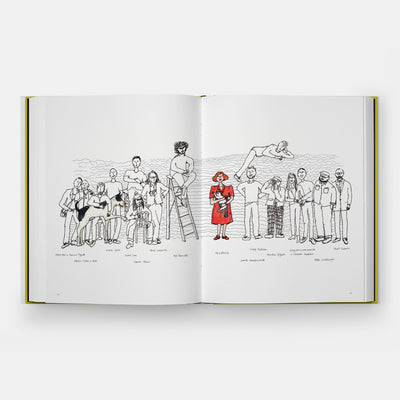












You may know Jenny Walton from her vintage shopping column in Vogue, her ever-popular Substack newsletter, Jenny Sais Quoi, or perhaps you are one of her nearly 400,000 Instagram followers.
Walton has always channeled her keen observations of life into her artwork and fashion, understanding the innate crossovers between these two worlds.
From her beginnings as a fashion student, to street style star, to global fashion influencer, her name has become synonymous with self-expression. In her fashion journey, she seeks to share with readers the most valuable lesson she’s learned along the way: that the path to authentic personal style is paved not with wealth, trends, and fads, but with trust in your instincts, your taste, and, by no means least, yourself.
 Jenny Walton edition - studio photography by Theresa Rudzki
A graduate of Parsons with a BFA in Fashion Design, she worked in knitwear and as a jewelry designer, while also honing her skills as an illustrator, working for such brands as Prada, Miu Miu, Bottega Veneta, and Gucci.
Now, following hard on the high heels of her Monacelli book Jenny Sais Quoi: Adventures in Vintage & Personal Style, Phaidon, Monacelli, and Artspace are pleased to present a trio of limited-edition prints by the artist, designer, writer, and style icon. Rendered in Walton’s signature hand-drawn style, these exquisite archival pigment prints elevate fashion illustration to an art form.
Each print is produced in a limited edition of 75 and is signed and numbered by Walton. The images are printed on richly textured deckled-edge paper, presented in a custom-designed tulip envelope, and accompanied by a signed copy of Jenny Sais Quoi: Adventures in Vintage & Personal Style.

Jenny Walton in the studio - photography by Theresa Rudzki
Walton’s work weaves together illustration, memory, and observation. Her style – a mix of elegance, wit, and quiet confidence – reflects the influence of fashion illustration greats such as René Gruau, Cecil Beaton, and Christian Bérard, while also projecting a deeply personal visual language of her own.
The exclusive trio of prints brings Walton’s singular perspective into focus. As in her broader practice, color is given thoughtful consideration, with a vintage-inspired palette of soft blush tones, light blues, and vibrant greens. The images, a mix of portraits and narrative scenes made over the last year, are “related to trends and things I was seeing and liking,” she says. “I love looking at fashion shows and then coming up with my own world from that.”
 Jenny Walton edition photography by Garrett Carroll
Details of the trio of editions are as follows: Edition 1: Pillbox Portrait, 2026, Edition 2: 10,000 Hours of Style, 2026, Edition 3: Pink Illustration: Spring Fitting, 2026. Each is an edition of 75 and 15 Aps.
 Jenny Walton edition photography by Garrett Carroll
They are archival pigment prints on Hahnemühle German Etching paper and are accompanied by a signed copy of Jenny Sais Quoi: Adventures in Vintage & Personal Style. Each print is signed and numbered by the Artist and measures 9 x 11 inches. They are available individually priced $300, or as a complete set of three for $700.
We spoke to Jenny Walton about the editions, the book, and her wider work.

Jenny Walton edition photography by Garrett Carroll
Tell us about the specifics of this trio of editions All three of these are different illustrations that I created over the past year. The two colored ones, the green one and the pink one, I originally created for a Substack I was writing. They related to trends and things I was seeing and liking. One of them was inspired by looking at different images of a model I saw at a Prada show. I love looking at shows and then coming up with my own world from that.
That's how I judge what's a really good show. For instance, Chanel just showed a few days ago and I immediately started screenshotting the images. That inspired me to get out a pen and paper, which is really nice, because then it's a case of one artist inspiring another.
And then the second, green one, I had made, again originally for a Substack essay I was writing about shopping. This one was about wearing your nightgown out, wearing underwear as outerwear. Then we ended up using it in the book because it went along with an essay quite well, but that wasn't originally the intended use of it.
I like this idea of this woman going through the more intimate section of her wardrobe and pulling out all these things and having lots to choose from. I put a little bag on her shoulder to show she's still going out, she's not staying in with these things. So it's fun. She's giving me a bit of a side eye. That's my vision of what's happening.
The third one was an illustration I had been working on. The Financial Times was interviewing me for an article about the return of pillbox hats. I had one and they photographed me in it. But I'm always trying to push, so I asked to illustrate something.
 Jenny Walton in the studio - photography by Theresa Rudzki
What I liked is we have two figures that are further away at a distance, and you have different things going on. You've got a mix of clothing and this fantastic acid green color. They each have a very different attitude. The pink one is more pretty, it might be a girl that's more into a traditionally feminine aesthetic, the other one might be a bit funky and challenging. And the third one, I like that she is a bit of a portrait. I wanted to have at least one portrait. We added the border after the fact just to punch it up as well, because the book is very colorful and we wanted to reflect that.
So we’ve got a little bit of blue and whimsy, but then we've also got a serious stern look going on, kind of old school glamor. I like this mix where maybe there's a little bit of seriousness in her expression, but then there's a bit of whimsy too.
 Jenny Walton edition - studio photography by Theresa Rudzki
What were your inspirations, and your inspirations for this series? It's mainly inspired by looking at illustrations from almost 100 years ago. I love looking at old Illustrations. There are so many great ones out there. I love collecting vintage magazines for that reason too. The first illustrator I bought a book of was René Gruau. His work is so perfect, and his illustrations have that beautiful Japanese ink line that's just incredible.
But I would find that hard to imitate or to try to replicate. And also it would feel so precise, that there was something about it where that was making it feel maybe a bit dated in a way. But he's obviously the master. When I started, I always sketched with markers, and, for me, it became more about movement.
After looking at René Gruau, I looked at Cecil Beaton quite a lot, and also Christian Bérard. Bérard had this beautiful looseness to his style that I felt was more contemporary and felt like something I could connect to a little bit more.
I went to Parsons and my degree was in fashion design, but we studied fashion illustration. All of our classes were six-hours-long, and we had a six-hour-long drawing class where we had to stand the entire time. I thought oh God, what am I doing here? But it was really great. That's how I learned to start drawing quickly and get more movement and gesture into my work. That's always the goal. How can you do something in as simple a way as possible? That was always the goal of fashion illustrators because they were sketching quickly at shows.
 Jenny Walton edition - studio photography by Theresa Rudzki
How did it all start for you? I grew up with my mother taking me and my sisters to the flea market and giving us five dollars and telling us to buy whatever. I started collecting smoking pipes, I just had that eye. She was a great quilter, so she taught me how to sew. That's how I ended up going to school for fashion because I started making my own clothes.
I remember that there was there was a cartoonist book that my mom got me when I was pretty young, six or seven. It was a book in which you got to draw characters in a very simple way. I haven't actually thought about this in forever! I remember copying that book like crazy and loving the fact that you could express someone being sad or mad just by changing a line.
I also, in a way, learned how to paint through sewing, because my mom taught me embroidery, just like her mom had taught her. So I had this rainbow-embroidered pillow that read: I love my cat Pumpkin. I also painted constantly as a kid. I was always in the art room, hiding out!
You’re either interested in having an eye for aesthetics or you're not. But once you have that curiosity and that interest, it just expands for your whole life.
 Jenny Walton in the studio - photography by Theresa Rudzki
What was your formal arts education like and what did you learn from it? When I learned fashion illustration at Parsons, everything shifted for me. I did two years as a design assistant, but I hated doing emails, I was terrible at it. But I loved sitting on the subway and listening to music and sketching. So I thought that I should just keep following that.
I'm lucky because Instagram really took off around this time. I was posting every day around 2014. Back then it became enough to just share who you were and what you were seeing, and these special little moments every day. You were able to not only build a world for yourself that way, but able to create a following and a business out of that, where people just wanted to watch you be you, and see what apartment you're living in, and what shows you're inspired by, and what things you want to sketch.
A lot of what I do is not dictated by anybody else, so I have that freedom. And so that's how it's come together in this way where I can do a book, where I'm writing, and I'm doing an oil painting of an amazing moment I saw, but then I can also do fashion illustration. It never turns off, really.
 Jenny Walton in the studio - photography by Theresa Rudzki
How would you describe the process that resulted in both the book and your illustrations and paintings? I talk about this in the book in an essay called Flow State Fashion, which is more about dressing, but basically it's getting into flow. I'll usually do a few gestural things just to get the energy out. I won't judge anything and I'll use crappy printer paper just to start things flowing. It's the same as when I start trying on outfits, I'll photograph the first few, I'll look back and think those are horrible, or just boring.
With my work and my images I'm never usually thinking of a specific person or a contemporary person. I live in a dream world. I'm sure a lot of the audience for these editions will be made up of people who have followed me for 10 plus years. I'm sure it'll be people who have been following along for a long time and have wanted to own a piece of what I do but just haven't had an opportunity to do that yet.