

![Handwork: Handcrafted Objects that Made America [Craft in America]](http://www.phaidon.com/cdn/shop/files/M-handwork-en-3727-3d-standing-front-3000_cf7b8381-b3a2-41fd-86da-6fe623fb0a35.jpg?v=1784715138&width=400)
![Handwork: Handcrafted Objects that Made America [Craft in America]](http://www.phaidon.com/cdn/shop/files/M-handwork-en-3727-3d-overview-3000_038c21c2-0af7-41e2-8a96-9b0beaf9c2d6.jpg?v=1784715138&width=400)
![Handwork: Handcrafted Objects that Made America [Craft in America]](http://www.phaidon.com/cdn/shop/files/M-handwork-en-3727-3d-spread-1-3000_675d5a59-80e7-4b98-bb57-f9d68d61b20d.jpg?v=1784715138&width=400)
![Handwork: Handcrafted Objects that Made America [Craft in America]](http://www.phaidon.com/cdn/shop/files/M-handwork-en-3727-3d-spread-2-3000_a21c9230-7856-470d-8101-09ae2fef75e3.jpg?v=1784715138&width=400)
![Handwork: Handcrafted Objects that Made America [Craft in America]](http://www.phaidon.com/cdn/shop/files/M-handwork-en-3727-3d-spread-3-3000_6dbd48c4-eaab-4b0d-86a2-19b97d8be954.jpg?v=1784715138&width=400)
![Handwork: Handcrafted Objects that Made America [Craft in America]](http://www.phaidon.com/cdn/shop/files/M-handwork-en-3727-3d-spread-4-3000_851a14d9-3b23-4197-85c5-3a4503b24548.jpg?v=1784715138&width=400)
![Handwork: Handcrafted Objects that Made America [Craft in America]](http://www.phaidon.com/cdn/shop/files/M-handwork-en-3727-3d-spread-5-3000_232b034c-682e-4a6f-b47b-81d5a99dd497.jpg?v=1784715138&width=400)
![Handwork: Handcrafted Objects that Made America [Craft in America]](http://www.phaidon.com/cdn/shop/files/M-handwork-en-3727-3d-spread-6-3000_4c787d9d-1fb6-4812-9652-d15d93423bc0.jpg?v=1784715138&width=400)











Over the past decade, the artist and Oscar-nominated filmmaker, Garrett Bradley has emerged as one of the most singular voices in contemporary cinema, crafting work that bridges the distance between archival documentation and lived experience. In a way, her work addresses the very texture of memory itself.
Born in New York, and a resident of New Orleans, Louisiana, Bradley first gained attention through a series of short films that combined lyrical imagery with sharp political observation.
That sensibility reached a wider audience with Time, her acclaimed and Oscar-nominated 2020 feature documentary chronicling the decades-long fight of Fox Rich to free her incarcerated husband from prison. The film, shot in velvety black and white, transformed a criminal-justice narrative into conceptual theater. Bradley intertwined contemporary footage with home-videos, allowing time to fold in on itself until the years lost to incarceration became palpable. As in much of her wider work, Garrett framed her subjects with a richness once reserved for movie stars, with moments of humdrum domesticity bathed in a saintly, luminous glow.
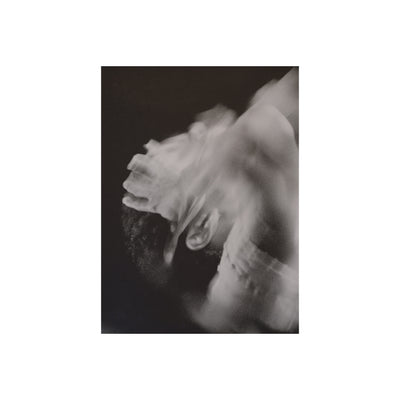
Now, Phaidon, Artspace, and New York art institution The Kitchen are pleased to present In the palm of my hand, 2026, a new limited-edition print by the artist and Kitchen 2026 Gala Honoree. Bradley’s new edition distils her practice into an intimate, collectible form, capturing Bradley’s cinematic language in still form, where light, tension, and atmosphere are the focus.
It is an archival pigment print on matte coated bond paper at 192gsm, measuring 22.5 x 30 inches. It comes in an edition of 30 + 2 AP priced at $1,200. The edition comes from a trilogy of films exploring the nuanced overlap between women’s interior and exterior lives.
 Garrett Bradley - In the palm of my hand, 2026 - photography Alex Smith
“Films are made up of still images, and I’ve always thought that if I could pause a film I’ve made, and that moment could adequately articulate an entire idea, I would have accomplished what I wanted. A static image is also time based and can shift and grow for as long as you’re willing to stay with it,” she tells Artspace.
Proceeds from the sale of In the palm of my hand, 2026 will support The Kitchen’s artistic program and its mission dedicated to offering experimental artists opportunities to create and present new work within, and across, the disciplines of dance, film, literature, music, theater, video, and visual art.
Her work is held in permanent collections globally, including The Studio Museum in Harlem, The Museum of Modern Art, The Tate Modern, the Smithsonian National Portrait Gallery and more.
Subsequent recognition has included the Arts and Letters Award for Art from the American Academy of Arts and Letters (2022), the Eye Art & Film Prize (2023), a United Artists Fellowship (2024), a Guggenheim Fellowship (2024), and a MacArthur Fellowship (2025), recognizing her as a recipient of the MacArthur ‘Genius’ Award.
Bradley’s writing and visual essays have appeared in a range of publications, including The New York Times Magazine, Artforum, Frieze, BOMB, e-flux and more. Her work has been featured in exhibition catalogues and critical anthologies, including Garrett Bradley: American Rhapsody (Contemporary Arts Museum Houston, 2019), Revolutions (Eye Filmmuseum, 2025), and Devotion (MIT Press and Lisson Gallery, 2023).
Founded in 1971 as an artist-driven collective, The Kitchen today reaffirms and expands upon its originating vision as a dynamic cultural institution that centers artists, prioritizes people, and puts process first. It encourages wild thought, risky play, and innovative and experimental making.
On the eve of the release of In the palm of my hand, 2026 we asked Garrett Bradley about the edition and her wider practice.
 Garrett Bradley with In the palm of my hand, 2026 - photography Alex Smith
Tell us about the original work this edition comes from and why you chose it? The edition comes from a trilogy of films exploring the nuanced overlap between women’s interior and exterior lives. The first film, AKA, focused on the nuanced relationships between mothers and daughters, particularly in relation to race and upward mobility outside the family structure. I was interested in what is lost and gained as women move through the world carrying intimate familial bonds while also being shaped by love, labor, and social expectation. How do these relationships shape the way we see ourselves, and the way others come to see us?
The second film in the trilogy, SAFE—from which this edition is drawn—turns more directly toward interior life. I wanted to explore the difficulty of representing emotion, intuition, instinct, and psychic overwhelm through cinema, especially since the interior can never be fully visible or resolved into image. I was thinking about Kevin Quashie and his suggestion that interiority itself is a radical space within Black life precisely because it resists spectacle and easy description.
Across the trilogy, I approach visual metaphor as a way of approximating interior emotion and recovering less visible histories. The image chosen for this edition felt especially connected to the present moment, to the ways sound and our sensorial landscape shape our inner lives, and how those inner lives in turn, shape our material reality.
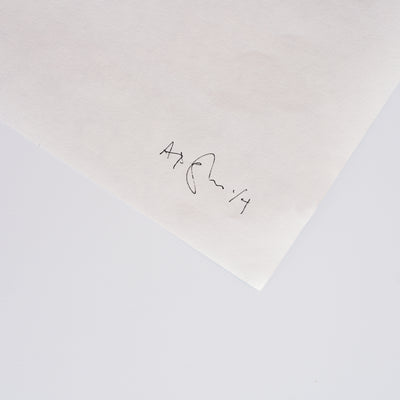
 Garrett Bradley signing In the palm of my hand, 2026 - photography Alex Smith
What was your thought process when choosing the title? With all that’s going on, I got the world in my palm. It’s a riff on the Lauryn Hill lyric from the song Final Hour... It was kind of a literal thought process. Our heads consumed with the world, our heads in our hands, the world in one’s palm...
With this edition is there a relationship you want to pursue between film and static image, or do you view them as very separate entities? I see them as extensions of one another. Films are made up of still images, and I’ve always thought that if I could pause a film I’ve made, and that moment could adequately articulate an entire idea, I would have accomplished what I wanted. A static image is also time based and can shift and grow for as long as you’re willing to stay with it. That isn’t exactly the case with moving images which have more control over the pace of your experience.
What interests you about monochrome as a visual aesthetic and a way of communicating your thoughts? I think I’m drawn to the way the shape and content of something operates differently when you remove color.
What filmmakers, artists, or thinkers have most influenced your visual language? Toni Morrison, Kevin Quashie, William Greaves, Lil Wayne, Art Blakey, my parents, my friends, my neighbors, strangers, my daughter, American football. I'd like to think a visual language comes out of being exposed to an amalgamation of people and experiences. It’s an attempt at materializing a headspace – something that comes out of your mind back into the world as something that is tangible and can be reabsorbed.

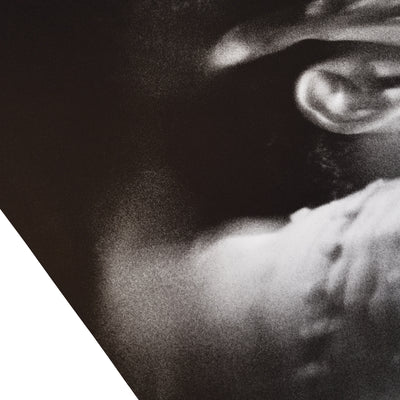
Garrett Bradley - In the palm of my hand, 2026 (detail) - photography Alex Smith
What do you hope audiences carry with them after experiencing your work, and this work in particular? I’m not sure I have an explicit hope for what one takes away. I’m more invested in the experience of looking or watching as being a respite. An experience that you can dissolve with, or fall into for a moment.
Your work often blurs the line between documentary and experimental film, how do you define truth in your storytelling? I define truth alongside transparency. Why am I making something and to what end? How am I making it? Are the two mirroring one another? If I say, I’m interested in making something about love then it has to be made with love. The architecture, design, and execution of the work all need to match the emotional intention.
You studied religion at college, do those studies play a part in your work? Yes. Religion is ultimately about humanity confronting the unknowable. Ritual, transcendence, a perpetual curiosity and commitment to better understanding. They are creative questions as much as spiritual ones. I think we’re all searching for revelation and art can offer that to both the artist and the viewer.
 Garrett Bradley - In the palm of my hand, 2026 - photography Alex Smith
You've lived in a few places; how do specific locations inform the emotional or political dimensions of your work? The work has for the most part, been born out of these locations and more specifically, out of relationships with people, what people think or feel about one thing or the next gets alchemized through dialogue with another and the work and form of the work, is inspired by and built upon that.
What do editions mean to you, what role do they play in your practice, and do you buy editions yourself? I think editions can operate differently depending on their context. In this case, the edition is in support of The Kitchen which is a New York staple and artistic institution that has and continues to foster artists over several generations. I think art and civic action are inseparable and this edition in particular underscores that.
What did it feel like to be nominated for an Oscar, and to win the big four critics' awards? Of course, it is gratifying to feel that something you care about and have made also resonates outward into the world. I also feel that that resonance is like a weather system, it ebbs and flows even if the work itself remains unchanged. The biggest gift of all is having the trust and support to keep working and to return to your process, uncertain again of what’s possible.
Take a closer look at In the palm of my hand, 2026.