





Search:
Type:
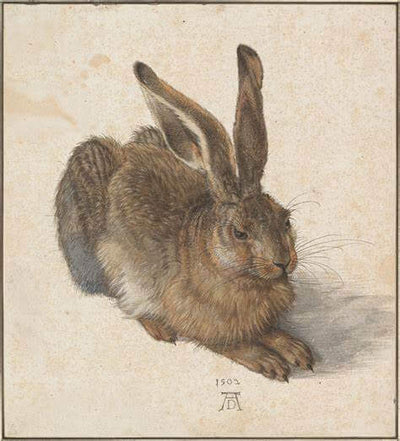
Albrecht Dürer detailed engraving of a hare with realistic fur texture and naturalistic shading
Phaidon’s 15 Minute Art Lesson - The Point and Pitfalls of Art by E. H. Gombrich
Museums and galleries may be closed, but the world of art remains vibrant and accessible through E.H. Gombrich’s timeless introduction to *The Story of Art*. In this engaging excerpt, Gombrich challenges traditional notions of “Art with a capital A,” reminding us that art is about artists and personal experience rather than rigid definitions. He encourages us to appreciate all kinds of beauty—from Rubens’ proud portraits to Dürer’s unvarnished realism—and to remain open to new perspectives on color, form, and representation. Through insightful examples and a warm, scholarly tone, he invites readers to embark on a journey of discovery, shedding prejudices and seeing art and nature with fresh eyes. This passage celebrates the joy of truly observing and understanding art beyond labels, promising an enriching adventure for all who dare to look deeply.
Read more
capuchin monkey close-up portrait detailed facial features natural habitat wildlife photography
Phaidon's 15 Minute Art Lesson - Impressionism and The Great Outdoors – by Carla Rachman
The Impressionists forever changed how we experience art by capturing not just landscapes but the fleeting sensations of light, atmosphere, and modern life. Emerging from their 1874 Paris exhibition, these artists—led by figures like Monet and Pissarro—focused on painting the mood and moment rather than precise topography, challenging traditional expectations with their "sketch-like" style. Monet’s iconic Impression, Sunrise symbolizes this shift, emphasizing the ephemeral effects of color and light over exact detail. The movement also embraced the dynamic urban environment of Haussmannized Paris, depicting its boulevards and bustling life through the detached eyes of the flâneur. Despite initial criticism, the Impressionists gained recognition for their fresh, personal vision of nature and city life, reminding us today of the profound beauty found in everyday moments spent outdoors, whether under the sun or in the soft glow of a café.
Read more
kitchen knife with wooden handle on white background
Why does Yoshitomo Nara’s girl have a knife in her hand?
In 1991, Yoshitomo Nara created his iconic painting, The Girl with the Knife in Her Hand, introducing the captivating motif of big-headed girls that would define much of his work. Rooted in his childhood in rural northern Japan and influenced by Shinto beliefs and the protective figure of Jizō, Nara’s art intertwines innocence with subtle menace. His portrayal of childlike figures, embodying the complex Japanese concept of kawaii—ranging from pitiable to beloved—brims with dark humor and emotional depth. The girl’s innocent yet unsettling stare, coupled with the small knife she holds, challenges viewers’ perceptions, blending cuteness with an ambiguous threat. Nara’s work aims to evoke empathy and connection, transcending mere aesthetics to probe the tensions between vulnerability and power in contemporary culture.
Read more
Mother Istanbul artwork vibrant cityscape cultural landmarks colorful illustration
Adrián Villa Rojas staged a global rebirth on an Istanbul island
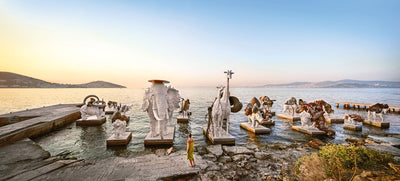
Adrián Villar Rojas’s monumental installation, The Most Beautiful of All Mothers, reimagines a post-Anthropocene world where life has returned to its primordial origins, rising from the sea as strange, haunting creatures. Situated on Büyükada Island by the shore of Leon Trotsky’s former house—where the exiled revolutionary once dreamed of a global proletarian uprising—this evocative work features over twenty-nine animal sculptures crafted from diverse materials collected from across the globe. Curated by Carolyn Christov-Bakargiev for the 2015 Istanbul Biennial, the piece embodies a powerful blend of sci-fi imagination and ecological anxiety, inviting viewers to contemplate a future after humanity’s collapse, where nature’s resilient inhabitants reclaim the earth, indifferent to human fate.
Read more
3D book cover image of resource with ISBN 9780714875019
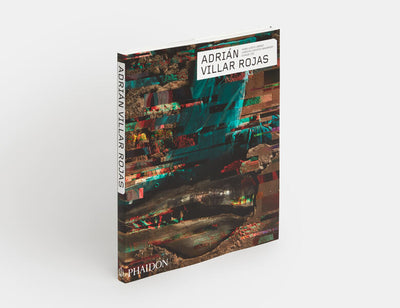
All you need to know about Adrián Villar Rojas
Argentinian artist Adrián Villar Rojas challenges the permanence of contemporary art by creating large-scale sculptures that embrace decay and entropy, reflecting on humanity’s impact on nature and the passage of time. From his early playful adaptations of toys to haunting installations like My Dead Family, a whale sculpture that cracks and erodes, and The Most Beautiful of All Mothers, featuring animal figures rising from the Bosphorus, Villar Rojas explores themes of mortality, ecological crisis, and cultural memory. His works, often ephemeral and collaborative, draw on organic and industrial materials to evoke a future shaped by the Anthropocene, while also questioning museum hierarchies and historical narratives. By designing art intended to degrade, he invites us to reflect on legacy, survival, and the fragile traces we leave behind.
Read more
Nam June Paik portrait digital art pioneer and video artist
Rubber boots, electric shocks and Zen Buddhism – this is what a 1970s visit to Nam June Paik’s studio was like
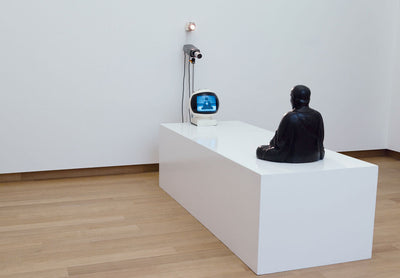
Barbara London, founding curator of MoMA’s video art program, reflects on her encounters with Nam June Paik, a pioneering video artist whose experimental approach revolutionized the medium. From his cluttered studio filled with wires and magnets to his ambitious vision of shaping the TV screen as an artistic canvas akin to the masters of painting, Paik pushed the boundaries of video art with inventive techniques and a playful spirit. His groundbreaking work, like the 1973 piece Global Groove, combined rapid-fire editing with diverse cultural elements, capturing and transforming the attention of viewers and broadcast engineers alike. Collaborating with technician Shuya Abe, Paik developed innovative tools such as the video synthesizer that expanded the possibilities of visual effects. Barbara London celebrates Paik’s legacy as a visionary who made video art both accessible and profoundly influential, securing its place as an enduring and dynamic art form.
Read more
Bill Viola artwork portrait digital art contemporary artist
Bill Viola, the artist who linked martyrdom to the moving image
In her captivating new book, Barbara London, founding curator of MoMA’s video program, recounts the pioneering journey of video artist Bill Viola, who as a youth marveled at the futuristic technology of the 1964 World’s Fair. Blending high-tech innovation with deep spiritual influences—from Renaissance art to Persian mysticism—Viola masterfully uses video to explore timeless themes of solitude, faith, and inner strength. London highlights Viola’s groundbreaking 1985 MoMA retrospective, featuring the evocative installation *Room for St. John of the Cross*, which merged modern video and sound technology with the poignant story of a 16th-century mystic. This work not only elevated video art into the realm of profound emotional and philosophical expression but also marked a pivotal moment in MoMA’s embrace of the medium, celebrating its power to convey the depth and grace traditionally reserved for classical forms.
Read more
Julia Scher portrait professional headshot creative artist
Do you know about Julia Scher, the original surveillance artist?
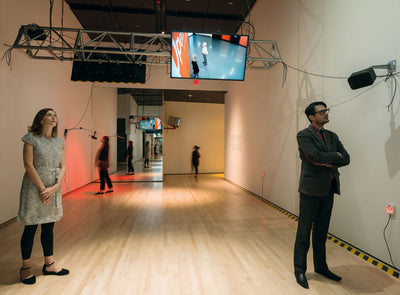
Long before the digital surveillance revelations of today, artists were already grappling with the implications of being constantly watched, as highlighted in Barbara London’s new book, *Video/Art: The First Fifty Years*. From the early 1980s German filmmaker Michael Klier’s video using actual surveillance footage, to Julia Scher’s pioneering work on predictive behavior and social control through her installations in places like the San Francisco Museum of Modern Art, artists have explored how surveillance shapes public and private life. Scher’s evolving project *Predictive Engineering* cleverly plays with viewers’ perceptions—sometimes tricking them with pre-recorded footage—to comment on the pervasiveness of surveillance long before such ideas became mainstream in public policy or social media. Her ongoing updates to the work illustrate the challenges and importance of preserving media art as a reflection of our shifting relationship with privacy, control, and technology.
Read more
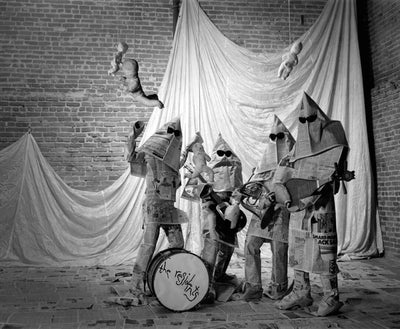
The Residents band members performing on stage with masks and costumes
The Residents rise from anonymous musicians to video art pioneers
In the late 1970s, as electronic technologies evolved, curator Barbara London championed pioneering artists who used music and video to critique society, despite museums’ reluctance to embrace punk, graffiti, and sound-based art. Recognizing the groundbreaking work of figures like David Bowie, Captain Beefheart, Laurie Anderson, and the avant-garde collective The Residents, London fought to include their multimedia creations in MoMA’s archives, anticipating their lasting cultural impact. Her efforts highlighted the dynamic intersections of video, performance, and music, with The Residents’ darkly inventive, satirical works becoming emblematic of this fertile new artistic territory. London’s dedication ensured these once marginalized voices earned their place in art history, celebrating a vibrant era of cross-genre innovation documented in her book *Video/Art: The First Fifty Years*.
Read more
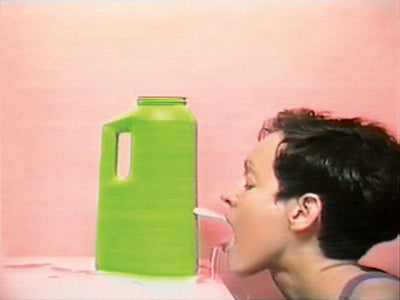
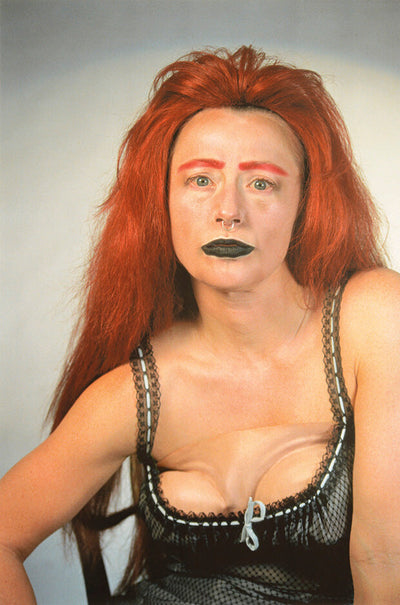
Cheryl Donegan contemporary artist artwork photograph
Meet the Riot Grrrl video artist who upset older feminists
Video art, an avant-garde medium deeply shaped by television’s evolution, is explored in Barbara London’s new book, Video/Art: The First Fifty Years. London, the founding curator of MoMA’s video art program, highlights the 1990s wave of young artists influenced by MTV and DIY aesthetics, including Cheryl Donegan, whose provocative work blended feminist politics with punk and pop culture. Donegan’s iconic video Head (1993) challenges traditional portrayals of sex, labor, and gender with irreverent humor and irony, confronting criticisms from feminist peers while carving out a bold, lasting space within video art. London’s book chronicles video art’s transformation from a niche practice to a major contemporary medium, tracing its journey from analog beginnings to digital innovations and reaffirming its cultural significance today.
Read more
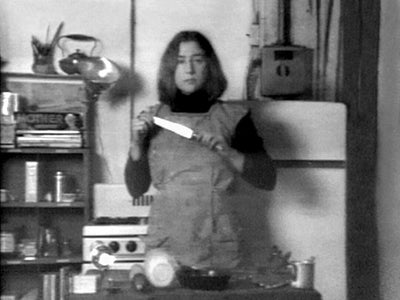
Martha Rosler artwork photograph contemporary art collage social commentary
Martha Rosler is the video artist who sliced TV clichés to pieces
In 1975, MoMA began acquiring pioneering video artworks, marking video as the first new medium in their collection since film. Among these groundbreaking pieces was Martha Rosler’s Semiotics of the Kitchen, a striking six-and-a-half-minute video in which Rosler performs the alphabet using culinary tools, transforming a kitchen setting into a powerful critique of gender roles, mass media, and societal expectations. This innovative work exemplifies how early video artists challenged the rigid formats of television and blurred the lines between popular culture and high art, laying the groundwork for identity politics and critical discourse on inequality that continues to resonate today.
Read more
portrait of Michele smiling outdoors with natural background
Curator and Editor Michele Robecchi Picks his Favourite Affordable Works on Artspace
Michele Robecchi, a seasoned writer and curator based in London, shares his curated selection of standout contemporary artworks currently available on Artspace. From Gianni Motti’s provocative use of cash as art to Ceal Floyer’s minimalist reflections on personal struggle, and Pope .L’s witty societal critiques, each piece offers a unique entry point into the art world. Highlights include Adel Abdessemed’s hauntingly colorful nod to Abstract Expressionism, Mario Schifano’s pioneering European Pop Art, and Lorraine O’Grady’s powerful newspaper-cutout poems addressing gender and race. Robecchi also celebrates artists like Nari Ward, Pipilotti Rist, Elizabeth Catlett, and Sister Mary Corita Kent, whose diverse works range from social justice themes to poetic visual narratives, showcasing the rich, multi-layered conversations contemporary art can ignite.
Read more
Barbara London contemporary art curator portrait photograph
INTERVIEW: Barbara London on the birth of video art
Barbara London, former curator at MoMA, reflects on her pioneering journey in video art from the 1970s to today, chronicled in her new book *Video/Art: The First Fifty Years*. She shares fascinating stories—from receiving quirky artist tapes like one featuring a dead chicken, to the early rivalry between filmmakers and video artists, and the vital role collaborations with musicians and interdisciplinary creators played. London highlights the technical challenges and innovations that shaped the medium, the importance of preserving early video works amidst evolving technology, and the open, dynamic New York art scene that nurtured this groundbreaking art form. Her firsthand accounts offer a compelling glimpse into how video art grew from experimental fringes to a celebrated contemporary medium, while she continues to explore what the future holds.
Read more
Harland Miller artwork cover image resource 004-5
So good they named it once? Harland Miller returns to York
Harland Miller, known for his melancholic and hard-boiled persona, draws heavily on his roots in York, the city where he grew up, despite his international career in Brooklyn, Paris, and London. His upcoming largest solo exhibition, "Harland Miller: York So Nice They Named It Once," at York Art Gallery from February to May 2020, showcases works reflecting his connection to York and Yorkshire’s culture, including his Pelican Bad Weather Paintings and the recent Letter Painting series inspired by medieval manuscripts. The exhibition reveals a nuanced, wry affection for his hometown, blending his signature appropriation style with local themes. For those unable to attend, his comprehensive monograph, "Harland Miller: In Shadows I Boogie," offers an engaging insight into his art and story.
Read more
Othoniel artistic sculpture colorful abstract design
How Chanel and Peter Marino supersized Jean-Michel Othoniel
French artist Jean-Michel Othoniel’s partnership with renowned architect and collector Peter Marino has transformed commercial sculpture by blending artistry with luxury retail design. Initially struggling financially despite his European gallery success, Othoniel found new creative freedom through Marino’s commissions for flagship Chanel stores, producing monumental glass pearl sculptures that challenged both technical limits and his own artistic scope. This collaboration pushed Othoniel from intricate, delicate works toward grand, architectural-scale pieces, demonstrating how art and commerce can fuel innovation. Othoniel’s latest solo exhibition is on view at Perrotin in Shanghai, while his impressive large-scale sculptures continue to captivate visitors in Chanel’s iconic retail spaces worldwide.
Read more
Book cover image of resource 9780714877594-950-1 with detailed illustration and title visible
All you need to know about Video/Art: The First Fifty Years
Barbara London’s new book, *Video/Art: The First Fifty Years*, traces the evolution of video art from its radical 1960s origins to its status as a leading contemporary art form today. Drawing on her extensive experience as MoMA’s founding video curator, London explores how video artists like Nam June Paik, Laurie Anderson, and Bill Viola broke away from traditional filmmaking to create immersive, interactive audiovisual experiences. The book highlights the medium’s political significance, its intersection with consumer electronics, and its vibrant cultural impact, blending personal insights with a rich history of artists, artworks, and technological shifts. Perfect for art lovers, cinephiles, and pop culture enthusiasts, this compelling narrative reveals how video art has become an essential thread in the tapestry of modern creativity.
Read more
Minimalist interior design by John Pawson featuring clean lines and natural light
INTERVIEW: John Pawson on Calvin Klein, The Design Museum and one piece of advice he'd give to his younger self
John Pawson’s new book, *Anatomy of Minimum*, captures the serene simplicity and meticulous precision that define his architectural style, revealing a journey shaped by relentless determination and evolving perspective. Reflecting on four decades of work, Pawson shares candid insights into his early fiery drive, transformative collaborations with clients like Calvin Klein, and the lessons learned from missteps and creative conflicts. From intimate domestic projects to grand public spaces, including his own rural home and the iconic Design Museum, Pawson’s designs balance rigorous craftsmanship with a deep respect for materials and light. Despite shifting energy and tempered enthusiasm at 70, Pawson remains passionate about learning and shaping spaces that resonate both functionally and emotionally, illustrating how architecture is both a personal and collaborative journey.
Read more
Nicholas Bonner portrait photograph professional headshot
INTERVIEW: Nick Bonner on art in North Korea
Nick Bonner, a British lecturer and filmmaker, has amassed one of the largest collections of North Korean art, focusing on woodblock and linocut prints that depict everyday life in the DPRK. Since his first visit in 1993, Bonner has collected nearly a thousand pieces, revealing a gradual evolution in style from minimalist monotones to vibrant, detailed works. This unique art form, often described as Juche Realism—a North Korean take on Socialist Realism—celebrates the working class and serves ideological purposes rather than pure artistic expression. Despite its propagandistic nature, the art holds a distinct beauty and reflects the country's culture and political ethos. While there is little international market or understanding of North Korean art, Bonner’s collection, featured in his book *Printed in North Korea*, offers rare insight into the lives of the country's people and the artists who create under strict state control, blending tradition with limited personal expression within a controlled system.
Read more
John Currin portrait painting detailed brushwork realistic style
The Lives of Artists – John Currin
Calvin Tomkins has spent nearly six decades profiling the most influential figures in contemporary art for The New Yorker, capturing not just their work but the complex human stories behind the artists. His new six-volume anthology, The Lives of Artists, brings together 82 of these compelling profiles, offering rich insights into the creative minds shaping art history. Among these intimate portrayals is the nuanced account of painter John Currin and sculptor Rachel Feinstein’s marriage—a blend of contrasting personalities that fuels their creativity and resilience. Tomkins reveals both the inspiring support Feinstein provides during Currin’s struggles and the personal battles he faces, painting a vivid picture of an artist’s journey through triumphs and challenges. This collection is a must-have for art lovers who want to understand the passion, struggles, and humanity behind great art.
Read more
Cover image of book with ISBN 9781838661038 featuring abstract colorful design
Jonas Wood talks about his new print edition Bball Studio
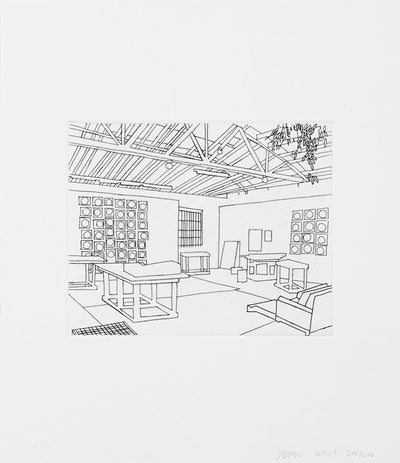
Jonas Wood’s new limited edition print, *Bball Studio* (2019), beautifully captures the nostalgia and creative evolution of his original studio from 2007, where he transformed from a small studio painter into an artist working with a team. This etching, produced by Wood’s own studio and signed in a numbered edition of 200, revisits the original drawing used for the cover of his Contemporary Artist Series book, offering a glimpse into his artistic process with floating basketball motifs. Accompanied by a hardcover monograph and a silkscreened tote bag, the edition supports Creative Growth, a nonprofit aiding artists with disabilities. Wood reflects on how his studio was a dynamic space of work, play, and family life, making this print a true blueprint of his creative journey and personal history.
Read more
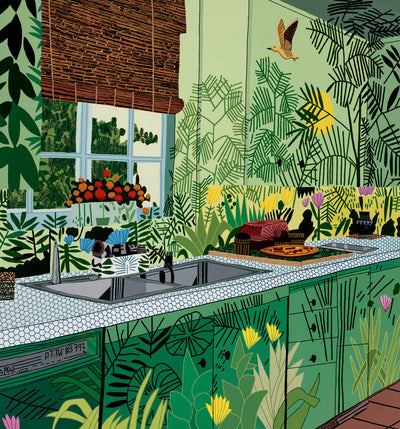
jungle kitchen outdoor cooking area with tropical plants and wooden furniture
Picturing Jonas Wood – Tropical Foliage
Los Angeles painter Jonas Wood’s frequent inclusion of tropical plants in his work reflects a deep connection to Californian modernism, where European Bauhaus influences blend with the region’s sensuous natural environment. As explored by Met curator Ian Alteveer, plants like the philodendron became iconic in mid-century modernist architecture, symbolizing an aesthetic that fused indoor and outdoor living. Wood’s paintings, including his series Clippings, echo this tradition through stylized botanical forms that honor modernist principles of shape and repetition, drawing inspiration from artists like Alexander Calder and David Hockney. Beyond a simple love of horticulture, Wood’s art celebrates the legacy of modernism’s integration of art, life, and environment, making his work a vibrant continuation of this bold, experimental movement.
Read more
resource 006 7 abstract geometric pattern with blue and orange shapes
13 things we learned from Jean-Michel Othoniel’s new interview
Jean-Michel Othoniel, the French sculptor renowned for his intricate and vibrant glass artworks, creates pieces that beautifully balance themes of fragility, transformation, and loss. From his cultural upbringing in the industrial town of Saint-Étienne to his formative years in Paris and eye-opening experiences in New York, Othoniel’s journey is marked by a profound sense of freedom and artistic exploration amid the era’s social upheavals. His unique vision propelled him from intimate gallery pieces to monumental public commissions worldwide, including iconic works like Kiosk of the Nightwalkers in Paris and 114 fountain sculptures in Qatar. Navigating the challenges of the art market and personal solitude, Othoniel remains a singular, innovative artist who encourages others to embrace their uniqueness, viewing solitude not as isolation but as a vital space for creative discovery.
Read more
every morning sunrise over calm lake with reflection of trees and sky
Picturing Jonas Wood – Picasso, Albers and other greats
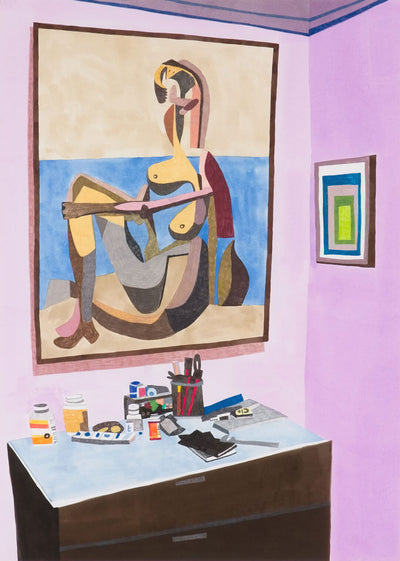
Jonas Wood’s artistic vision is deeply shaped by his family’s rich creative heritage, particularly the impressive art collection amassed by his grandfather, Dr. Israel J. Rosefsky, a paediatrician turned painter and collector of masterpieces by Francis Bacon, Roy Lichtenstein, Picasso, and more. Wood’s work pays heartfelt homage to these influences, seamlessly weaving references to iconic artists like Picasso, Matisse, Warhol, and Albers into his vibrant paintings. Unlike mere appropriation, Wood’s reproductions reveal an intimate, earnest connection to the masters, embodying a genuine respect and affection that fuels his unique style. Through this blend of homage and innovation, Wood invites viewers to rediscover the power and beauty of these celebrated artists, while confidently asserting his own creative voice.
Read more
first flower close-up vibrant petals blooming natural beauty
Childhood in North Korea is a little bit different. . .
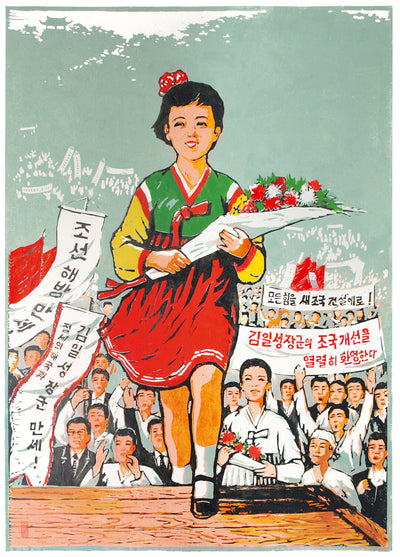
In North Korea, schoolchildren’s report cards and rankings extend beyond academics to shape lifelong social and professional competition, reflecting the country’s rigid ideological system. Nicholas Bonner’s book *Printed in North Korea: The Art of Everyday Life in the DPRK* reveals how student monitors embody socialism’s moral values, and how school trips emulate historical pilgrimages honoring the nation’s leaders. Artworks depicting children at play offer rare glimpses of innocence untouched by state propaganda, highlighting a human side amid strict societal control. Featuring unique prints from the 1950s to today, the collection captures the rich cultural fabric of a largely hidden society through the eyes of its artists, revealing everyday life in a land often seen only through political lenses.
Read more
close-up image of bullets ammunition on dark background
Picturing Jonas Wood - Sports
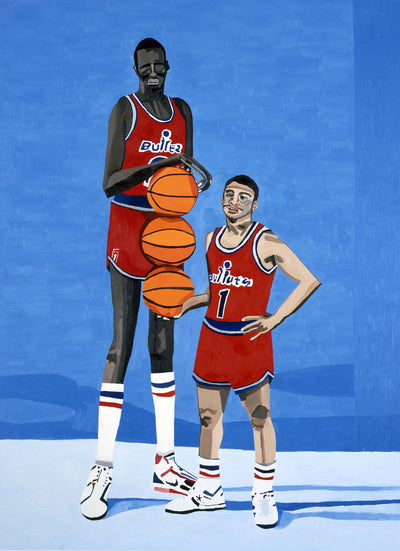
American painter Jonas Wood draws a unique connection between sports and art, channeling his passion for athletes and competition into vibrant, stylized portraits and imagery. Growing up in Boston amid the Celtics' glory days, Wood found in sports a rich source of inspiration, appreciating the discipline, practice, and emotion shared by both athletes and artists. His sharp-lined, colorful works transform familiar sports motifs into a meditation on repetition, everyday life, and dedication. Praised by curators and embraced by major galleries, Wood’s art merges his love for sports with a rigorous artistic practice, creating a captivating dialogue where passion and perseverance intersect.
Read more
128 9 ulim waterfall scenic natural landscape water cascading rocks lush greenery
Landscapes in North Korea are a little bit different...
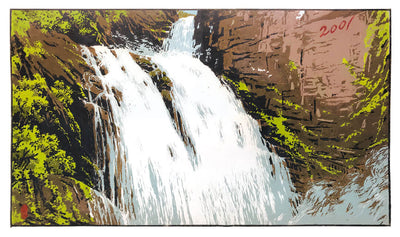
In North Korea, even seemingly serene landscapes are charged with revolutionary significance, reflecting the deep intertwining of art and politics. The new book *Printed in North Korea: The Art of Everyday Life in the DPRK* reveals how nature scenes, while visually appealing, serve as powerful symbols of the nation’s history and leadership, depicting iconic sites like the Chongbong Bivouac where Kim Il Sung’s revolutionary army once camped, or the Ulim Waterfall, transformed into a patriotic emblem by Kim Jung Il’s regime. These artworks, alongside vivid portrayals of everyday workers, offer a rare and fascinating glimpse into the culture shaped by North Korea’s political narrative, showcasing the extraordinary talent of its artists within a tightly controlled social and ideological framework.
Read more
Abstract painting by Jonas Wood featuring vibrant colors and geometric shapes
11 things we learned from Jonas Wood’s new interview
Boston-born, LA-based artist Jonas Wood is renowned for his vibrant, flat paintings that blend influences from family photos, sports imagery, and modern art traditions. In a revealing interview with fellow painter Mark Grotjahn, Wood shares his unapologetic approach to ignoring classical perspective, his respect for artistic forebears like Picasso and Mondrian, and his journey from quitting his job to making a breakthrough solo show in New York. He also discusses the personal significance behind his work, including the influence of his wife’s ceramics and his choice to feature accessible subjects like athletes rather than family portraits. A thoughtful and candid artist, Wood embraces a diverse range of materials and styles to create works that challenge convention while celebrating modernism’s evolving legacy.
Read more
la gran carbonara creamy pasta dish with pancetta and parmesan cheese
How Big Mamma turned up the heat (and with it, the love)
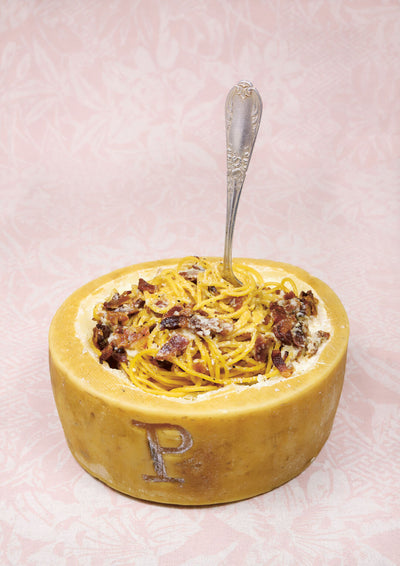
French founders Victor Lugger and Tigrane Seydoux have captured the heart and soul of Italian dining with their Big Mamma group, creating vibrant restaurants across France and Great Britain that channel the warmth and generosity of authentic Italian trattorias. Their debut cookbook, Big Mamma Cucina Popolare, shares the passion behind their culinary journey—offering recipes infused with the flavors of Italy, the joy of togetherness, and the magic ingredient of love. From carefully sourced ingredients and youthful Italian chefs to mouthwatering dishes like Burratelli and Tigramisu, every page invites home cooks to recreate the spectacular yet simple pleasures of Italian cuisine rooted in happy memories and genuine care.
Read more
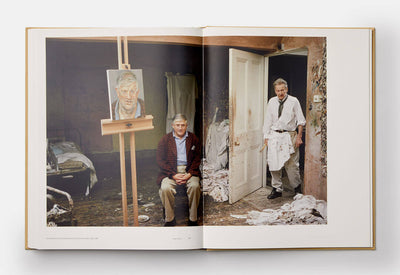
Lucian Freud A Life book cover pages 4 and 5 detailed artwork and text
INTERVIEW: David Dawson on how hard work kept Freud fit
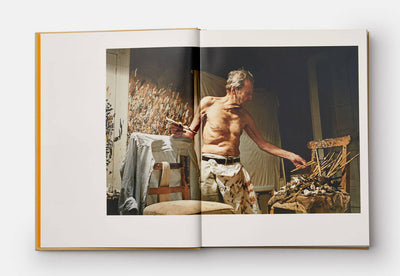
Lucian Freud: A Life offers an intimate portrait of the legendary British painter through rare photographs, family snapshots, and candid moments captured in his final weeks. The book reveals Freud’s relentless dedication to his craft, standing and painting every day, fueled by discipline, fitness, and a sharp mind that shunned distractions like excessive drinking. Through insights from David Dawson, Freud’s assistant and close companion, we glimpse a man who worked seven days a week, blending intense focus with a love of good food and jazz, while pushing the limits of his willpower to sustain a prolific late career. Far from succumbing to age or mortality, Freud remained vibrant and engaged, his art a testament to his passionate, unyielding approach to life and painting.
Read more
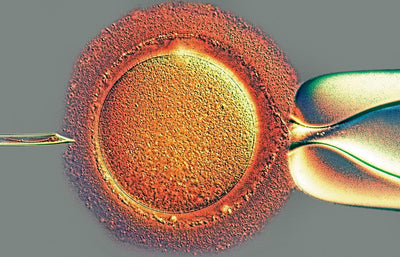
spaceman in a white spacesuit floating in space against a dark starry background
The Art of Anatomy - Lennart Nilsson
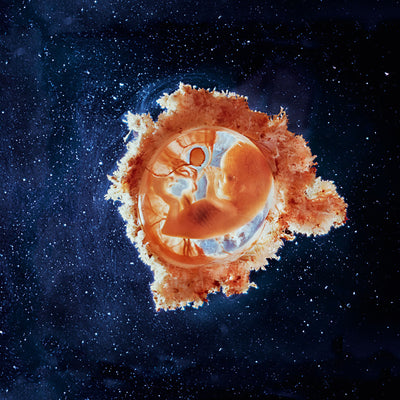
Swedish photographer Lennart Nilsson’s groundbreaking 1965 images of a thirteen-week-old human fetus gave the world an unprecedented, intimate glimpse into life before birth, captivating millions and shaping perspectives on fetal development. While these stunning photographs—some captured during medical procedures, others reportedly taken from miscarried or aborted fetuses—sparked awe and fueled debates, including the anti-abortion movement, they also carry a complex legacy. Nilsson’s pioneering work extended beyond the womb, with his images of viruses and even unborn life sent into deep space aboard the Voyager probes. Explore more remarkable visuals that reveal the human body’s mysteries throughout history in the book Anatomy: Exploring the Human Body.
Read more
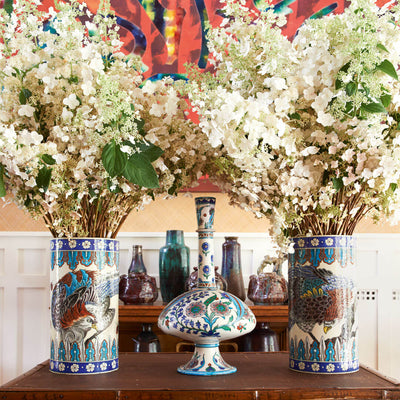
300 deck at Marino wooden outdoor deck with railing and scenic coastal view
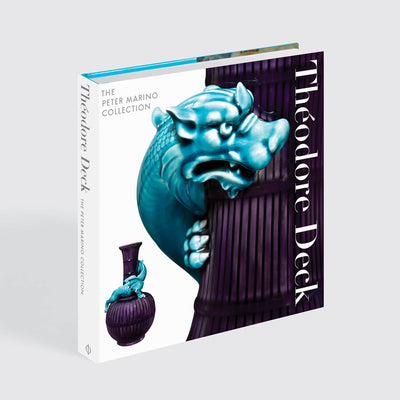
How did Peter Marino discover Théodore Deck?
Architect and collector Peter Marino, renowned for designing exquisite retail spaces for brands like Chanel and Dior, shares the fascinating story behind his passion for French ceramics in Théodore Deck: The Peter Marino Collection. Introduced to these late 19th- and early 20th-century works through a chance friendship with the knowledgeable Alice Stern, Marino fell in love with Deck’s distinctive earthenware, especially the iconic “bleu de Deck” pieces adorned with painted flowers, women, and birds. What began as an overlooked Victorian curiosity blossomed into a treasured collection that highlights the beauty and historical significance of these often underappreciated decorative arts. This book offers an intimate glimpse into Marino’s journey and deep appreciation, enriched with stunning photography and expert insights.
Read more
book cover image featuring ISBN 9780714879925
All you need to know about Théodore Deck
Around 40 years ago, architect and collector Peter Marino discovered a small turquoise vase in Paris that sparked his lifelong passion for the work of 19th-century French ceramicist Théodore Deck. Over four decades, Marino has assembled an extraordinary collection that offers a deep dive into the Belle Époque ceramics movement, hailed as France's most successful decorative art of the 19th century. Deck’s innovative workshop fused traditional techniques with global influences from Japan, China, and the Italian Renaissance, while also embracing a progressive collaboration between artists, chemists, and sculptors to elevate ceramics beyond mere decoration. Recognized internationally in its time, Deck’s work continues to captivate with its ethereal beauty and technical mastery. Marino’s collection will be showcased permanently at his new Peter Marino Art Foundation in New York, and the newly published book *Théodore Deck: The Peter Marino Collection* richly documents this legacy with exquisite photographs and insightful commentary, making it a treasure for collectors, historians, and art lovers alike.
Read more
Lucian Freud a Life book pages 220 221 detailed artwork analysis
INTERVIEW: David Dawson on Lucian Freud's Famous Friends
Lucian Freud: A Life offers a captivating visual biography of the renowned British painter, unveiling his world through intimate words, unpublished photos, and striking portraits. Beginning with childhood snapshots and concluding with rare images from his final studio days, the book explores Freud’s artistic evolution shaped profoundly by close friendships with figures like Francis Bacon and Frank Auerbach. Through candid recollections from his longtime assistant David Dawson, we glimpse how Bacon’s bold approach inspired Freud to transform his style, working with loaded brushstrokes and larger canvases, while his close bond with Auerbach fueled brilliant intellectual and poetic exchanges. This rich portrait celebrates Freud’s legacy as one of the most powerful artists bridging the twentieth and twenty-first centuries.
Read more
sperm approaching egg fertilization process human reproduction biology image
The battle between anatomy, religion and magic
Anatomy: Exploring the Human Body delves into the evolving journey of understanding human anatomy, from ancient battlefield wounds and mystical beliefs to the systematic dissections that challenged long-held dogmas. The article highlights how cultural, religious, and scientific shifts influenced anatomical study, culminating in Renaissance breakthroughs by pioneers like Andreas Vesalius. It traces the progression from visible organs to cellular biology and ponders modern advances such as artificial intelligence and genetic engineering, raising profound questions about the future of human identity and ethics. This rich historical narrative invites readers to appreciate the intricate and sometimes contentious history behind our knowledge of the human form.
Read more
Book cover image featuring ISBN 9780714879888 with a 780-1 label
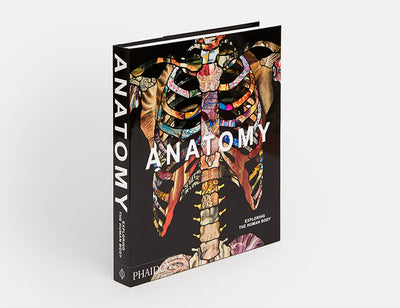
All you need to know about Anatomy
Anatomy: Exploring the Human Body is a captivating visual journey through over 5,000 years of humanity’s fascination with the human form, featuring 300 carefully curated works spanning art, science, and history. This richly illustrated book, part of Phaidon’s acclaimed ‘Explorer’ series, offers a fresh perspective on how we’ve depicted and understood our bodies—from ancient depictions like the Venus of Willendorf and Homeric trauma accounts to Renaissance studies by Michelangelo and modern artworks by Damien Hirst. Blending fine art with medical history and cutting-edge science, it traces the evolving anatomy knowledge shaped by cultures from ancient Alexandria to medieval Europe and beyond. A unique mix of classical imagery, anatomical dissections, and contemporary interpretations invites readers to explore what it truly means to be human in a world increasingly influenced by technology and genetic discoveries.
Read more
Kikito Border decorative pattern in vibrant colors
How JR went global
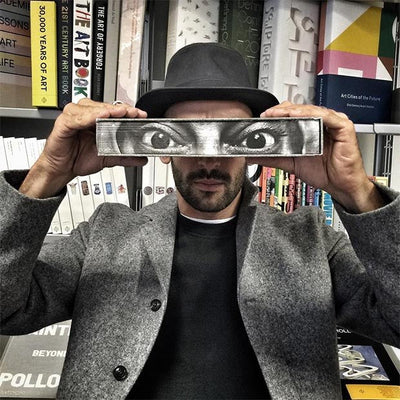
Since winning the TED Prize in 2011, French artist JR has transformed global participatory art through his groundbreaking Inside Out project, which empowers ordinary people worldwide to create and share large-scale black-and-white portraits that amplify diverse social messages. By turning the camera over to communities—from protestors to immigrant laborers—JR has sparked a powerful international network, enabling local voices to reach global audiences while fostering solidarity and visibility around issues like police violence, gun rights, and inequality. His use of expressive portraits, photobooth trucks, and mass collaboration transcends traditional gallery spaces, harnessing the universal language of imagery to inspire change and connect humanity on a profound level.
Read more
Book cover image for resource with ISBN 9780714879444 featuring FBcat design
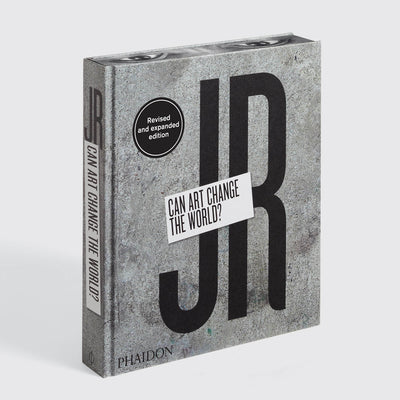
All you need to know about JR: Can Art Change the World? (Revised and Expanded Edition)
French artist JR uses large-scale public portraits to spotlight social issues around the world, from immigration and gun control in the US to life in impoverished neighborhoods across Paris, Rio, and Kenya. His empathetic approach gives voice to diverse perspectives without imposing his own, encouraging real conversations through powerful, relatable imagery. Highlighted in the comprehensive new monograph JR: Can Art Change the World?, his projects blend art and activism, transforming communities and provoking reflection. From acclaimed collaborations with cultural icons to intimate portraits of everyday heroes, JR’s work demonstrates how creativity can inspire social change and foster human connection.
Read more
book cover image of 9780714878775 with fbcat branding
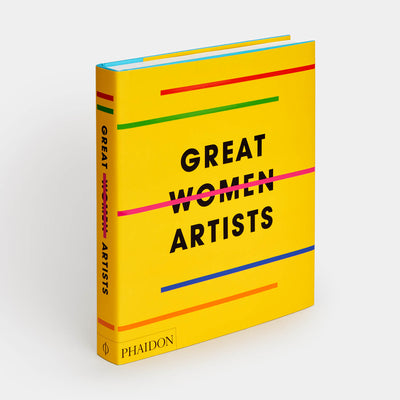
All you need to know about Great Women Artists
Great Women Artists is a groundbreaking, fully illustrated book celebrating over 400 female artists spanning 500 years, from Renaissance trailblazers like Properzia de’ Rossi to contemporary stars like Tschabalala Self. Organized alphabetically, it uncovers forgotten and celebrated women who shaped art history—from pioneers like Artemisia Gentileschi to cultural icons such as Marisol and Alma Thomas—and highlights their lasting impact through vivid imagery and engaging stories. This volume challenges the male-dominated art narrative, reflecting a richer, more diverse evolution of art and inviting readers to discover and champion talented women artists until they receive the recognition they deserve on equal footing with their male counterparts.
Read more
front cover of the book with ISBN 9781838660147 featuring a colorful abstract design
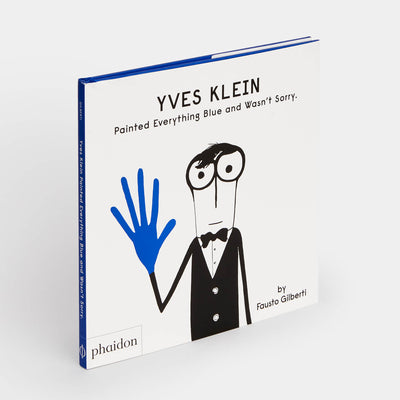
All you need to know about Yves Klein Painted Everything Blue and Wasn’t Sorry
Fausto Gilberti’s charming new book, *Yves Klein Painted Everything Blue and Wasn’t Sorry*, offers a clever and quirky biography of the iconic modern artist crafted especially for children. Inspired by his own experiences introducing his young kids to contemporary art, Gilberti uses his distinctive minimal, stickman-like illustrations—reminiscent of Jean Dubuffet and Keith Haring—to bring to life the wild stories and eccentric creations of Klein. The book delivers a witty and lively narrative paired with bold blue splashes that perfectly capture Klein’s irreverent spirit, making the complex world of modern art accessible and engaging for gallery-going families, curious kids, and readers of all ages eager to explore the life of one of France’s most celebrated 20th-century artists.
Read more
2019 JR Chronicles Chronicles of NYC signature image high resolution 3000w 600x510 pixels
JR features one thousand New Yorkers in his epic new work
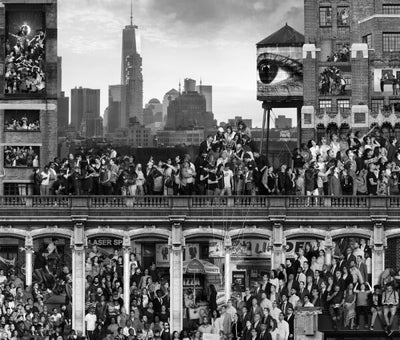
Since 2017, JR has created monumental participatory murals called Chronicles, inspired by Diego Rivera, that blend hundreds of portraits into powerful narratives addressing cities and social issues. His works have spotlighted places like San Francisco and Paris and tackled topics such as gun ownership, famously featured in Time’s 2018 cover. In his largest solo exhibition, JR unveils The Chronicles of New York City at the Brooklyn Museum, a mural showcasing over a thousand New Yorkers alongside interactive recordings sharing their stories. Running from October 2019 to May 2020, the exhibition includes a rich array of photographs, videos, dioramas, and archival works, marking JR’s first major North American show and celebrating his profound belief in the transformative power of art.
Read more
passport photo example showing front-facing headshot with neutral background and proper lighting
Eight sides of Andy
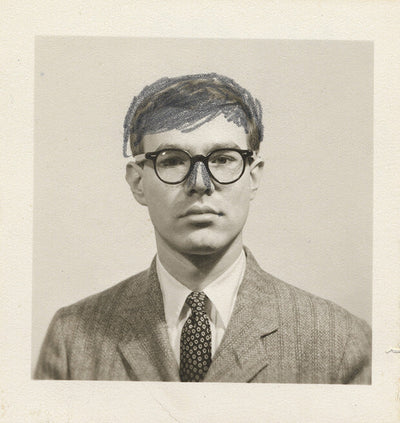
Andy Warhol, a multifaceted artist renowned for his repetitive yet transformative approach, led a life rich with diverse roles and personas. From his early success as an illustrator using his innovative blotted-line technique, to shaping Pop art with his keen eye on 1960s commercial signage, Warhol continuously redefined art and communication. Though famously shy in public, he skillfully conveyed complex ideas and created a universal network of influence, while also dabbling in window displays and filmmaking—his groundbreaking film *Sleep* challenging art and cinema alike. As a socialite and starmaker, he nurtured brief yet iconic relationships, like with Edie Sedgwick, and transformed with fame, adopting the enigmatic persona of “Drella.” Despite the spotlight, Warhol often saw himself as merely the host at his Factory gatherings, where the eclectic crowd gathered to see one another more than the man himself. This exploration celebrates eight compelling facets of Warhol’s extraordinary life and legacy.
Read more
High-resolution image of Trevor Paglen artwork from 2017 showing abstract geometric patterns and satellite imagery elements
'Don’t shoot!' Trevor Paglen's impassioned plea to the NSA
Trevor Paglen’s art powerfully captures the essence of our contemporary moment by unveiling hidden landscapes shaped by surveillance and secrecy. After realizing that only an outdated image of the National Security Agency’s Fort Meade headquarters existed publicly, Paglen legally took to the skies in a helicopter to document the building as it stands today—despite the NSA’s attempts to obscure it during his flight. The resulting photograph reveals the NSA not as a menacing fortress but as an ordinary, almost mall-like institution, inviting us to reconsider how we perceive and hold accountable such powerful entities embedded in our daily lives. Through his work, Paglen challenges us to see beyond the surface and engage critically with the invisible systems that shape our world.
Read more
Harland Miller artwork cover image resource 004-5
Phaidon Introductions: Michael Bracewell on Harland Miller
Harland Miller’s art captivates with its witty, deadpan titles resembling Penguin paperback covers, but as critic Michael Bracewell reveals, these clever texts are just the starting point of a profound artistic journey. Miller’s works blend literary humor with deep formal exploration, using layered brushstrokes, stains, and abstract expressionist techniques to transform simple book covers into emotional, brooding meditations on painting itself. His large-scale canvases evoke bleak British seaside melancholy while engaging with American artistic traditions like Abstract Expressionism and Pop art, creating a unique mix of irony, nostalgia, and painterly intensity. Through these deceptively straightforward images, Miller invites viewers to look beyond words and appreciate the tactile, psychological complexity of paint as a medium, marrying cultural commentary with a rich visual language that both challenges and delights.
Read more
Haring artwork abstract colorful painting
Remembering Keith Haring
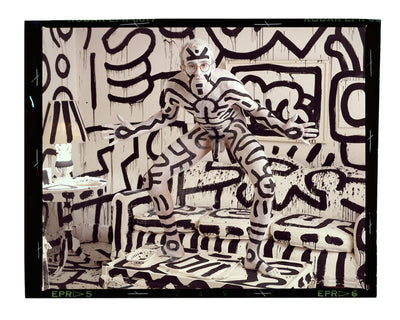
In 1986, Annie Leibovitz captured iconic images of Keith Haring, who was then a vibrant figure in New York’s art and club scenes, blending his pop star charisma with bold, public art. Inspired by an Andy Warhol commission, Haring painted his torso and parts of his body in striking black lines for the shoot, embracing a raw, fearless expression that mirrored the city's gritty energy. The permissive spirit of New York in the 1980s nurtured Haring’s work, allowing him to transform public spaces and challenge norms, from subway art to the intimate, celebratory mural he created for a gay community center to mark the anniversary of the Stonewall riots. This blend of audacity, creativity, and cultural commentary defines Haring’s legacy, reflecting a time when art, identity, and urban life intertwined freely.
Read more
331 rr in studio professional photography session with lighting equipment and backdrop
What made Robert Ryman unique
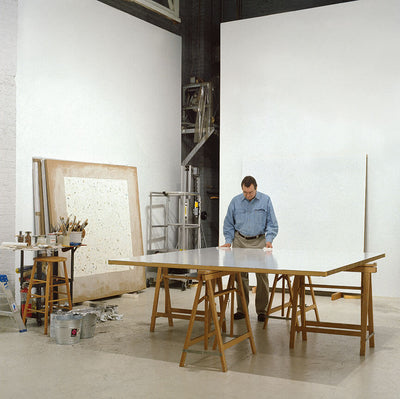
Robert Ryman, celebrated minimalist painter known for his profound exploration of paint’s presence and texture, redefined how we perceive art through his focus on the ‘how’ rather than the ‘what’ of painting. Rooted in a deep connection to jazz improvisation and enriched by years studying masterpieces at the Museum of Modern Art, Ryman’s work challenges notions of minimalism by blending ascetic restraint with inventive experimentation. Eschewing emotional struggle in favor of intuitive practice, he likened painting to typing—an act guided by feeling rather than conscious thought. His seemingly simple white-on-white canvases reveal an intricate dialogue with paint itself, inviting viewers to experience the material as rich and charged, making each encounter unique and endlessly compelling.
Read more
Bertoia wire chair side view modern mid-century design
The life that shaped Harry Bertoia’s art
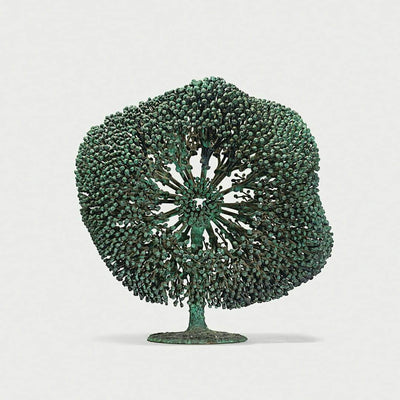
Harry Bertoia, best known for his iconic 1952 Diamond chair, was a pioneering artist and metalworker whose innovative use of wire and metal transformed both design and sculpture. Born in northern Italy and emigrating to the U.S. at 15, Bertoia combined his admiration for traditional metalwork with the modernist idealism of improving life through design. Working at Knoll in the early 1950s, he embraced wire out of necessity, creating structurally strong yet elegant pieces that extended into his renowned wire sculptures. Later, living in rural Pennsylvania inspired larger nature-themed works in bronze and copper, including stunning dandelion sculptures commissioned for the 1964 New York World’s Fair. Full of warmth, humor, and relentless creativity, Bertoia’s legacy bridges art and everyday life, showcasing how vision and resourcefulness can elevate simple materials into timeless beauty.
Read more
332 333 ice watch close-up on wrist modern design black and silver colors
Olafur Eliasson's Ice Watch is headed for London
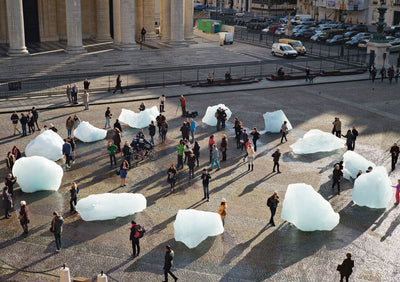
Olafur Eliasson’s evocative installation Ice Watch brings the urgent reality of climate change into public spaces by presenting massive glacial ice blocks harvested near Greenland in a striking clock formation. Since its debut in Copenhagen in 2014, coinciding with a major UN climate report, the work has traveled to Paris and now London, where the melting ice on display invites viewers to connect physically and emotionally with the planet’s rapidly changing environment. Collaborating with scientists and philanthropists, Eliasson encourages people to engage deeply—touching, listening to, and reflecting on the ice—to overcome feelings of distance and apathy, fostering a sense of immediacy and shared responsibility for our ecological future.
Read more
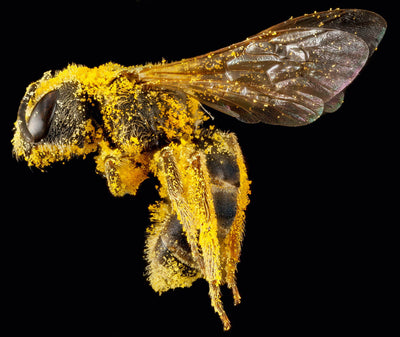
bee inventory chart showing different types of bees and their roles in the hive
WSJ's Alexandra Wolfe is an Animal lover!
The Wall Street Journal’s arts section recently celebrated the captivating world of animals through a review of the new book *Animal: Exploring the Zoological World*. Alexandra Wolfe highlights humanity’s enduring fascination with animal imagery, from ancient cave paintings to modern 3D prints, showcasing 300 diverse artworks that capture the beauty and mystery of wildlife. The review particularly praises Sir Edwin Landseer’s iconic *Monarch of the Glen* alongside contemporary pieces like the US Geological Survey’s detailed pollen-covered sweat bee. Victoria Clarke, the book’s editor, reflects on how art allows us to marvel at creatures we can never fully understand, inviting readers to explore the enchanting zoological realm within the pages of this stunning collection.
Read more
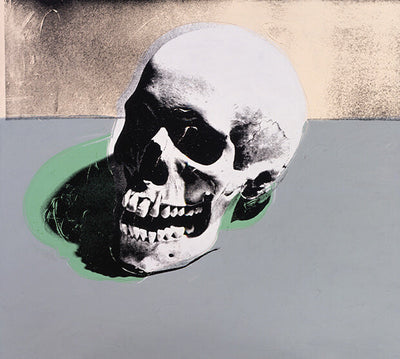
Dali Warhol Skull artwork 1976 surrealism pop art fusion colorful skull painting
For Halloween, the story behind Warhol's 'classic still life'
In 1975, Andy Warhol’s fascination with mortality took a striking form when he incorporated a human skull—purchased in Paris—into his art, transforming a classic symbol of death into an emblematic portrait for all. This macabre yet playful motif evolved into his acclaimed Skulls series of the late 1970s, spanning collages, prints, paintings, and drawings. Unlike his iconic Campbell’s Soup cans, these skulls echoed traditional still-life while hinting at deeper themes of existential reflection, political symbolism, and cultural anxieties like punk rock and the AIDS crisis. Warhol’s repeated use of the skull shifted its chilling associations into an enigmatic experience, blending cold concept with unsettling allure. This haunting yet captivating chapter of his work is explored in detail in The Andy Warhol Catalogue Raisonné, Paintings 1976-1978 - Volume 5.
Read more
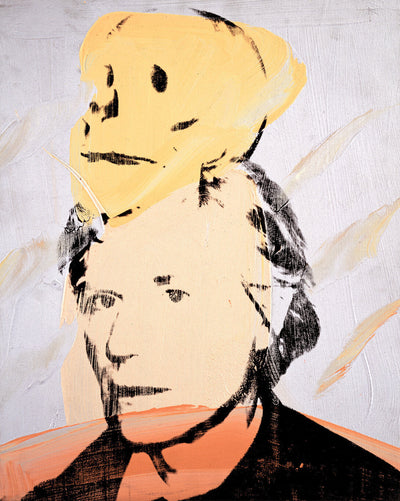
Self portrait with skull artistic photograph dark background dramatic lighting
'A walking Gallup poll' - the social side of Andy Warhol’s incredible creativity according to Arnold Lehman of Phillips
Andy Warhol, often dismissive of his own creativity, claimed his portraits were just faces without real ideas, yet his inventive work from 1976-1978 reveals a rich artistic vision, as highlighted in the new volume of The Andy Warhol Catalogue Raisonné. Scholars continue to debate his originality, with some describing him as a “walking Gallup poll” who absorbed public ideas and transformed them into his distinctive style. Influential voices like Whitney Museum curator Donna De Salvo and Warhol’s close collaborator Vincent Fremont emphasize how Warhol skillfully blended external influences with his unique sensibility, crafting art that was both culturally resonant and unmistakably “Andy.” This complex interplay between perception and innovation underscores Warhol’s genius, making his later works an essential study in the evolution of contemporary art.
Read more
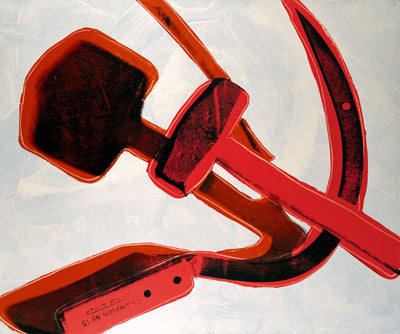
red hammer and sickle symbol on a white background vintage communist emblem
'He saw hammers and sickles when he went to Italy in the 70s' - Factory studio boss Vincent Fremont on Andy Warhol
Andy Warhol uniquely captured the zeitgeist of his era by incorporating culturally charged symbols into his art, often drawing from commercial imagery as well as politically potent icons like the hammer and sickle. Inspired by his experiences in 1970s Italy during a turbulent period of political unrest, Warhol transformed these communist symbols into powerful artworks, including his striking Skull series, which referenced fascist imagery. Despite initial resistance from the Italian art scene due to the contentious nature of these pieces, exhibitions like the 1976 show at Leo Castelli in New York demonstrated their lasting impact. Today, these works continue to resonate, showcasing Warhol’s fearless engagement with political and cultural themes that remain provocative and relevant.
Read more
Portrait of Thilo Frank in OE style
‘I grew up surrounded by art that embraced abstraction, mythology and allowed space for imagination' - Olafur Eliasson on landscape, Experience and the art his father made
Olafur Eliasson’s artistic journey is deeply rooted in his family’s creative legacy and the landscapes of Iceland and Denmark where he grew up. Influenced by his father’s mythological, narrative-driven art and later inspired by the Light and Space movement artists, Eliasson developed a unique relationship with nature that transcends conventional depictions. His works, from the photographic Waterfalls Series to the immersive 2014 Riverbed installation, highlight an experiential approach to the environment, emphasizing the emotional and practical experience of place rather than grand, sublime moments. Eliasson invites us to engage with nature’s nuances, where every step of a journey holds meaning, reflecting his view that no moment in the landscape deserves to be privileged over another.
Read more
006 7 wt self portrait artwork image
Sex, cigarettes and spongey bread - the things Wolfgang Tillmans loved about London in the Eighties
Wolfgang Tillmans’ early encounters with Britain in the 1980s—marked by its quirky cooked breakfasts, spongy bread, and a subtly charged sexual atmosphere—set the stage for a lifelong passion for bold self-expression and vibrant urban culture. As detailed in a recent New Yorker profile, Tillmans’ teenage years were a mix of English classes, playful transformations in Victoria Station bathrooms, and brief forays into iconic gay nightclubs, painting a picture of youthful daring against the backdrop of small-town German life. Friends from his hometown recall the magnetic “go-for-it” spirit that fueled his adventures and artistic journey, a mindset that continues to illuminate his work decades later.
Read more

portrait of a woman named Kerry smiling outdoors with natural light
'This is probably the first instance in the art world where a black person took part in a capital competition and won'
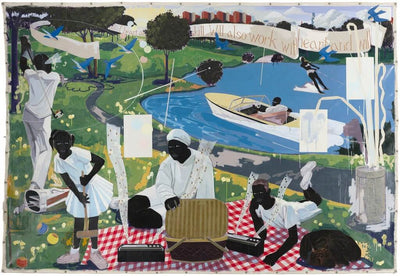
Kerry James Marshall recently reflected on rapper Sean Combs’ landmark $21.1 million purchase of his painting *Past Times*, highlighting its historic significance as a moment where a Black individual won a major art market competition. Speaking ahead of his *Collected Works* exhibition in Vancouver, Marshall emphasized the growing presence and influence of African American collectors, while reminding us of the deep-rooted challenges Black people have faced in accessing wealth and art ownership throughout history. The Vancouver show features over three decades of Marshall’s powerful sculptures, drawings, and paintings, showcasing why he holds the auction record for the highest price paid for a living African American artist.
Read more
close-up of ebony wooden gate with intricate carvings and metal hinges
Why Theaster Gates believes black magazines matter
US artist Theaster Gates, known for transforming neglected buildings into cultural hubs, is set to revive the legacy of the Johnson Publishing Company this summer at the Stony Island Arts Bank in Chicago. The exhibition, "A Johnson Publishing Story," running from June 28 to September 39, showcases paintings, sculptures, mid-century furnishings, and archival materials from the iconic African-American owned publisher of Ebony and Jet magazines. By recreating spaces like "The Johnson" lounge and displaying works inspired by the archive, Gates highlights the profound impact Johnson Publishing had on African-American representation and emphasizes the importance of preserving these vital stories and cultural artifacts for future generations.
Read more
vintage pastimes collage featuring classic hobbies and leisure activities
The poignant truth behind Kerry James Marshall's new $21 million Sotheby's auction record
A striking $25,000 painting by Chicago artist Kerry James Marshall recently sold at Sotheby’s New York for an astounding $21.1 million, reflecting both the meteoric rise of the artist and the cultural significance of his work. Known for placing black figures at the heart of grand, epic narrative paintings, Marshall’s 1997 piece from his Garden Project series defies traditional art historical norms by portraying black people engaging in leisure activities typically linked to white upper-class identity, such as golf and water-skiing. Measuring an impressive 290 x 396 cm, the painting challenges and redefines the often exclusionary representation found in museums, offering a powerful corrective that reclaims space for black subjects in world-class art. More than a record-breaking auction result, Marshall’s work is a forceful statement in the ongoing movement for justice within the art world.
Read more
JR Lead logo with abstract design in blue and white colors
JR is on TIME Magazine's 100 most influential list
TIME magazine's annual TIME 100 List sparks debate every year, but some inclusions are undeniably deserving, like French artist and activist JR. Celebrated for his powerful public art that bridges cultural divides, JR transforms communities through giant photographs that create meaningful encounters worldwide. Notable projects include his Oscar-nominated documentary *Faces Places* and a poignant installation on the U.S.-Mexico border that humanizes immigration issues. Partnering with Laurene Powell Jobs on the Inside Out/Dreamers project, JR has empowered communities to advocate for social change through compelling visual storytelling. His work challenges perceptions and fosters connections that resonate far beyond the art itself.
Read more
Narcissus Dali surreal artwork with melting clocks and distorted reflections
How Caravaggio, Freud and Dalí saw Narcissus
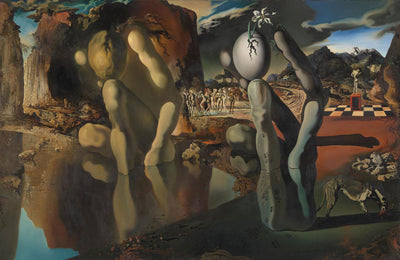
Narcissus, the beautiful youth from Greek mythology who fell entranced by his own reflection, has inspired artists across centuries to explore themes of vanity and self-obsession. Caravaggio’s hauntingly realistic painting captures the tragic cycle of Narcissus’s self-love, while Lucien Freud’s 20th-century depiction emphasizes the intense gaze of the self-absorbed figure, offering a modern psychological depth. Salvador Dalí’s surreal 1937 masterpiece weaves multiple moments of the myth into one canvas, using striking visual illusions to tell the full story of Narcissus’s transformation and the sorrow of his rejected lovers. These diverse interpretations reveal the timeless allure of Narcissus’s tale and its enduring presence in art, as explored in the new book *Flying Too Close to the Sun: Myths in Art from Classical to Contemporary*.
Read more
Mark Bradford contemporary abstract mixed media artwork vibrant colors textured layers
Mark Bradford’s tribute to Jack Whitten
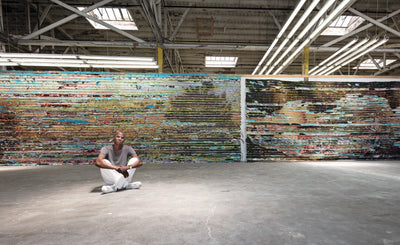
The late Jack Whitten created powerful abstract works that conveyed profound social narratives rooted in his experience as an African-American artist from the segregated South. His later pieces, predominantly black and silver, evoke landscapes of destruction and rebirth, blending past and future. Whitten’s legacy resonates strongly with fellow abstract artist Mark Bradford, whose sprawling, collage-like works reflect urban flux and creative destruction. Bradford’s latest exhibition at Hauser & Wirth in Los Angeles features vibrant new pieces layered with printed materials pulled from the city’s streets, some with playful comic book-inspired titles. Among them, "Moody Blues For Jack Whitten" stands out as an homage to his friend, capturing rhythmic blue tones initiated before Whitten’s passing. Bradford admires Whitten’s dedication to the craft and his role as a pioneering African-American abstract painter, embodying a lineage of deeply engaged and process-driven artistry.
Read more
Wolfgang Tillmans abstract photographic artwork with vibrant colors and dynamic composition
Why alien life made Wolfgang Tillmans rethink politics
Wolfgang Tillmans, the acclaimed photographer and political activist, once hoped that discovering Earth-like planets and potential extraterrestrial life would challenge religious views and usher in a new era of humility, much like Copernicus's revolution. However, despite advancements in space exploration, faith communities remained unchanged, prompting Tillmans to explore the roots of political polarization and the appeal of right-wing movements like Trump and Brexit. Drawing on insights from cognitive science and philosophy, he highlights how emotions such as disgust fuel ideological divides, while voices like Carolin Emcke suggest that irony, ambivalence, and playfulness might be the best tools to counter fanaticism and protect open democracy. Ultimately, Tillmans invites us to engage with serious issues not just with conviction, but with joy and creativity.
Read more
Mark Bradford Helter Skelter abstract mixed media artwork on canvas
John McEnroe's $9m Mark Bradford map
LA artist Mark Bradford creates massive, fraying cartographical works that explore urban disintegration and race dynamics, using maps not as tools of idealized order but as testimonies to social breakdown. His 10-meter-long piece Helter Skelter I (2007), composed of found street materials and named after the Beatles song linked to the infamous Charles Manson cult, powerfully evokes a divided city fraught with tension. Now owned by tennis legend and collector John McEnroe, this striking black-and-white work is set to headline Phillips' upcoming auction in London with a record estimate of £6-8 million, reflecting both its cultural significance and monumental scale. As McEnroe notes, such a piece truly belongs in a museum where its profound message can be widely appreciated.
Read more
Maggies Centre Steven Holl architectural design exterior view
Steven Holl unveils his light-filled Maggie’s Centre for London
Founded in 1995 by the late Maggie Jencks, Maggie’s Centres offer vital support for people with cancer through thoughtfully designed spaces that contrast the clinical feel of hospitals. Steven Holl’s latest Maggie’s Centre at St Bart’s Hospital in London exemplifies this mission with its serene architecture, inspired by medieval musical notation symbolizing a “breath of life.” Constructed from concrete, bamboo, and matte glass, the luminous three-story building features a kitchen, counseling rooms, a library, and a rooftop garden, all united by Holl’s masterful use of colored light that shifts with the time of day, creating an uplifting, joyful sanctuary for visitors and staff alike.
Read more
Chipping Norton town view with historic buildings and blue sky
John Pawson's World of Colour: Blue
John Pawson, the renowned British architect and designer, extends his minimalist vision beyond buildings to photography, capturing everyday scenes with a careful, understated elegance. His new book, Spectrum, showcases a diverse collection of images arranged by color—from serene mediterranean landscapes to humble textures like worn brick walls and weathered clapboards. Rather than spotlighting grand vistas, Pawson’s photos invite viewers to appreciate quiet beauty and subtle details, reflecting his belief that “God is in the details.” Spectrum offers a serene, thoughtfully curated journey through the colors and forms that define Pawson’s unique artistic perspective.
Read more
Jenny Holzer AIDS Memorial artwork installation
Jenny Holzer talks about her NYC AIDS Memorial
Jenny Holzer, renowned for her powerful use of language in public art, has created a poignant AIDS memorial in New York City’s Greenwich Village, near the historic site of St. Vincent’s Hospital, a focal point of the city’s AIDS epidemic. The memorial features engraved granite pavers with selections from Walt Whitman’s “Song of Myself,” celebrating life, the human body, and unity beyond death—an inspired choice reflecting the spirit and resilience of the LGBT community most affected by the epidemic. Holzer, who no longer uses her own words in her art, collaborated with poets to adapt Whitman’s text for this heartfelt tribute. As part of a modern approach, she is also developing an app to augment the memorial, allowing users to engage with memories and poetry digitally. Addressing the ongoing challenges of AIDS and contemporary cultural conflicts, Holzer underscores the enduring need for compassion, openness, and remembrance in the face of this continuing epidemic.
Read more
John Currin painting Thanksgiving portrait woman seated at table with turkey and autumn decorations
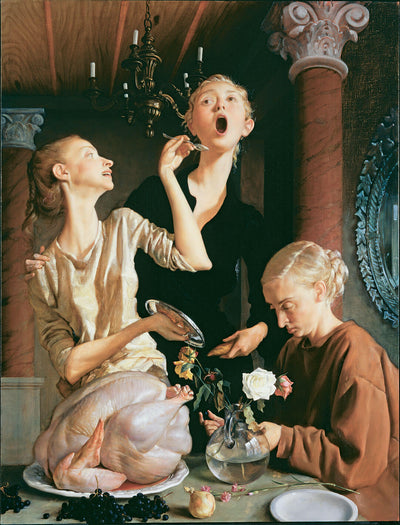
Decoding John Currin’s spooky Thanksgiving
John Currin, a figurative painter known for his stylized approach, often blurs the line between reality and imagination, as seen in his 2003 work Thanksgiving, which was modeled by his wife, artist Rachel Feinstein. Embracing the High Renaissance mannerist style, Currin distorts proportions to create a hauntingly beautiful but unsettling scene, where the figures appear fragile, the flowers wilted, and the turkey eerily pale. The painting reflects both life and death, resonating with Currin's experience as an expectant father, while also echoing the complexity found in Ludovico Carracci’s Baroque masterpiece The Lamentation, which Currin admires for its blend of realistic and stylized elements. This duality enriches Currin’s art, capturing a mysterious presence that feels both alive and otherworldly.
Read more
Untitled artwork created in 1962 abstract composition with bold colors and geometric shapes
Why you must not call Robert Ryman’s paintings ‘pictures’
Art historian Vittorio Colaizzi sheds light on the distinctive nature of Robert Ryman’s work, emphasizing that Ryman’s pieces transcend conventional ideas of paintings or pictures. Rather than focusing on representational masterpieces, Ryman’s art is about the materiality and experience of painting itself, inviting viewers to engage with each work as a dynamic encounter. Colaizzi highlights the importance of proper display conditions—ample space and natural light—to truly appreciate Ryman’s minimalist, elemental approach, with notable collections at Dia:Beacon, the Pennsylvania Academy of Fine Arts, and the National Gallery of Art. Embracing Ryman’s philosophy that it’s “not the what, the how,” these works continue to resonate, carrying forward the legacy of 20th-century abstraction into the present.
Read more
Versions IV album cover 1992 artwork image
Don't get Robert Ryman? Try viewing his work as sculptures!
Robert Ryman, renowned for his abstract paintings rendered almost entirely in white, challenges conventional expectations of art by focusing on the materiality and process of painting rather than imagery. Art historian Vittorio Colaizzi highlights that Ryman’s work invites viewers to experience painting akin to sculpture—appreciating texture, form, and the physical space it occupies—rather than searching for narrative or elaborate visuals. Ryman redefines painting as a performative act, emphasizing the unique application of paint that creates a tangible, continuous space linked to our own. This approach not only questions traditional abstract notions but also underscores Ryman’s continued relevance in contemporary art, as he crafts striking images through pure process and material exploration.
Read more
Portrait of John Currin painted in a contemporary style with detailed facial features and expressive brushwork
The Artist Project: John Currin on Ludovico Carracci
Contemporary painter John Currin offers a fresh perspective on Ludovico Carracci’s The Lamentation, seeing in it a compelling blend of mannerist stylization and naturalistic detail that transcends traditional religious interpretation. Raised outside the church, Currin approaches the piece as both an artistic and spiritual exploration, appreciating how Carracci’s intentional tensions between realism and stylization create a paradoxical presence that feels both alive and lifeless, much like the figure of Christ himself. This interplay between the real and surreal, the deep and flat, reveals an enduring magic in painting—a dynamic struggle captured centuries ago that continues to resonate in modern art.
Read more
katzbykatz logo or brand image
Alex Katz - 'I never had any self-confidence until I was 30'
Renowned artist Alex Katz reflects on his enduring journey from a determined art student sketching subway commuters in 1940s New York to a celebrated painter known for his bold, muscular style and signature clarity of line. Katz shares insights into his meticulous creative process, balancing large brush strokes with carefully premixed colors, and his knack for capturing powerful, image-driven paintings that hold their own in the art world. Remembering his time at Cooper Union amid jazz-filled nights and a fierce drive to excel despite self-doubt, Katz reveals how those formative years shaped his unique approach, setting him apart from the modernist trends of his era. With candid reflections on both his masterpieces and near misses, plus admiration for fellow artists like Marlene Dumas, Katz’s story is a vibrant testament to passion, persistence, and artistic evolution, celebrated in a current exhibition at Timothy Taylor in London.
Read more
Clare Twomey portrait artist ceramic sculptor close-up image
Clare Twomey - Why I Create
Clare Twomey reveals clay as a profoundly human material, rich with history and social significance, that continues to inspire contemporary art through its tactile, democratic nature. Embracing clay’s potential for transformation, Twomey explores themes of exchange, memory, and vulnerability in her large-scale works, challenging traditional distinctions between fine art and craft. Celebrating luminaries like Picasso and Wedgwood, she highlights how clay bridges communal experience and individual expression. Twomey’s upcoming project at Tate Modern invites audiences to engage directly with the material, reflecting the growing resurgence of ceramics as a dynamic medium in today’s art world.
Read more
Mark Bradford portrait McCarther Foundation event
Why Mark Bradford thinks the Robert E Lee statue should stay
Los Angeles artist Mark Bradford offers a nuanced perspective on the controversial Robert E. Lee statue in Charlottesville, Virginia. While Bradford, an African American and advocate for Black rights, understands the statue’s troubling racial symbolism, he does not fully support its removal unless accompanied by educational context. He emphasizes the importance of confronting the full history behind such monuments rather than hastily erasing them, urging that empty spaces left by removal should be thoughtfully contextualized. Bradford’s approach invites a deeper conversation about history, memory, and how public art reflects societal values, urging a careful balance between acknowledging past injustices and fostering informed understanding.
Read more
Nauman Fountain water feature with cascading water and modern design in outdoor garden setting
5 key points for the Tate’s new Bruce Nauman show
Bruce Nauman is a challenging and enigmatic artist whose neon works draw parallels between art and commercial signage, evoking a raw, brassy aesthetic rooted in everyday urban life. His pieces like "Violins Violence Silence" blend poetic language with stark contrasts, reflecting his existential view of humanity. Nauman’s videos, such as "Violent Incident," confront themes of violence and gender with unsettling symmetry, refusing to trivialize serious issues. Influences from figures like Henry Moore and Man Ray surface in his sculptures, linking contemporary and historical art dialogues. His video works, including "Good Boy Bad Boy," are designed as ongoing experiences rather than finite narratives, inviting viewers to engage on their own terms—making Nauman’s art a persistent, provocative presence that challenges and captivates.
Read more
red kapoor vintage black and white portrait classic Bollywood actor
Anish Kapoor dyes this earth red in memory of refugees
Argentina’s Parque de la Memoria in Buenos Aires, originally created to honor victims of the Dirty War, now hosts a powerful solo exhibition by British artist Anish Kapoor titled Destierro, or "exile." Departing from the park’s historical focus on state violence, Kapoor’s installation uses vivid red earth and a striking blue digger to evoke the harsh realities of displacement and neglect faced by refugees worldwide. Through this evocative display, Kapoor highlights the new, invisible borders that divide those with a place to call home from those without, offering a moving reflection on exile and the human cost of conflict.
Read more
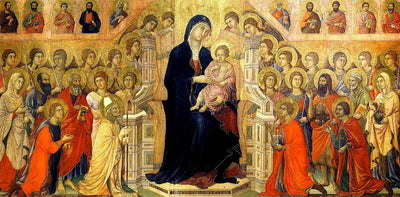
Duccio Maestà panel from 1308 depicting the Virgin Mary and Christ Child surrounded by saints and angels in medieval Italian art style
The altarpiece that helped art break away from the church
The unveiling of Duccio’s Maestà Altarpiece in 1311 Siena was a momentous civic and religious occasion, marked by a grand procession and communal reverence that blurred the lines between art and devotion. This double-sided altarpiece, with its serene Madonna and Child on one side and vivid scenes from Christ’s life on the other, heralded a shift in Italian art from Byzantine rigidity to the expressive, narrative-driven approach of the early Renaissance. Duccio, alongside pioneers like Cimabue and Giotto, began imbuing sacred stories with human emotion, realistic settings, and dynamic interactions, setting the stage for the profound artistic revolutions later epitomized by Leonardo, Michelangelo, and Raphael. Through his lyrical storytelling and attention to both landscape and feeling, Duccio’s work remains a pivotal bridge from medieval tradition to the flourishing humanism of Renaissance art.
Read more
cr freeze opening close-up industrial equipment machinery maintenance
A Movement in a Moment: Young British Artists
Britain’s groundbreaking 20th century art movement, the Young British Artists (YBAs), was ignited not by manifesto but by the slick, entrepreneurial 1988 exhibition “Freeze,” curated by then-student Damien Hirst. This seminal show, staged in a vacant London Docklands building, brought together innovative art graduates from Goldsmiths College, showcasing a bold, conceptual style that captured the spirit of the Thatcher era's self-driven ambition. Backed by influential figures like collector Charles Saatchi and guided by art mentors such as Michael Craig-Martin, the YBAs quickly moved from guerrilla exhibitions to major commercial success, culminating in high-profile shows like Saatchi’s 1997 “Sensation” at the Royal Academy. Though decades have passed, the vibrant energy and entrepreneurial spirit sparked by “Freeze” continue to influence London’s art scene, inspiring new generations despite rising costs and changing times.
Read more
gropiusleadii plant close-up green leaves natural habitat
How Walter Gropius made the modern age
Born in an era of upheaval, Walter Gropius revolutionized art and architecture by founding the Bauhaus in 1919—a school that fused fine arts and crafts into a modern interdisciplinary approach. Embracing innovation and functionality, the Bauhaus nurtured legendary masters like Kandinsky and Klee, emphasizing bold experimentation coupled with purposeful design. Though it closed under Nazi oppression, its legacy endures worldwide in everything from sleek furniture to iconic buildings, shaping contemporary aesthetics with a philosophy that balanced beauty and utility. This transformative movement reshaped creative education and style, discarding ornate excess for the elegant simplicity that defines modern design today.
Read more
Keith Haring artwork 1986 vibrant street art colorful figures iconic pop art style
When Keith Haring turned a men's room into art
Keith Haring, born on May 4, 1958, transformed public spaces into vibrant canvases with his iconic pop-infused graffiti, gaining fame from his subway chalk drawings to opening his Pop Shop in Soho. In 1989, to mark the twentieth anniversary of the Stonewall Riots, he created a striking mural titled Once Upon a Time in the men’s room of New York’s Lesbian and Gay Community Services Center, celebrating this pivotal moment in LGBTQ+ history with exuberant, joyous imagery. This mural, once hidden in a lavatory, now serves as a powerful testament to art’s ability to challenge boundaries and foster community, embodying the spirited intersection of queer culture and creative expression.
Read more
GCCII logo or graphic representing GCCII organization
Why Frieze NY is all about collaboration this week
This year’s Frieze Art Fair in New York highlights a surge in political activism through contemporary art, showcasing collectives that challenge individualism and institutional power. Featured works include pieces by renowned duo Elmgreen & Dragset, Cuban collective Los Carpinteros, and the playful Arabian group GCC, all critiquing state apparatuses, societal constructs, and diplomatic rituals. The fair also hosts discussions on art’s role in political and social change, while British duo Thomson & Craighead present an apocalyptic multimedia installation evoking a sense of looming fear. This vibrant display of collaborative creativity and activism reflects the evolving landscape of contemporary art today.
Read more
subway train interior with passengers and seats in modern design
Sarah Sze explains her 2nd Avenue subway art
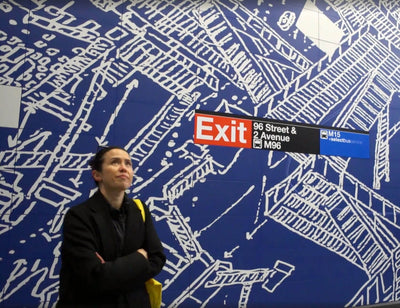
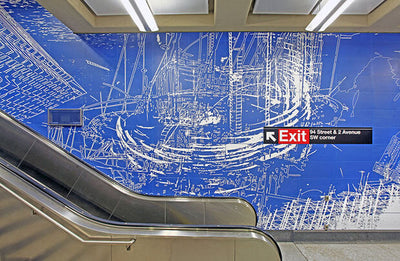
Sarah Sze’s latest installation, Blueprint for a Landscape, transforms the 96th Street St 2nd Avenue subway station into a dynamic artistic experience that mirrors the rhythms of urban movement. Drawing inspiration from Cubists, Russian Constructivists, and Futurists, Sze’s work plays with perception, speed, and stillness through a series of tiled wall designs that guide travelers like a visual way-finding system. This public art piece not only beautifies a democratic space but reflects Sze’s personal journey from sketching subway riders to having her art permanently installed in the city’s transit system, promising to engage commuters for generations to come.
Read more
Swamped 1990 movie poster with a man in a boat surrounded by water and trees
Peter Doig meets Albert Camus in Beijing
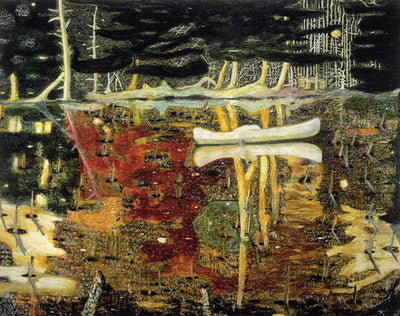
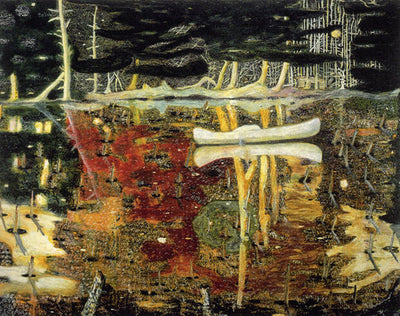
The Faurschou Foundation, a dynamic new art institution founded by Danish collector Jens Faurschou, continues to elevate its profile with a captivating Peter Doig exhibition in Beijing titled "Cabins and Canoes: The Unreasonable Silence of the World." Curated by Christie’s expert Francis Outred, the show features iconic large-scale works like Swamped and The Architect’s Home in the Ravine, which have set impressive auction records. Doig’s paintings, rich with beautiful yet enigmatic landscapes, explore themes of wandering and alienation, masterfully paired with evocative lines from Albert Camus’ essay The Myth of Sisyphus. This unexpected literary connection deepens the experience, inviting viewers to sense the “unreasonable silence” underlying the lush imagery, making for a thought-provoking showcase this spring.
Read more
Wolfgang Tillmans abstract photographic artwork with vibrant colors and dynamic composition
A Message of Love from Wolfgang Tillmans
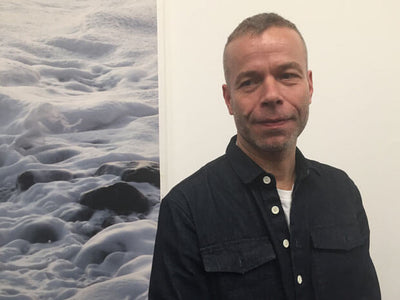
Wolfgang Tillmans, the groundbreaking German photographer and the first non-British artist to win the Turner Prize, offers a captivating exploration of change and connection in his latest Tate Modern exhibition. Centered around the pivotal year 2003, marked by global upheaval and Tillmans’s own artistic evolution into vibrant experiments with color, form, and digital technology, the show delves into both political and personal realms without being overtly political. Through a stunning array of images that reflect the natural world and a globally intertwined society, Tillmans’s work invites viewers to embrace hope and recognize the beauty in our differences as they simultaneously unite us.
Read more
This feeling is emotional expression abstract art colorful background
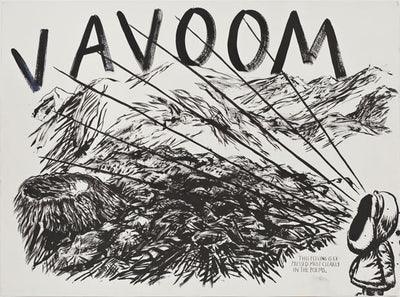
Understand Raymond Pettibon in three works
Californian artist Raymond Pettibon has created an astonishing body of work, estimated at around twenty thousand drawings since 1978, with 800 pieces featured in the largest retrospective of his career at New York’s New Museum. Pettibon’s art is a complex interplay of image and text, demanding viewers actively engage to uncover layered meanings that blend literary references, personal memoir, and cultural critique. His use of pop culture icons like Superman, Batman, and Felix the Cat transcends nostalgia, transforming these figures into powerful symbols of American identity, trauma, and history. Far from straightforward, Pettibon’s work invites deep interpretation, revealing a rich intellectual foundation and a unique vision that challenges and captivates in equal measure.
Read more
shia lead portrait close-up face intense expression
How Shia LaBeouf and two art school graduates made the definitive Trump protest artwork
When Hollywood star Shia LaBeouf transitioned into the fine art world in 2014, he embraced collaboration over solo creation, partnering with Central Saint Martins graduates Nastja Säde Rönkkö and Luke Turner. Together, they crafted provocative works blending performance and public engagement, from the silent, interactive installation #IAMSORRY to the GPS-driven hitchhiking project #TAKEMEANYWHERE. Their most ambitious piece, He Will Not Divide Us, launched during President Trump's inauguration, inviting continuous public participation as a mantra of resistance streamed live for the duration of the presidency. Despite skepticism from both the art world and Hollywood peers, LaBeouf and his collaborators have reclaimed collective creative expression and protest, proving that even movie stars thrive best in teamwork.
Read more
Sarah Szem Subway portrait close-up smiling woman with short hair and glasses in urban subway station background
Sarah Sze goes underground in New York
New York City’s new Second Avenue Subway is set to open its first phase on January 1, 2017, unveiling four stunning stations at 63rd, 72nd, 86th, and 96th Streets, each featuring unique tile murals by acclaimed artists Sarah Sze, Chuck Close, Vik Muniz, and Jean Shin. These artworks offer vibrant interpretations of city life—from Sze’s abstract, rhythmic “Blueprint for a Landscape” at 96th Street, capturing the bustling pace of modern life, to Close’s iconic portraits of famous New York art figures at 86th Street. Muniz brings to life everyday New Yorkers in full-figure portraits at 72nd Street, while Shin’s work at 63rd Street reflects historical memories of the old elevated train lines, providing a captivating visual journey that bridges past and present beneath the city streets.
Read more
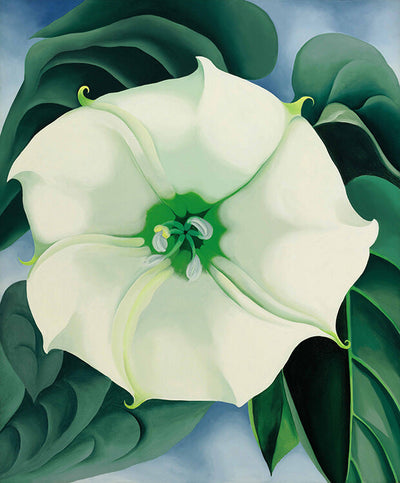
Emily Dickinson surrounded by various plants in a natural setting
The Art of the Plant – Emily Dickinson
Our new book, *Plant: Exploring the Botanical World*, invites readers to marvel at 300 stunning botanical images spanning centuries, capturing the vibrant life and delicate transience of plants. Among these treasures is a poignant herbarium crafted by the young Emily Dickinson, whose pressed flowers reflect not only her fascination with nature but also her contemplation of mortality and immortality. This collection reveals Dickinson’s intimate connection to the plant world—from meticulously labeling hundreds of specimens to preserving flowers for friends accompanied by poems—offering a beautiful glimpse into a 19th-century pastime infused with poetic depth. Delve into this rich visual journey celebrating both scientific discovery and artistic wonder in the botanical realm.
Read more
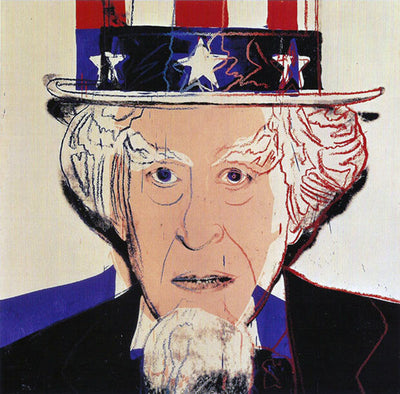
Abstract mixed-media artwork by Sarah Sze featuring intricate arrangements of everyday objects and delicate structures
A few of Sarah Sze's favourite things
As Christmas approaches and gift lists take shape, artist Sarah Sze invites us into her world of transforming the everyday into sculptural marvels. In a fascinating interview with Paul Bernard Holdengräber for the New York Public Library, Sze shares her favorite objects that inspire her art, revealing her deep engagement with themes of time, value, and the interplay between permanence and impermanence. From the ancient ritual rebuilding of Japan's Ise Shrine to an innovative sculpture made from humble toilet paper, Sze explores how ordinary materials and timeless practices fuel creative expression. She contrasts the ephemeral with the eternal through admiration for Vermeer's exquisite domestic scenes and Robert Rauschenberg's boundary-blurring textiles, highlighting art's connection to craft, history, and everyday life. This thoughtful glimpse into Sze’s influences not only enriches our understanding of her work but also sparks fresh appreciation for the beauty hidden in the mundane.

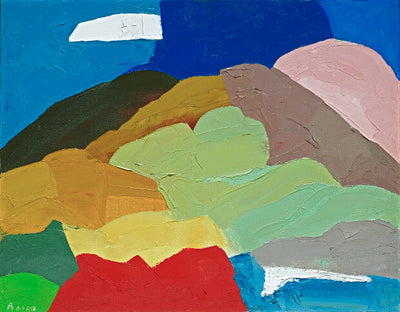
Read more
Monica Bonvicini Harness contemporary art installation metal chains and industrial materials
How Monica Bonvicini put the sex into construction
In her first UK retrospective at BALTIC, Monica Bonvicini transforms industrial materials and construction site tools into provocative artworks that explore themes of power, sexuality, and gender dynamics. Drawing on her early career installing exhibitions and her experiences in Berlin’s gay sadomasochism clubs, Bonvicini blurs the lines between macho environments and eroticism through pieces like leather-covered tools, rubberized harnesses, and chained fluorescent lights. Her work challenges the boundaries of art and society, using familiar materials to expose the hidden sex and strength embedded in everyday structures, inviting viewers to reconsider who defines limits and how power is displayed in our built world.
Read more
screen shot of a website page taken on November 15 2016 at 17 44 11 showing user interface elements and content
Gerhard Richter says art is the highest form of hope
German painter Gerhard Richter’s enduring belief in art as a profound source of hope and solace shines through in this reflective interview. At 84, Richter reaffirms art’s comforting power, sharing how timeless works like the 16th-century Isenheim Altarpiece, with its tragic yet beautiful depiction of Christ, provide deep emotional resonance. While he notes a shift in contemporary art towards a more playful and democratic spirit, echoing novelist Thomas Mann’s prediction, Richter highlights that the abundance of art today offers unprecedented opportunities for inspiration and comfort. His perspective invites us to appreciate the enduring, human value of beauty in art as a vital wellspring of optimism.
Read more
delphiniums flowers blue purple garden tall spikes blooming summer
The Art of the Plant – Edward Steichen
Our new book, *Plant: Exploring the Botanical World*, celebrates the rich history of botanical art with 300 stunning and pioneering images created by botanists, illustrators, and fine artists alike. Among these is the work of Edward Steichen, a renowned 20th-century photographer and horticulturalist whose passion for breeding delphiniums at his Connecticut farm shines through in his evocative compositions. Steichen’s photographs blend artistic mastery and botanical expertise, capturing the beauty of his plants while reflecting the turbulent times of World War II. His delphinium exhibitions at the Museum of Modern Art are hailed as early examples of bio art, showcasing flowers in a mesmerizing palette of blues and mists. Delve into the world of botanical imagery with *Plant: Exploring the Botanical World* and discover the art and science intertwined in nature’s most captivating forms.
Read more
Andy Warhol self-portrait passport photograph with altered nose 1956
Andy Warhol’s body of art
Andy Warhol: My Perfect Body, a new exhibition at The Andy Warhol Museum in Pittsburgh, offers a deep dive into the artist’s complex relationship with the body. Featuring a range of works from his early 1962 repainting of a rhinoplasty ad to his provocative "oxidisation" paintings where urine activated copper paint, the show reveals Warhol’s fascination with both physical perfection and imperfection. Through pieces like physiological diagrams, images juxtaposing Christ with bodybuilders, and candid Polaroids of his own post-shooting wounds, the exhibition explores Warhol's vulnerability and self-presentation. Even his iconic empty Electric Chairs series is re-examined as a haunting surrogate body. This revealing collection paints a portrait of Warhol as an artist deeply engaged with the body, both its celebrated forms and its fragilities.
Read more
etel adnan interview portrait with artistic background and thoughtful expression
An art lesson from 'new' painter Etel Adnan (91)
At 91, Etel Adnan stands as a vibrant testament to a lifetime of creativity and wisdom, having flourished as a painter, poet, journalist, novelist, and lecturer over seven decades. Deeply understanding art’s role in society, Adnan powerfully describes art as a force that humanizes, elevates, and connects us beyond our physical selves, feeding the spirit and soothing fears. She expands the definition of art to include everyday acts done with care—like gardening, cooking, and sewing—highlighting their artistic instinct and transcendent potential. Adnan’s insightful perspective invites us to see art not just as decoration, but as an essential, living thread in the fabric of society.
Read more
skyladder with metal frame and safety rails against blue sky background
Why does Cai Guo-Qiang like blowing things up?
More than a thousand years after the Chinese discovery of gunpowder, artist Cai Guo-Qiang channels its explosive power to bridge the ephemeral and the immortal. Sky Ladder, a riveting new Netflix documentary directed by Kevin Macdonald, traces Cai’s journey from his childhood in Mao-era China to global art stardom, focusing on his breathtaking 500-meter burning ladder launched in 2015 near his birthplace. Blending land art, fireworks, and sky writing, Cai’s work is a cathartic response to cultural repression, as he transforms destruction into creation through grand explosive displays. Yet, as the film reveals, his visionary projects often clash with political constraints, underscoring the ongoing battle behind his spectacular artistic achievements.
Read more
portrait of Jac Whitten smiling outdoors with blurred natural background
Jack Whitten - Why I Paint
Jack Whitten’s Queens studio is a fascinating blend of workshop and laboratory, filled not with traditional paintbrushes but with an array of inventive tools and containers brimming with acrylic paint. Since the early 1970s, Whitten revolutionized painting by pouring and dragging paint with custom-made implements, creating physical yet elegant works marked by vibrant striations of color. Reflecting on his artistic philosophy, Whitten describes himself as “Quantum man,” transcending conventional boundaries of identity, race, and politics, and emphasizing deep collaboration with matter through imagination and persistent exploration. His work embodies the concept of entanglement—a flexible, resilient force binding disparate elements—born from decades of rigorous research into the nature of matter, both physical and psychic. Known for both creation and destruction of his pieces, Whitten maintains a commitment to honoring the visual as sacred, seeking to transform rather than pollute it, a vision celebrated in the Vitamin P3 series that highlights innovative contributions to contemporary painting.
Read more
Cindy Sherm 1920s vintage portrait woman flapper style fashion hairstyle
Why Cindy Sherman has just won a painting prize
US photographer Cindy Sherman has been awarded Japan’s prestigious Praemium Imperiale painting prize, an unexpected but meaningful recognition of her influential self-portraiture created through photography rather than traditional painting. Since 1989, the Japanese state has honored pioneers across various artistic fields, including photography and video, alongside celebrated painters like Gerhard Richter and Willem de Kooning. Joining a distinguished group of laureates this year, including Martin Scorsese and Paulo Mendes da Rocha, Sherman is being celebrated for her significant international impact and contribution to the global arts community. She will receive ¥15 million ($145,000) and her medal at a ceremony in Tokyo this October.
Read more
Theaster Gates portrait photo by Sara Pooley contemporary artist urban renewal creative studio
Theaster Gates, a gazebo and Black Lives Matter
In 2014, the tragic shooting of twelve-year-old Tamir Rice by a Cleveland police officer sparked national outrage and fueled the Black Lives Matter movement. Now, the very gazebo where Rice was fatally shot is set to be relocated to Chicago by artist Theaster Gates, known for transforming neglected urban spaces into meaningful art installations. Gates and the Rice family hope the gazebo will become a powerful site for mediation and reconciliation at the Stony Island Arts Bank, turning a painful symbol into a place of healing and reflection.
Read more
Jr Brazill lead portrait professional headshot smiling outdoors
JR's incredible new Olympics art revealed!
Mohamed Younes Idriss, the talented Sudan-born high jumper based in Cologne, may have missed qualifying for the 2016 Olympics, but thanks to French artist and activist JR, he’s found a striking new platform in Rio. JR unveiled a dramatic scaffold portrait of Mohamed mid-jump atop an apartment block, part of his Inside Out Project—a public art initiative that highlights overlooked individuals across the globe. Known for shining a light on diverse communities, JR’s latest work celebrates athletes who didn’t make the Olympic cut but are immortalized through bold, captivating street art, reminding us of the powerful stories behind the games.
Read more
white jimsonweed flower close-up with green leaves background
Sex, Stieglitz and Georgia O’Keeffe
The new Georgia O’Keeffe exhibition at Tate Modern, the first major UK retrospective in two decades, seeks to challenge long-standing misconceptions about the artist, especially the persistent sexual interpretations of her work. Curator Tanya Barsons highlights O’Keeffe’s intelligence and passion, emphasizing her focus on form, design, and beauty rather than erotic symbolism. This exhibition also explores the complex influence of her husband, Alfred Stieglitz, whose own avant-garde views and fascination with sexuality shaped public perceptions of O’Keeffe’s paintings. Despite O’Keeffe’s denial of these interpretations, some of her work may subtly reflect such themes. Yet the show ultimately encourages viewers to look beyond these readings and appreciate her mastery of color and form, especially as she evolved in later life, finding solitude and fresh inspiration in the landscapes of New Mexico, where she created some of her most striking compositions.
Read more
Warhol style Uncle Sam pop art illustration with vibrant colors and bold design
When Warhol painted Uncle Sam
Andy Warhol’s 1981 Myths series brilliantly captures the complex and often contradictory nature of American identity through iconic figures from popular culture, ranging from Dracula and Mickey Mouse to Uncle Sam and Superman. Using Polaroid photographs of actors portraying these characters, Warhol crafted silk-screened prints that explore the blend of fantasy and reality in the national imagination. By including himself as the mysterious crime-fighter The Shadow, Warhol hinted at his own role as a cultural observer and participant in this myth-making. The series reflects a media-saturated America, where advertising, film, and TV create modern heroes and villains, offering a compelling commentary on how collective dreams shape the nation’s sense of self.
Read more
Abstract mixed-media artwork by Sarah Sze featuring intricate arrangements of everyday objects and vibrant colors
Meet Sarah Sze’s incredible, extended social circle
Sarah Sze’s intricate sculptures, made from everyday objects to entire SUVs, reveal a deeply personal and social dimension that reflects her life and relationships. In a recent profile, the renowned artist shares how her work is enriched by the company of friends and family, including her husband Siddhartha Mukherjee, a Pulitzer Prize-winning physician and author, and their close-knit circle of accomplished creatives. Rooted in a family history of remarkable achievements, Sze’s commitment to excellence was instilled by her parents, shaping her artistic vision. Despite her high-profile life, she embraces the quirks and imperfections of balancing art and family, offering a fascinating glimpse into the world behind her mesmerizing installations.
Read more
EA 036 Untitled 1995-2000 oil on canvas painting 355x455 cm abstract artwork colorful textured brushstrokes
How a 91-year-old lecturer became a 2016 art star
At 91, Etel Adnan is emerging as a celebrated figure in the international art world, adding visual artistry to her accomplished career as a Lebanese American novelist, poet, and philosopher. Born in Lebanon and educated in Paris, Harvard, and Berkeley, Adnan’s rich cultural heritage and life experiences deeply inform her vibrant abstract paintings and innovative works, including oil on canvas, watercolors, and wool tapestries inspired by Persian rugs. Her new show, The Weight of the World at London’s Serpentine Sackler Gallery, showcases decades of creative output—spanning from the 1960s to 2016—alongside films, poetry, and evocative concertina-fold sketchbooks. A profound love for nature, especially Mount Tamalpais, threads through this diverse collection, reflecting a life lived fully across languages, continents, and artistic mediums.
Read more
JRLouvres Lefiel lead promotional image with artistic design and branding elements
What happened at JR’s Louvre takeover
The Louvre embraced the unconventional artistry of JR by granting him full creative control to transform its iconic glass pyramid with a striking trompe l'oeil panoramic paste-up and host a vibrant 24-hour celebration. The event featured a master class, discussions with fellow artists and a philosopher, an exclusive film screening with Agnès Varda, a magical performance, nocturnal tours, and a mesmerizing six-hour concert inside the pyramid. The next morning, chef Jean Imbert prepared a Greco-Roman-inspired breakfast beside classical sculptures, followed by a creative workshop and an outdoor performance where JR and Chinese artist Liu Bolin playfully attempted to merge with the artwork — a reminder that JR’s impact is impossible to overlook.
Read more
jr arcade fire band performing live on stage with vibrant lighting and enthusiastic crowd in background
Arcade Fire jump in the water with JR in Paris
Parisian art lovers have been treated to a stunning new installation as JR, the city’s greatest living public artist, wraps the iconic Louvre pyramid in a striking black-and-white trompe l'oeil that seamlessly blends the glass structure into the Cour Napoleon. To celebrate the completed work, JR invited Arcade Fire’s Win Butler and Régine Chassagne to perform a free DJ set at the nearby Jardin des Tuileries, delighting the crowd with a mix of classic art pop and an intimate rendition of their own hit, My Body is a Cage. The installation remains on view until June 27, with JR promising even more surprises across the Louvre and the first arrondissement, featuring appearances by notable figures like filmmaker Agnès Varda, model Cara Delevingne, and musician Matthieu Chedid. For those eager to dive deeper into JR’s visionary world, his book JR: Can Art Change the World? offers an insightful exploration of his extraordinary work.
Read more
Portrait of Yayoi Kusama 2014 colorful polka dot art background
A quick look at the new Yayoi Kusama show
Yayoi Kusama’s latest exhibition at the Victoria Miro Gallery in London invites visitors into a mesmerizing world of infinity and introspection, featuring new paintings from her My Eternal Soul series, iconic pumpkin sculptures, and sensory mirror rooms designed to evoke both wonder and contemplation. Highlighted by the stunning daylight-activated stainless steel installation "Where The Lights In My Heart Go," Kusama’s work explores the tension between self-obliteration and monumental self-expression through infinite patterns, nets, and reflective surfaces that envelop viewers in a vast psychological and cosmic space. Curator Marie Laurberg emphasizes Kusama’s enduring themes of infinity and the abyss, rooted in her early inspirations from nature and her groundbreaking installation art from the 1960s, making this exhibit a profound journey through desire, fear, and the infinite unknown.
Read more
JRLouvreLead promotional banner featuring Louvre museum highlights and exclusive art tours
Watch JR disappear the Louvre’s pyramid
Parisian artist JR is transforming the Louvre with his innovative anamorphic art, blending the iconic I M Pei pyramid into the Cour Napoléon courtyard through striking visual distortions. While the exhibition officially opens on May 25, social media is already buzzing with images of this bold, accessible installation. The excitement culminates on May 29 with a 24-hour museum takeover, a vibrant multimedia event featuring collaborations with notable creatives like filmmaker Agnes Varda, model Cara Delevingne, and musician Matthieu Chedid, making it a must-see celebration of contemporary art and audience interaction.
Read more
006 7 wt self portrait artwork image
Wolfgang Tillmans takes over the Tate
The Tate Modern is set to host a mid-career retrospective of Wolfgang Tillmans, the German Turner Prize-winning photographer known for his innovative visual arts, performance, and installation work. Focusing on his output since 2003, the show will also feature a unique ten-day installation in the Tate’s South Tank, showcasing live events. Tillmans’ diverse approach spans from magazine photography—starting with i-D and vintage publications—to immersive music experiences, such as his Berlin gallery’s listening room dedicated to 1980s indie band Colourbox. His eclectic “multi-vectored” hanging style layers framed and unframed images to create dynamic, inclusive narratives, while his personal projects include striking astronomical images like the 2004 transit of Venus. Collaborations with artists like Isa Genzken and Jenny Holzer further highlight his integrated artistic community, promising a multifaceted and engaging exhibition.
Read more
Mark Bradford truly rich man artwork abstract mixed media portrait
Get to know the US artist for the 2017 Biennale
Mark Bradford, the acclaimed Californian artist and U.S. representative at the 2017 Venice Biennale, challenges traditional notions of abstract painting by transforming found urban materials into layered, complex works that reflect the sociopolitical landscape of his South Los Angeles neighborhood, Leimert Park. Using discarded paper advertisements and posters collected from the streets—what he calls "merchant posters"—Bradford constructs intricate compositions that, while seemingly abstract, reveal a deeper engagement with real-life themes of community, identity, and the city’s vibrant pulse. His art, described as “devouring machines” by Museu de Arte de São Paulo’s Adriano Pedrosa, blurs the line between painting and collage, offering viewers an evocative map of urban life that resists simple interpretation, embodying the histories and stories embedded in everyday ephemera.
Read more
Sarah Sze intricate mixed media art installation with colorful geometric shapes and suspended elements
Why Sarah Sze’s words are as intricate as her art
American sculptor Sarah Sze offers a captivating glimpse into her multifaceted art practice, blending sculpture, drawing, and the natural world. Discussing her 2011 High Line piece, *Still Life with Landscape (Model for a Habitat)*, she reveals how she creates three-dimensional models that play with perspective and space, turning the walk itself into an element of the sculpture. Drawing remains a vital, immediate first step in her creative process, embodying fragility and potential. Sze’s complex installations—incorporating everyday objects like SUVs and birth-control packets—resist simple interpretation, instead inviting viewers into shifting mental and physical landscapes. For those intrigued by her thoughtful reflections and innovative art, an upcoming talk and new monograph offer deeper insights into her life and work.
Read more
Cindy Sherm portrait 1920s vintage style woman with bob haircut and flapper dress
Cindy Sherman's hooked to the silver screen
Cindy Sherman, renowned for her transformative self-portraits, first captivated audiences in the late 1970s with her iconic Untitled Film Stills series, where she embodied a range of classic b-movie starlets. Over the decades, Sherman's work evolved to explore themes of fame, beauty, and societal expectations, notably in her poignant Publicity Still series from 2000, which highlights the struggles of actresses facing the harsh realities of aging in Hollywood. Returning to her roots with a new exhibition at Metro Pictures, Sherman channels the elegance of Hollywood’s silent era, presenting regal, art-deco inspired images that celebrate the proto-feminist flapper style. This fresh take reaffirms her status as a pioneering artist who continuously reinvents the narrative of female identity on screen.
Read more
close-up of a person holding a vintage camera with a blurred background
Olafur Eliasson gives a Green Light to refugees
Green Light is a striking medium-sized geometric lamp designed by Danish-Icelandic artist Olafur Eliasson, crafted from wood, recycled plastic, nylon, and LEDs, making it a perfect fit for contemporary interiors. Beyond its aesthetic appeal, the lamp’s true significance lies in its creation process, as it is assembled by young refugees, local students, and community members through a unique three-month program hosted at Vienna’s TBA21 art foundation. This initiative combines craftsmanship with educational workshops on art, citizenship, solidarity, and empowerment, aiming to support refugees’ integration and welcome them into the city. Eliasson envisions Green Light as a symbol of hope and responsibility amid the refugee crisis, shining a compassionate beacon both for newcomers and the residents of Vienna.
Read more
Mario character illustration in red hat and blue overalls standing with arms crossed
Frieze is bringing this Mario Bellini car back to NY
Mario Bellini’s 1972 Kar-A-Sutra was a daring and playful reimagining of the people carrier, designed as a mobile living room with a cheeky twist, complete with risqué illustrations and a whimsical mime-filled photo shoot. Though never produced, British artist Anthea Hamilton is reviving this provocative concept at this year’s Frieze art fair in New York, bringing the car—and its resident mimes demonstrating creative uses—to life once more. Hamilton’s project continues her tradition of resurrecting lost Italian designs, following her recent reinterpretation of Gaetano Pesce’s unrealized doorway arch. Alongside Hamilton’s homage, Frieze promises an array of vibrant and quirky installations from international artists, including giant inflatables, multimedia sculptures, mirror-wearing performers, and even a professional pickpocket discreetly delivering tiny sculptures to unsuspecting visitors—a lively celebration of art’s playful spirit.
Read more
Olafur Eliasson Davos artwork installation photograph
Olafur Eliasson wins award for improving the world
Olafur Eliasson has been honored with a Crystal Award for his outstanding dedication to improving the world, recognized alongside figures like Leonardo DiCaprio and will.i.am. Celebrated for monumental works such as The New York City Waterfalls and Ice Watch, Eliasson also co-leads Little Sun, a social venture providing sustainable light to off-grid communities. The award, part of the World Economic Forum’s tradition, acknowledges artists who drive social change through their creativity. Eliasson emphasizes art’s power to unite diverse perspectives and foster global empathy, while the Schwab Foundation highlights his transformative impact on urban spaces. Alongside this, a new book, *Studio Olafur Eliasson The Kitchen*, reveals the creative spirit behind his Berlin studio’s daily vegetarian meals, fostering community and inspiration among artists and collaborators.
Read more
Bridget Riley Current 1964 abstract black and white optical art painting from Scala Archives
Op Art - you don't need to be an expert to get it
Op Art, with its mesmerizing optical illusions and vibrant interplay of shapes and colors, captured the imagination of the 1960s, influencing not only the art world but fashion, music, and design. Coined by Time magazine in 1964, Op Art alongside Kinetic Art—known for its moving sculptures—engaged a broad audience eager for dynamic, accessible experiences that blurred the lines between high and low culture. Now celebrated in Eye Attack: Op Art and Kinetic Art 1950-1970 at Denmark’s Louisiana Museum of Modern Art, this exhibition reunites around 100 works by iconic artists like Victor Vasarely, Bridget Riley, and Julio Le Parc, highlighting these mid-century movements’ enduring ability to dazzle and democratize art in a world grappling with rapid cultural change.
Read more
book to bids Sherman cover image with a vintage typewriter and handwritten notes on a wooden desk
From Book to Bid – Cindy Sherman’s Untitled #352
Cindy Sherman's Headshot series from 2000 offers a poignant and complex exploration of aging actresses caught in society’s ruthless obsession with youth and glamour. Unlike her earlier Untitled Film Stills, which celebrated classic Hollywood heroines, these images portray women who are older, struggling to maintain a youthful facade through layers of makeup and costume in a desperate bid for recognition. Far from mere caricature, Sherman—both photographer and model—embodies these roles with a nuanced critique of appearance, identity, and societal pressures, highlighting the bittersweet tension between aspiration and reality in the pursuit of enduring fame.
Read more
fwoodman1976 untitled artwork abstract colors and shapes
My Body of Art – Foam Photography Museum curator Kim Knoppers on Providence, Rhode Island
Francesca Woodman’s poignant 102-image retrospective, On Being an Angel, currently showing at Moderna Museet in Stockholm and soon at Amsterdam’s Foam gallery, captures a haunting exploration of body, gender, and identity that remains strikingly relevant today. Despite her tragic early death at 22, Woodman’s black-and-white self-portraits, often set in dilapidated interiors, reveal a dark, gothic aesthetic infused with surreal and classical elements. Curators highlight her unique voice and enduring influence on contemporary photographers who similarly use their bodies to interrogate gender and visibility. More than mere snapshots, these images are profound meditations on the gaze, presence, and self, continuing to resonate and inspire decades after their creation.
Read more
Aerial view of Kibera slum in Nairobi Kenya showing densely packed housing and urban landscape
Why has an ad agency 'stolen' this JR artwork?
JR’s Women Are Heroes project in Kenya’s Kibera neighborhood celebrated the vital role of local women by adorning rooftops with large photographic banners, doubling as waterproofing for their homes. Recently, US agency Deutsch launched “Art Heist for Good,” removing these banners—sometimes without full local consent—to auction them internationally and fund sanitation projects through the charity Water Is Life. While the initiative aims to improve conditions, it raises complex questions about the ethics of repurposing public art installed on people’s homes without the artist’s involvement. Despite this, the project highlights how art can unexpectedly impact communities, aligning with JR’s vision of art as an ongoing process that can truly change the world.
Read more
Robert Mapplethorpe self-portrait black and white photograph artistic portrait
My Body of Art - photography critic Philip Gefter on the power of Robert Mapplethorpe's male nudes
Up until the early 1960s, laws in the US criminalized homosexual male sex and censored nude imagery, but a cultural shift soon began that intertwined the rise of gay rights with photography's emergence as a respected art form. Philip Gefter, a noted photography critic and former New York Times editor, credits pioneers like Robert Mapplethorpe with transforming the public perception of the male nude, helping to normalize its presence in galleries and advertising alike. Although male nudes were photographed long before, Mapplethorpe and his contemporaries challenged social taboos by bringing explicit images into the mainstream art world, gradually desensitizing audiences and influencing later media. Gefter argues that while progress has been significant, acceptance of the male body in its full reality remains incomplete, reflecting an ongoing evolution in how we discuss sexuality and art.
Read more
Tina Barney Holstan portrait photograph
My Body of Art - Tina Barney on her nudes, why she admires Rineke Dijkstra and that Halston photo
New York photographer Tina Barney, celebrated for her vivid portraits of affluent family and friends, reveals a lesser-known chapter of her work in a rare series of nude portraits from the early 1990s. Diverging from her signature staged scenes, these intimate yet clinical images focus on form, light, and texture rather than identity or emotion, capturing the human body in a way akin to still life. Barney’s exploration emerged from a desire to move beyond the stiffness of her usual subjects, embracing anonymous models photographed in personal spaces. Her nuanced perspective on skin, hands, and composition underscores a profound fascination with the human figure itself. The article also highlights Barney’s admiration for other artists like Rineke Dijkstra, whose emotive, unidealized portraits challenge conventional narratives of motherhood and identity, probing deeper sociological themes. Through these reflections and anecdotes, including the iconic yet modestly regarded fashion shoot, the piece invites readers to reconsider the intersections of identity, form, and art in photography.
Read more
portrait of a man with a beard wearing a dark jacket against a neutral background
My Body of Art - Bill Arning on Sucking Toe
The way the human body is portrayed in art has evolved dramatically over time, shaped by shifting cultural, political, and social currents. Bill Arning, veteran curator and Executive Director at Contemporary Arts Museum Houston, highlights how contemporary perspectives on feminism, race, and sexuality have transformed portraiture, contrasting it with earlier periods like the Weimar Republic’s “New Objectivity.” Arning illustrates this shift through examples such as Peter Hujar’s provocative 1970s photographs and the changing acceptance of queer identities today. He also observes that modern societal obsession with physical perfection has fostered a renewed artistic fascination with bodily flaws and imperfections, celebrating the “fleshy and smelly joys” of human vulnerability. Through a cross-cultural and historical lens, Arning praises the book *Body of Art* for illuminating this vibrant continuum and deepening our understanding of the body’s role in art throughout history.
Read more
daylight scene with bright sunlight and clear sky over a natural landscape
The Art of the Map - Olafur Eliasson
Danish-Icelandic artist Olafur Eliasson, known for exploring sunlight through works like the Weather Project and solar-powered lamps, created the 2005 Daylight Map to visualize the passage of sunlight around the globe. Using twenty-four neon tubes to represent time zones, Eliasson’s map intriguingly reveals that these divisions are not perfectly parallel but distorted by political borders. The illuminated tubes change in real time, highlighting regions experiencing daylight while underscoring the persistent presence of artificial light worldwide. This dynamic piece, reflecting Eliasson’s environmental and ecological concerns, offers a captivating perspective on the intersection of natural phenomena and human influence.
Read more
full size render of a modern architectural building exterior with glass and steel elements
Ai Weiwei and Anish Kapoor go walkabout
Pavement café tables were scattered and pigeons took flight as a huge crowd of media and well-wishers joined artists Ai Weiwei and Anish Kapoor on a spirited walk through London. From the Royal Academy on Piccadilly to Stratford in East London, the pair boldly defied traffic signals and gathered attention, draped in blankets symbolizing solidarity with the world’s estimated 60 million refugees. Inviting the public and press to bring their own blankets, the artists captured the moment on their iPhones, amplifying a powerful message of empathy and awareness. This striking demonstration is set to travel to major cities worldwide, uniting art and activism in a moving global statement.
Read more
jrlead logo with abstract design representing leadership and growth in blue and green colors
How is JR using his new Phaidon book?
French artist JR uses his striking black-and-white street portraits to shine a light on marginalized communities worldwide, from Parisian suburbs to favelas in Rio and neighborhoods in Nairobi and New York. More than just images, his work fosters trust and social connection, turning fleeting installations into lasting social dialogues. His new monograph captures the breadth of his projects, illustrating how art can break down barriers and inspire change. JR sees the creation process—and the community engagement it sparks—as the true essence of his art, proving that when he asks, "Can art change the world?" the answer is an inspiring yes.
Read more
Aerial view of Kibera slum in Nairobi Kenya showing densely packed housing and community structures
How JR found heroism in the faces of these women
"JR: Can Art Change The World?" is a striking monograph that delves into the work of the enigmatic Parisian artist JR, who transforms urban spaces by showcasing the faces of ordinary people, often those overlooked or marginalized. Central to his mission is the project Women Are Heroes, where JR highlights the strength and dignity of women living in conflict zones, many of whom face severe injustices. Through powerful black-and-white portraits pasted in their communities, these women tell stories of resilience, hope, and defiance, capturing moments of raw humanity. The book offers a profound reflection on visibility, identity, and social change, inviting readers to reconsider the power of art in giving voice to the invisible.
Read more
Theaster Gates portrait photo by Sara Pooley urban artist creative studio black background
Theaster Gates: Art, lies and pottery
Theaster Gates is a multifaceted artist whose work spans ceramics, performance, and social engagement, deeply rooted in the fight for racial equality. His 2007 exhibition, Plate Convergences, brilliantly blended art and storytelling, featuring a performance where Gates served Southern soul food alongside Japanese sushi on plates he crafted from Mississippi clay. The story he wove about a Japanese ceramicist who bridged cultures was ultimately revealed as a fabrication, highlighting Gates’ intention to challenge perceptions of art and reality through creative deception. This compelling blend of cultural commentary and artistic innovation makes Gates a fascinating figure whose work continues to provoke thought and inspire dialogue.
Read more
Weiwei Forever Bicycles art installation featuring numerous white bicycles arranged in a circular pattern
Ai Weiwei’s bicycles come to London
Following the 2012 Olympics, London saw a surge in cycling, but few would recognize the type of bike in Ai Weiwei’s striking sculpture, Forever. On display from 3–14 September near the iconic Gherkin, the piece is a cluster of steel bicycles once ubiquitous in China, made by the Forever company since 1940. Once a symbol of everyday Chinese workers, these bikes now evoke a bygone era as China’s society has shifted towards motor vehicles. Ai Weiwei created his first Forever sculpture in 2003, drawing inspiration from Marcel Duchamp’s Bicycle Wheel and exploring themes of collective power, harmony, and the tension between individuality and conformity. Installed amid London’s financial district as part of Sculpture in the City, the work intriguingly contrasts the collaborative unity of the bikes with the modern pulse of the city’s banking hub, inviting viewers to reflect on community and identity.
Read more
ainadja logo with abstract colorful design representing creativity and innovation
Look who Ai Weiwei hung out with at the weekend
Ai Weiwei has embraced his newfound freedom after receiving a German visa, arriving in Munich for medical check-ups related to past injuries before heading to Berlin to discuss a visiting professorship at the University of the Arts. Welcomed warmly by the city’s mayor and artistic community, Ai has reconnected with fellow dissidents and artists, including Pussy Riot’s Nadia Tolokonnikova and actor Daniel Brühl, in gatherings organized by Cinema for Peace. He’s also spent time with Berlin-based artist Olafur Eliasson, Pulitzer-winning journalist Ian Johnson, and enjoyed Patti Smith performing her iconic album Horses. With his young son living in Berlin and plans to exhibit alongside his admired Andy Warhol in Melbourne, Ai reflects on the possibilities ahead with a mix of curiosity and determination, eager to communicate more freely through his art.
Read more
Olafur Eliasson artwork installation colorful light reflections
Olafur Eliasson on art schools and the art market
Olafur Eliasson, renowned for iconic works like The Weather Project and New York City Waterfalls, shares his insights on art education and the challenges young artists face today. He critiques the art world's conservatism and commodification, which stifles experimentation and encourages a narrow definition of success from the start of art school. Eliasson emphasizes the importance of physical experience and risk-taking in art, advocating for creative exploration beyond purely intellectual engagement. Through exercises that shift perception, like walking backwards or making spontaneous books, he encourages artists to rethink how they experience and shape reality. Drawing from his teaching at the Institut für Raumexperimente and his work in global contexts like Addis Ababa, Eliasson redefines the role of educator as a collaborative co-producer rather than a hierarchical authority, championing creativity as a force that actively produces reality.
Read more
swamped 1990 movie poster featuring a man and woman in a boat surrounded by alligators in a swamp setting
From Book to Bid – Peter Doig’s Swamped
This season’s major post-war and contemporary art auctions feature remarkable works with fascinating backstories, including Peter Doig’s 1990 painting Swamped, highlighted ahead of Christie’s New York sale. Inspired by a subtle scene from the horror film Friday the 13th, Doig’s recurring motif of canoes also nods to 19th-century artist George Caleb Bingham’s haunting Fur Traders Descending the Missouri. Swamped captures a dreamlike, swampy landscape where reflections and textures blur the boundary between paint and reality, evoking a profound sense of immersion and decay. Praised for its complex layering and atmospheric depth, the piece exemplifies Doig’s unique vision—transforming fleeting cinematic moments into richly evocative art that captivates and mystifies.
Read more
Portrait of Cindy Sherman in artistic style with dramatic lighting and expressive pose
From Book to Bid – Cindy Sherman's Untitled #470
Cindy Sherman’s Untitled #470, a striking chromogenic print up for auction at Phillips in New York, delves into the complex portrayal of mature society women confronting aging with a mix of poise, status, and underlying neurosis. Expected to fetch between $300,000 and $500,000, this work is part of Sherman’s series exploring the tension between social sophistication and the fragility beneath the surface, revealing the masks these women wear amid the pressures of public achievement. Curator Paul Moorhouse highlights how Sherman’s art captures the intricate, often unsettling strategies of self-presentation, making a powerful statement on vanity, identity, and the universal human plight of aging.
Read more
Portrait of Egon Schiele in expressive style with bold lines and vivid colors
Stories from the Secession - Art or porn?
The tension between eroticism and censorship in art is far from new, as vividly illustrated by the Vienna Secessionists featured in Peter Vergo’s *Art In Vienna 1898-1918*. Artists like Gustav Klimt and Egon Schiele challenged conservative norms by boldly exploring sexuality in their work, drawing both admiration and harsh criticism for what some deemed “pornographic.” Klimt’s Medicine, with its unapologetically nude female figure, sparked outrage, while Schiele’s raw depictions of the human form stirred controversy alike. Yet, both artists saw their art as a profound exploration of humanity, confronting social taboos rather than pandering to titillation. This glimpse into early 20th-century Vienna reveals a fascinating clash of progressive creativity and prudish resistance, inviting readers to reconsider the boundaries of art and the enduring dialogue between sex and censorship.
Read more
Warhol Shore Silver Clouds artwork featuring reflective silver balloons floating in a gallery space
Dancing on Warhol's Silver Clouds
The Stephen Petronio dance company’s recent staging of Merce Cunningham’s 1968 avant-garde piece RainForest at the Joyce Theatre brilliantly revives a quintessentially ’60s New York atmosphere, complete with Andy Warhol’s iconic Silver Clouds made from Mylar balloons. Inspired by the Pacific Northwest’s rainforests, this short dance performance features Warhol’s airy, floating Mylar creations, which added both visual intrigue and a playful challenge for the dancers. Warhol’s suggestion to dance naked among the clouds was cleverly adapted with flesh-colored leotards, while the dancers mastered the art of gently pushing the helium-filled balloons to keep them afloat. This inventive and whimsical fusion of art, dance, and technology not only honors the original work’s spirit but also brings a fresh vibrancy to Warhol’s captivating collaboration with Cunningham.
Read more
family of three smiling outdoors in casual clothing
Zhang Xiaogang explained in 5 paintings
Zhang Xiaogang, born in 1958 amidst the upheavals of the Cultural Revolution, has emerged as China’s foremost contemporary painter by intertwining personal memory with the nation's turbulent history through his evocative art. His journey from Socialist Realism to deeply symbolic works reflects influences ranging from Van Gogh’s emotional brushwork to Frida Kahlo’s magical realism and Gerhard Richter’s photographic introspection. Zhang’s landmark series, like Bloodline—Big Family, poignantly captures the collective anxieties and social pressures of his generation, while later pieces explore the shifting landscapes of daily life under socialism with haunting clarity. His art offers a profound meditation on memory, history, and identity, marked by emotional turbulence and the quest to understand a complex era.
Read more
abstract colorful painting by Francis Picabia featuring a female figure with geometric shapes and vibrant hues
The mechanised world of Francis Picabia
On the anniversary of Francis Picabia's birth, we explore his transformative experience in early 20th-century New York, where he and Marcel Duchamp became pivotal figures in breaking European artistic conventions. Fleeing war-torn Europe, Picabia found inspiration in American machinery and urban life, leading to his distinctive mechanomorphic artworks—playful, erotic machine compositions that symbolized the energy and sexuality of the modern world. His collaborations with Alfred Stieglitz’s avant-garde circle and contributions to the journal 291 highlight this revolutionary fusion of art and machine culture. Iconic works such as the mechanical portrait of Stieglitz, the symbolic "Voila la Femme," and "Fille née sans mere" reflect Picabia’s innovative mix of technology, sexuality, and industrial metaphors, capturing the restless spirit of New York and the dawn of modern art.
Read more
Renoir painting of a galette dessert on a plate with a rustic background
How Renoir captured the countryside in the city
Pierre-Auguste Renoir, the renowned French painter who passed away on December 3, 1919, masterfully captured the interplay between industry and nature through his Impressionist works painted en plein air. His art reflects not only the quick, expressive brushstrokes of Impressionism but also the naturalistic sensibilities of the Barbizon School, appealing to an urbanizing audience nostalgic for untouched landscapes amid rapid industrial change. Renoir benefited from innovations such as premixed paint tubes, which enabled him to seize candid outdoor moments, portraying scenes from both Paris and its surrounding countryside. His famous piece, *Dance at the Moulin de la Galette*, immortalizes a transformative era in Montmartre, blending the vibrancy of modern life with fading natural beauty, offering a vivid historical snapshot of Parisian culture at a crossroads.
Read more
Goya Linda icon artwork 620x583 pixels colorful illustration
Gombrich Explains Goya
Ghosts and witches may seem like quaint Halloween amusements today, but their roots in art reveal a far darker heritage. EH Gombrich’s *The Story of Art* highlights how Francisco Goya, working amid the upheaval of post-revolutionary Europe, transformed traditional subjects into haunting visions that exposed vanity, cruelty, and oppression. Goya’s court portraits reveal the stark, unforgiving truths beneath regal facades, while his groundbreaking etchings delve into nightmarish apparitions and fantastical monsters, embodying the turmoil of his era. His iconic work *The Giant* epitomizes this shift: a colossal, eerie figure looming over a tiny landscape, evoking deep anxiety and poetic mystery. This willingness to channel personal and political fears onto canvas paved the way for the eerie imagery we now associate with horror, making Goya a pioneering figure in the art of the uncanny.
Read more
orange pumpkin with green stem on white background autumn harvest seasonal decoration
Yayoi Kusama: from fried onions to pumpkins
Yayoi Kusama’s journey from privileged beginnings to becoming the world’s top-selling contemporary female artist is a compelling tale of resilience and creativity. Despite growing up wealthy and advised to marry for security, Kusama bravely moved to New York in 1958, enduring poverty and isolation while pursuing her art. Supported by figures like Georgia O’Keeffe but facing harsh winters and financial struggles due to Japanese foreign exchange restrictions, Kusama’s tenacity led her to establish a vibrant presence in the New York art scene. Her iconic pumpkin-themed works, created after a return to Japan prompted by mental health challenges, serve as both self-portraits and symbols of endurance, embodying her admiration for the pumpkin’s humble strength and charm. These pieces, alongside a new series of paintings, will be featured in her upcoming exhibition at Victoria Miro Gallery, celebrating her remarkable legacy and ongoing creative spirit.
Read more
key hanging on a rustic wooden wall with natural light highlighting its texture and details
Understanding Anselm Kiefer’s Interior
The upcoming Anselm Kiefer exhibition at the Royal Academy promises to be a blockbuster, filling every gallery with a combination of retrospective works and new commissions from the acclaimed German artist. Among the highlights is the monumental painting *Interior (Innenraum)*, a haunting depiction of the Mosaic Room in Hitler’s New Reich Chancellery, layered with complex materials that evoke both ancient imperial grandeur and the dark legacy of National Socialism. This evocative ambiguity is central to Kiefer’s work, challenging viewers to confront history's weight and its persistent echoes in the present. Celebrated as a profound history painter, Kiefer’s show offers a powerful and thought-provoking exploration of past and memory, opening 23 September and running through 14 December.
Read more
edspeed logo on white background representing fast and efficient educational services
Why is this Ruscha print Obama’s favourite gift?
President Obama, known for his thoughtful gift-giving, has chosen a striking print by American pop artist Ed Ruscha as a diplomatic present on multiple occasions, gifting the same 2003 work, *Column with Speedlines*, to both British Prime Minister David Cameron and Australian Prime Minister Tony Abbott. This choice reflects not only the White House’s admiration for Ruscha—whose piece *I think maybe I’ll...* hung in the president’s official residence—but also a deeper appreciation for American contemporary art. The print supports the Foundation for Art and Preservation in Embassies, promoting permanent American artworks abroad, while symbolically blending themes of government, modernity, and classic American culture in a subtle yet meaningful gesture on the world stage.
Read more
Estes 2 2 model rocket launch image
Richard Estes and the art of the photograph
In an era dominated by digital and drone photography, the legitimacy of photography as a source in fine art remains a lively debate rooted in the 19th century’s initial skepticism. Renowned photorealist Richard Estes stands out as an early adopter, blending photographic precision with painterly complexity in his work. The Portland Museum of Art’s retrospective, co-organized with the Smithsonian American Art Museum, offers a rare comprehensive look at Estes’ career, showcasing 50 pieces that explore urban scenes and reflective surfaces like plate-glass windows. Estes transforms transparency and reflection into intricate visual puzzles, merging interior and exterior worlds in paintings such as the iconic Teleflorist (1974), where abstraction and reality beautifully collide. Rejecting strict adherence to drawings or photographs, Estes’s approach highlights his commitment to artistic freedom and innovation, underscoring why his work remains vital and compelling.
Read more
sanitorium building exterior with clear sky and surrounding trees
Alain de Botton on Therapy as Art
Art as Therapy by Alain de Botton and John Armstrong challenges the notion that art is merely decorative, proposing instead that it holds real therapeutic power. This perspective is vividly embodied in projects like Mexican artist Pedro Reyes’ Sanatorium, a mobile clinic offering unexpected art-based therapies, and Marni Kotak’s raw, performance-driven Mad Meds exhibition, which chronicles her personal journey off psychiatric medication. De Botton applauds these artists for breaking free from the traditional idea that art should be obscure or purely aesthetic, highlighting a promising shift where art reconnects with its potential to heal and support the human soul. This new era of engaged, accessible art offers fresh hope for its role in our lives beyond the gallery walls.
Read more
black and white photograph of Bauhaus family members standing together outside a building
Kandinsky’s teaching celebrated in Bauhaus show
A major exhibition at the Bauhaus-Archiv in Berlin celebrates Wassily Kandinsky, one of the Bauhaus's most influential teachers, bringing together a rich collection of his archive materials from his professorship at the school. Visitors can explore Kandinsky’s lecture notes, student exercises, and illustrations alongside his striking prints and watercolours like the 1923 ‘Joyous Ascent.’ The show highlights his evolution from his early work in Moscow to his precise geometric explorations at the Bauhaus in Dessau, including his seminal book *Point and Line to Plane*, where he delved into the profound symbolism of shapes, especially the circle as a representation of the human soul. Supported by the Société Kandinsky and world-class archives, the exhibition also features works by Bauhaus peers such as Moholy-Nagy and Paul Klee, all while the Bauhaus-Archiv undergoes exciting renovations to better serve its growing audience. This immersive look at Kandinsky’s legacy runs until September 8, inviting art lovers to reconnect with the spirit of modernist innovation.
Read more
abstract expressionist painting by Jackson Pollock fake artwork splatter paint style
Knoedler case forger protests innocence in interview
Chinese-born artist Pei-Shen Qian, accused by the FBI of forging abstract expressionist paintings signed as Jackson Pollock and others, maintains his innocence in a revealing interview with ABC’s Nightline. Living modestly outside Shanghai after fleeing the US before charges were filed, Qian insists his works were mere copies intended for personal enjoyment, not deceitful forgeries sold as originals. Earning only about $6,000 per canvas, he denies involvement in any grand conspiracy, expressing surprise that anyone was fooled by his basic imitations of Pollock, Rothko, and contemporaries. Once part of Shanghai’s avant-garde art scene and later a struggling New York artist, Qian continues to paint but now signs only his own name, distancing himself from the infamous scandal that rocked the art world.
Read more
Bauhaus style new masterhouses modern architecture exterior design
How the Bauhaus houses were rebuilt
The restoration of the Bauhaus campus in Dessau has been completed with the sensitive reconstruction of two houses originally designed by Walter Gropius for Bauhaus artists László Moholy-Nagy and Wassily Kandinsky. Destroyed during WWII, these buildings have been thoughtfully rebuilt by Bruno Fioretti Marquez architects, who enhanced the minimalist exteriors while incorporating contemporary touches. Inside, German artist Olaf Nicolai’s installation, inspired by Moholy-Nagy’s work, adds a modern artistic dimension. Along with the renovation of a refreshment kiosk by Ludwig Mies van der Rohe, this marks the completion of a 22-year project celebrating Germany’s rich cultural heritage and the enduring legacy of Bauhaus design.
Read more
waxing hot lead promotional image showing a glowing metal rod being heated for industrial use
Bruce Nauman: from Smart Aleck to True Artist
In Peter Plagens’ new book, *Bruce Nauman: The True Artist*, the author offers a rare insider’s perspective on the complex mix of admiration and envy felt by fellow artists witnessing Nauman’s groundbreaking work rise to prominence. Initially skeptical of Nauman’s photographs and installations, Plagens candidly reveals how his early doubts masked a deeper envy and growing recognition of Nauman’s revolutionary approach, which prioritized the act of making art over the finished piece. From their youthful rivalry to a lasting friendship, Plagens provides an insightful guide to Nauman’s diverse career, highlighting his bold, fearless creativity and lasting influence on the art world. With appearances at major venues like the New Museum and upcoming talks, Plagens invites readers and audiences alike to explore the lasting impact of one of contemporary art’s most daring figures.
Read more
desire roof modern residential house with sloped roof and clear blue sky background
Monica Bonvicini shows some love in Zurich
Italian artist Monica Bonvicini boldly explores the intersections of desire, power, and cultural hierarchies through her provocative sculptures and installations, challenging traditional notions of fine art with themes drawn from fetishism and gender dynamics. Her work, including the striking "Desire" sign displayed this summer in Zurich’s Turbinenplatz as part of the Gasträume sculpture festival, invites viewers to question their own desires and positions within social constructs. Alongside the public installation, a retrospective at Zurich’s Peter Kilchmann gallery showcases evocative pieces like "Not For You" and etched-glass versions of her iconic signs, blending beauty and intimacy with elements of control and violence—an engaging confrontation with the viewer’s impulses and societal roles amplified by the artist’s distinct voice and experiences.
Read more
Andy Warhol race riot artwork colorful pop art style
Andy Warhol's Race Riot goes under the hammer
In 1963, photographer Charles Moore captured harrowing images of the Birmingham race riots that exposed the brutal realities of racial injustice in America, profoundly impacting the nation's consciousness. These powerful photographs caught the attention of Andy Warhol, who transformed them into his evocative "Race Riot" screen prints, part of his darker "Death and Disaster" series that explored America’s tragic undercurrents beyond his iconic pop art. Warhol’s work, shown in a 1964 Paris exhibition, challenged viewers to confront the manipulation and desensitization of media imagery, blending repetition and trauma in a haunting visual montage. Now offered at Christie’s, these prints embody Warhol’s unique political commentary and remain vital symbols of cultural unrest and artistic innovation.
Read more