

![Handwork: Handcrafted Objects that Made America [Craft in America]](http://www.phaidon.com/cdn/shop/files/M-handwork-en-3727-3d-standing-front-3000_cf7b8381-b3a2-41fd-86da-6fe623fb0a35.jpg?v=1784715138&width=400)
![Handwork: Handcrafted Objects that Made America [Craft in America]](http://www.phaidon.com/cdn/shop/files/M-handwork-en-3727-3d-overview-3000_038c21c2-0af7-41e2-8a96-9b0beaf9c2d6.jpg?v=1784715138&width=400)
![Handwork: Handcrafted Objects that Made America [Craft in America]](http://www.phaidon.com/cdn/shop/files/M-handwork-en-3727-3d-spread-1-3000_675d5a59-80e7-4b98-bb57-f9d68d61b20d.jpg?v=1784715138&width=400)
![Handwork: Handcrafted Objects that Made America [Craft in America]](http://www.phaidon.com/cdn/shop/files/M-handwork-en-3727-3d-spread-2-3000_a21c9230-7856-470d-8101-09ae2fef75e3.jpg?v=1784715138&width=400)
![Handwork: Handcrafted Objects that Made America [Craft in America]](http://www.phaidon.com/cdn/shop/files/M-handwork-en-3727-3d-spread-3-3000_6dbd48c4-eaab-4b0d-86a2-19b97d8be954.jpg?v=1784715138&width=400)
![Handwork: Handcrafted Objects that Made America [Craft in America]](http://www.phaidon.com/cdn/shop/files/M-handwork-en-3727-3d-spread-4-3000_851a14d9-3b23-4197-85c5-3a4503b24548.jpg?v=1784715138&width=400)
![Handwork: Handcrafted Objects that Made America [Craft in America]](http://www.phaidon.com/cdn/shop/files/M-handwork-en-3727-3d-spread-5-3000_232b034c-682e-4a6f-b47b-81d5a99dd497.jpg?v=1784715138&width=400)
![Handwork: Handcrafted Objects that Made America [Craft in America]](http://www.phaidon.com/cdn/shop/files/M-handwork-en-3727-3d-spread-6-3000_4c787d9d-1fb6-4812-9652-d15d93423bc0.jpg?v=1784715138&width=400)














There are few photographers whose work has so thoroughly re-shaped how all of us look at everyday life, and even fewer whose influence is so celebrated by those who understand what a special talent it takes to do just that.
Martin Parr occupied that rare position - a chronicler of the ordinary whose saturated, images force us to confront the quiet dramas of contemporary life.
(Main image Martin Parr - Chesnot /Contributor / Getty Images)
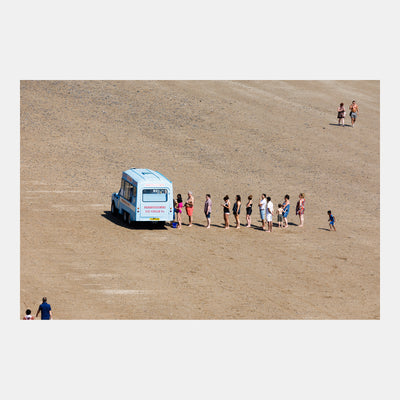
 Martin Parr, Benidorm, Spain, 1997. Credit: © Martin Parr / Magnum Photos
Over a career spanning five decades, the British photographer, and longtime beloved friend of Phaidon, transformed social documentary photography, understood and championed the photobook as a medium, and challenged assumptions about taste, class, and what deserves to be photographed.
In doing so, he documented not just a changing Britain, but a changing world - one shaped by mass consumption, media saturation, and globalised leisure.

Martin Parr, Musée du Louvre, Paris, France, 2012. Credit: © Martin Parr / Magnum Photos
Parr challenged traditional photojournalism by focusing on the untold intimate moments of ordinary lives. “With photography”, he said, “I like to create fiction out of reality.”
While he wanted his photographs to be “accessible to a wider audience. I don't want people to be mystified or puzzled by what I'm doing,” his influence on generations of photographers is literally enormous. He showed that documentary photography need not be earnest or heroic, that social commentary could be delivered with a laugh and a flash, usually a ring flash – and that ordinary life, windswept beach holidays, dodgy motorway meals, supermarkets, queueing even, deserved serious attention.
 Martin Parr, Tokyo, Japan, 1998. Credit: © Martin Parr / Magnum Photos
He once said, “Photography is a form of therapy for me.” That sense of therapy - of documenting what is familiar, banal, overlooked - remained consistent even as his subject matter diversified.
Though he began his career documenting Britain, his scope quickly expanded. Over decades he explored consumerism, tourism, globalisation, and lifestyle, always through the everyday. His gaze turned from seagulls and chip shops to high-fashion shows, global tourism, and food culture.

Martin Parr, Venice, Italy, 2005. Credit: © Martin Parr / Magnum Photos
In one of his last public remarks, discussing the cultural moment near the end of his life, he warned of unsustainable consumption, arguing that the kind of satirical voice he embodied was more necessary than ever.
When Phaidon.com last spoke to him, just two very short weeks ago, he was eager to send his forthcoming book Global Warning, as a Christmas gift to Zack Polanski, the new leader of the UK’s Green Party. He was shooting from the hip, however he could, to the very end.
 Martin Parr, Dubai, United Arab Emirates, 2007. Credit: © Martin Parr / Magnum Photos
Emerging in the early 1980s, Parr’s work arrived at a moment when post-war documentary photography in Britain still carried strong traditions, often black and white, socially committed, usually austere. But Martin chose to embrace colour, flash, and immediacy in a world of banal mass consumption.
His breakthrough came with The Last Resort, a brash, vivid series of images of working-class holidaymakers at a dilapidated seaside resort near Liverpool. As one commentator put it at the time, Parr “burst into colour” not in some idealised wonderland, but “in a downtrodden, dirty, unglamorous seaside resort, vivid, demanding our attention, socially aware and pulling us in like a magnet.”

Martin Parr, Kleine Scheidegg, Switzerland, 1994. Credit: © Martin Parr / Magnum Photos
Parr later described the beach of New Brighton as “tatty and run-down,” yet “vibrant”. It was this mixture of decay and zest for life that he found endlessly photogenic. The result was an aesthetic revolution that redefined what a post-war British photographer could look at: not just poverty or social hardship, but the messy contradictions of hope, of leisure, of real lives lived, as much as endured.
And his contribution to photography was not limited to his skills behind the lens. He also understood, probably more than anyone in history, the cultural power of the photobook as a medium.
 Martin Parr, Dorset, England, 2022. Credit: © Martin Parr / Magnum Photos
Together with critic and curator Gerry Badger, he co-authored the landmark three-volume series The Photobook: A History. Volume I surveys the development of the photobook from the nineteenth century to the Modernist and documentary experiments of the early 20th century.
Volume II continues the story through the mid-century; while Volume III brings the narrative into the contemporary era - covering post-World-War II photography, the rise of self-publishing, the globalisation of photographic culture, and the explosion of personal, diaristic photobooks.
 Martin Parr, Salford, England, 1986. Credit: © Martin Parr / Magnum Photos
The Photobook trilogy is now widely regarded as the definitive work on the subject - a resource for students, academics, collectors, and photographers alike.
Through this work, Parr helped reclaim the photobook not just as a vehicle for pictures, but as a medium of art, history, commentary - equal to exhibitions, journalism, or any other form of visual culture.
His commitment to the photobook mirrors his commitment to photography as a living tradition: one to collect, to preserve, to revisit, to question. Although behind the camera he was purposefully invisible - he looked like “a naff birdwatcher,” in the words of his biographer Wendy Jones - in his professional life he was truly impactful.
 Martin Parr, Glasgow, Scotland, 1999. Credit: © Martin Parr / Magnum Photos
In 2014, he founded the Martin Parr Foundation in Bristol to support British photographers. the public exhibition space and library opened in 2017 and has exhibited artists at the start of their career, including the Turner prize-nominated Rene Matic, Sebastian Bruno and Ian Weldon, alongside era-defining image-makers like Lee Miller, Ajamu X and Chris Kilip.
He published 100 books of his own and donated a portion of his collection of more than 12,000 photobooks to the Tate in 2017.
Yet his acceptance by the prestigious photo agency Magnum in 1994 was for some reason controversial. Henri Cartier-Bresson, did not like his less serious attitude towards documentary photography.

Martin Parr, Amer Fort, Jaipur, India, 2019. Credit: © Martin Parr / Magnum Photos
He was accepted, rejected and finally accepted by the smallest margin, a single vote, to Magnum. In 2014, he became Magnum’s president.
What ultimately defines Martin Parr’s legacy is not a single photograph or a single project. Rather, it is a worldview: that the patterns of consumption, leisure, aspiration, kitsch, decline - the textures of everyday life - are not beneath art, but the very substance of it.
“Martin was a true legend and an incredible man – a brilliant photographer, collector, bookmaker, and educator, but he was also a lovely person, jolly good fun and so generous in sharing his passion for photography with so many,” says Victoria Clarke, Martin’s longtime Phaidon editor.

Martin Parr, Mumbai, India, 2018. Credit: © Martin Parr / Magnum Photos
“I will really miss working with Martin. He is a huge part of the Phaidon family and will continue to be. In the world of photography and popular culture, he leaves a massive hole but also an incredible legacy and body of work.”
Even in death, his work remains alive - through the images, the books, the archives, the foundation, and the countless photographers, artists, and critics he inspired. As many have said - from Grayson Perry to the Pet Shop Boys - we will really, really miss him. But we can be thankful that his eye on the world will endure for generations to come.